
Quick answer
To choose a NetSuite implementation partner in Europe or the UK, shortlist firms with proven NetSuite delivery in your industry and in multi-subsidiary (OneWorld) set-ups. Check how they handle European tax, currencies and GDPR, compare scripted demos and statements of work like for like, speak to references, and agree post-go-live support before you sign.
Key takeaways
- The partner shapes your NetSuite outcome as much as the software does.
- Know which partner model you are buying from: Oracle NetSuite direct, a Solution Provider, an Alliance Partner or a SuiteApp developer.
- European projects add multi-subsidiary, multi-currency, local tax, GDPR and time-zone requirements. Test for them explicitly.
- Judge partners on scripted demos of your own processes and on the detail of their statement of work, not on slides.
- Agree who owns data migration, integrations and post-go-live support before the contract is signed.
Why your NetSuite partner matters as much as the software
Oracle NetSuite is a mature cloud ERP. Two businesses can buy the same licences and end up with very different results, and the difference usually comes from how the system was implemented.
Your implementation partner decides how your chart of accounts and subsidiaries are structured, which processes use standard features and which are customised, how data arrives in the new system and how your people learn to use it. Those decisions are hard to reverse once you are live.
For European businesses the stakes are higher. A project may need to cover several legal entities, currencies, VAT regimes and languages, with personal data handled in line with GDPR. Choosing a NetSuite implementation partner is therefore a business decision, not just a procurement exercise.
What is a NetSuite implementation partner?
A NetSuite implementation partner is a consulting firm that plans and delivers a NetSuite deployment: requirements, solution design, configuration, customisation, integrations, data migration, testing, training, go-live and ongoing support.
Partners range from small specialist NetSuite consultancies to large accounting and technology firms. Some focus on particular industries or regions; others provide specific services such as SuiteScript development, integrations or post-go-live support.
A NetSuite consultant is the individual doing the work: a functional consultant who maps your finance or supply-chain processes, or a technical consultant who writes SuiteScript and builds integrations. A partner brings a team of them together with a project manager, a methodology and accountability for the outcome. If you only need targeted help, our NetSuite consultation service may be enough.
What types of NetSuite partners are there?
Before comparing firms, understand which model you are buying from. It affects who holds your licence contract, who is accountable for delivery and where you go for support.
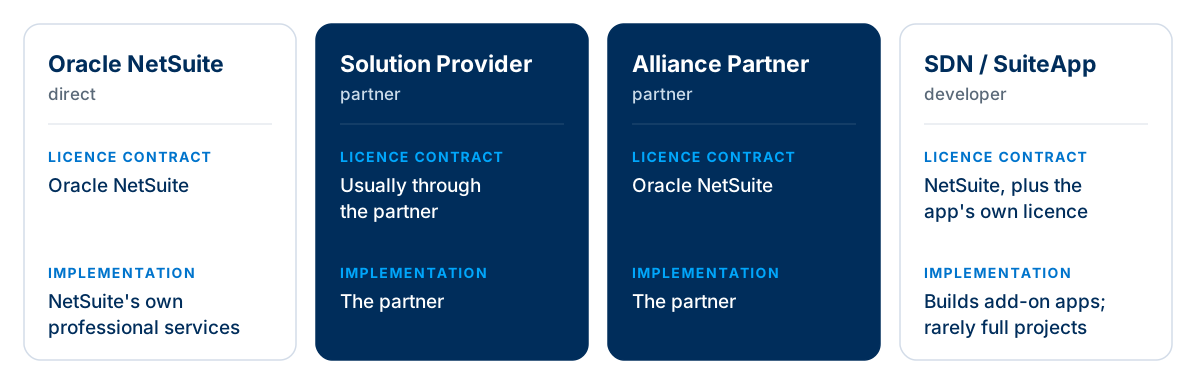
| Route | Licence contract | Who implements | A good fit when |
|---|---|---|---|
| Oracle NetSuite direct | Oracle NetSuite | NetSuite's own professional services | You want a single vendor relationship and your requirements fit NetSuite's standard approach well. |
| Solution Provider | Usually through the partner | The partner | You want one firm to handle both licensing and implementation. |
| Alliance Partner | Oracle NetSuite | The partner | You want to contract for licences with NetSuite and choose a consulting firm separately for delivery. |
| SuiteCloud Developer Network (SDN) | NetSuite, plus the app's own licence | Builds add-on SuiteApps; rarely full implementations | You need a specialist add-on, such as for a particular industry, tax or warehouse requirement. |
You will also meet specialist delivery partners: firms that provide SuiteScript development, integrations, migrations or support capacity, either to you directly or to other consulting firms. They can be valuable for technical work, but confirm who is ultimately accountable for your project.
Oracle NetSuite's partner programme names and terms can change. Confirm each firm's current status in Oracle NetSuite's official partner directory.
What European businesses need from a NetSuite partner
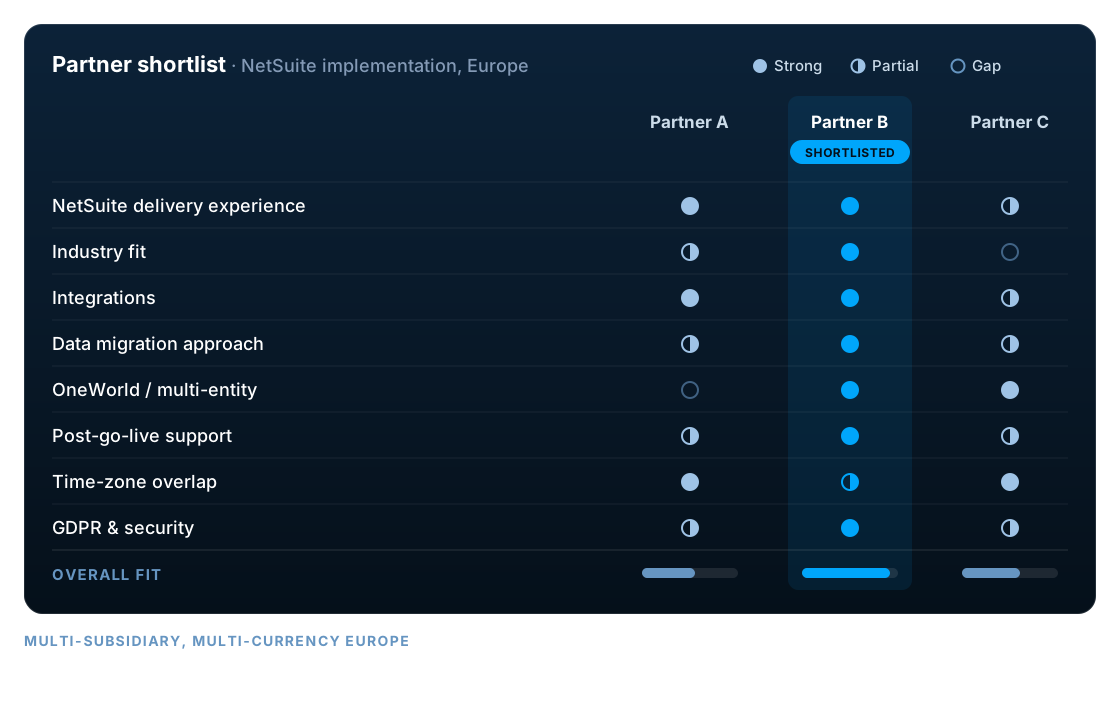
A NetSuite project in Europe often looks different from a single-country implementation. Test every shortlisted partner on the following.
Multi-subsidiary set-up with NetSuite OneWorld
Subsidiary hierarchy, intercompany transactions, eliminations and consolidated reporting designed for the group you will be in three years, not only today.
Currencies and consolidation
Transacting and reporting across EUR, GBP, CHF, the Nordic currencies or PLN, with revaluation and translation handled consistently.
VAT, e-invoicing and statutory reporting
Each country brings its own VAT rules and reporting obligations, such as Making Tax Digital in the UK, and several EU countries, including Belgium, Germany and Poland, are rolling out mandatory B2B e-invoicing. Ask how the partner configures these and which localisation SuiteApps they use, and validate the result with your tax advisers.
Languages
Workshops, training and user documentation may need to run in more than one language, even if the system itself is configured in English.
GDPR and data transfers
Understand how the partner will access and protect personal data, and what safeguards apply if any of their team works outside the EU, EEA or UK.
Time zones and working hours
Agree core overlap hours for workshops, testing and go-live support, especially across Central European, UK and non-European delivery teams.
How to find NetSuite partners in the UK and across Europe
Oracle NetSuite's Partner Directory is the most reliable starting point: filter it by region and partner type, then cross-check each firm's NetSuite certifications and comparable customers. Add peer recommendations and partners you have seen deliver in your industry, and aim for a shortlist of three to five.
What you test for depends on where your entities are. These are the questions that separate partners in each part of Europe:
United Kingdom and Ireland
Check Making Tax Digital for VAT submissions, UK and Irish subsidiaries in one OneWorld account, GBP and EUR banking, and UK GDPR transfer safeguards if any of the team sits outside the UK.
DACH (Germany, Austria, Switzerland)
Expect questions on German-language workshops and documentation, local GAAP alongside group reporting, CHF for Swiss entities and how incoming B2B e-invoices will be received and archived.
Benelux and France
Ask how the partner handles Belgian B2B e-invoicing, Dutch and French statutory reporting, and whether workshops can run in French or Dutch where your finance teams need it.
Nordics and Central & Eastern Europe
Test SEK, NOK, DKK and PLN handling, local bank file formats, Polish e-invoicing (KSeF) and how lean local finance teams will be supported after go-live.
For UK businesses, confirm that VAT returns can be filed from NetSuite through HMRC-recognised Making Tax Digital software. For any partner with staff outside the UK or EEA, ask which transfer safeguards they rely on under the UK GDPR and the EU GDPR.
10 criteria for choosing a NetSuite implementation partner
Proven NetSuite delivery
Look for a track record of NetSuite projects specifically, not ERP in general. NetSuite has its own data model, customisation tools and release cycle, and experience on other platforms does not transfer automatically.
Ask: How many NetSuite go-lives has the proposed team delivered, and which were most like ours?
Experience in your industry
A partner who knows distribution, manufacturing, software or professional services will recognise your processes quickly, suggest standard features before custom builds and anticipate the reports your finance team will ask for.
Ask: Can you show a project in our industry and explain what you would do differently now?
A clear implementation methodology
Ask how the project moves from discovery to design, build, testing, training and go-live, and what you receive at each stage. A good methodology makes decisions, sign-offs and responsibilities visible.
Ask: What are the phase gates, and what do we have to sign off at each one?
Integration capability
Most NetSuite projects connect to something else: e-commerce, CRM, banks, warehouse systems, payroll or EDI. Check whether the partner builds integrations itself, uses an integration platform or subcontracts, and how errors will be monitored once live.
Ask: Which integrations have you delivered with NetSuite, and how do you handle failed records?
Ownership of data migration
Data migration is where many timelines slip. Be clear about who extracts, cleanses, maps, loads and reconciles data, how many test migrations are included and how opening balances will be verified.
Ask: Which parts of migration do you own, which do we own, and how many trial loads are included?
Technical depth on the SuiteCloud platform
Even well-configured accounts need some scripting, workflows or custom records. A partner with SuiteScript and SuiteFlow skills can build these properly, and can also tell you when standard features are the better choice.
Ask: Who writes and reviews custom code, and how is it documented and tested?
The team you will actually get
The people in the sales meeting are not always the people on the project. Ask to meet the proposed project manager and lead consultant, and confirm how much of the work is subcontracted.
Ask: Who exactly will work on our project, and what happens if someone leaves?
Change management and training
A technically sound system can still fail if people do not use it. Look for role-based training, user acceptance testing that follows real end-to-end processes and support for the people whose daily work is changing.
Ask: How do you train finance, operations and management users differently?
Post-go-live support
The first weeks after go-live surface questions that testing did not. Ask what hypercare is included, how support is priced afterwards and how the partner helps you test NetSuite's twice-yearly releases.
Ask: What does support look like in month one, and in month twelve?
Commercial clarity
Compare proposals on scope, not just price. A lower quote may exclude data migration, integrations, reports or training that another partner included. Insist on a detailed statement of work, listed assumptions and a clear change-request process.
Ask: What is excluded from this proposal, and how are changes priced?
How to run a NetSuite partner selection
A structured selection makes partners comparable. Six steps work for most mid-sized European businesses.
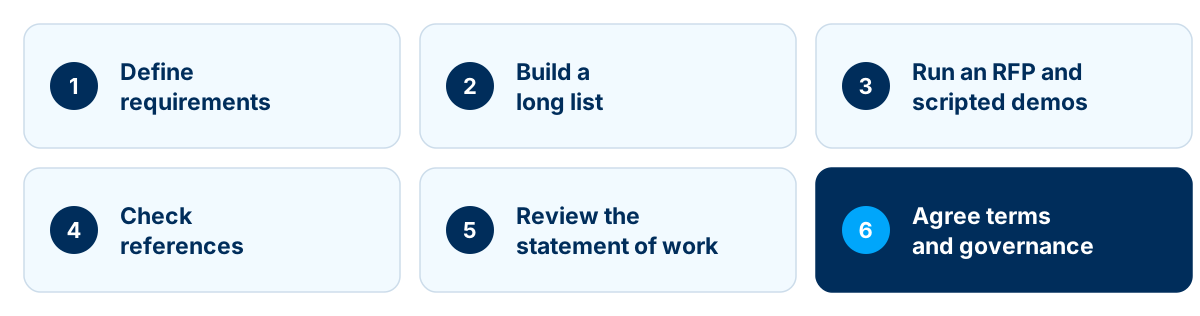
Step 1.Define your requirements
Document your key processes, entities, countries, integrations, reports and must-have versus nice-to-have features. This is what every partner will be measured against.
Step 2.Build a long list
Identify partners with NetSuite experience in your industry and region, using Oracle NetSuite's partner directory, peer recommendations and your own research. Aim for a manageable shortlist.
Step 3.Run an RFP and scripted demos
Send the same requirements to each partner and ask them to demonstrate your own scenarios, such as order-to-cash or intercompany, rather than a generic product tour.
Step 4.Check references
Speak to customers with similar size, industry and geography. Ask what went well, what slipped and how the partner behaved when something went wrong.
Step 5.Review the statement of work
Compare deliverables, assumptions, exclusions, responsibilities and the change-request process line by line. This is where proposals that look similar turn out to be different.
Step 6.Agree terms and governance
Confirm the team, the steering structure, how decisions are escalated, the post-go-live support model and how intellectual property and documentation are handed over.
Questions to ask a NetSuite implementation partner
Use these questions in your RFP and reference calls. Ask every partner the same ones.
Experience
- How many NetSuite implementations has the proposed team delivered?
- Which of your customers are most similar to us in industry and size?
- Which NetSuite certifications does the team hold?
- Can we speak to two or three of those customers?
Delivery
- What does your methodology look like, phase by phase?
- Who will be our project manager and lead consultant?
- How much of the work is subcontracted, and to whom?
- How do you run user acceptance testing?
Data and integrations
- Who owns data cleansing, mapping and reconciliation?
- How many trial migrations are included?
- How will each integration be built, monitored and supported?
- How do you decide between configuration and custom scripting?
Europe-specific
- Which European countries have you configured NetSuite for?
- How do you approach local VAT, e-invoicing and statutory reporting requirements?
- How will you process our personal data, and where will your team be located?
- What working hours will overlap with ours?
Support and commercials
- What hypercare is included after go-live?
- How is ongoing support priced and measured?
- What is excluded from this proposal?
- How are change requests estimated and approved?
Red flags when choosing a NetSuite partner
- A fixed price before discovery
- A firm price with no understanding of your processes usually means the risk has been moved into exclusions or change requests.
- Generic demos only
- A partner who cannot demonstrate your own scenarios may not have understood them.
- Vague data migration ownership
- If nobody clearly owns cleansing and reconciliation, it will fall back on your team late in the project.
- Customising first, asking later
- Proposing scripts for everything before exploring standard features increases cost and long-term maintenance.
- No named team
- If the partner will not name the project manager and lead consultant, you cannot judge who is delivering.
- Reluctance to share references
- Experienced partners can usually connect you with comparable customers.
- No answer on GDPR or data handling
- A European project needs a clear answer on how personal data will be accessed and protected.
- Support treated as an afterthought
- If post-go-live support is undefined, expect gaps exactly when your users need help most.
Already live with a partner and seeing these signs? Our guide to NetSuite reimplementation covers when to fix an existing account and when to start again.
NetSuite partner scorecard template
Score each shortlisted partner from 1 to 5 against every criterion, multiply by the weight and compare the totals. Adjust the example weights to reflect what matters most to your business.
| Criterion | Example weight | What a strong answer looks like |
|---|---|---|
| NetSuite delivery experience | 15% | Comparable go-lives by the proposed team |
| Industry experience | 10% | Relevant customers and processes demonstrated |
| Methodology and governance | 10% | Clear phases, sign-offs and escalation |
| Integrations | 10% | Proven approach, monitoring and error handling |
| Data migration | 10% | Named ownership, trial loads, reconciliation |
| European requirements | 10% | Multi-subsidiary, currencies, tax, GDPR covered |
| Team and continuity | 10% | Named people, low dependency on subcontractors |
| Training and change | 5% | Role-based training and process-led UAT |
| Post-go-live support | 10% | Defined hypercare and ongoing support model |
| Commercial clarity | 10% | Detailed SOW, assumptions and exclusions |
| Total | 100% | Score 1–5 per criterion × weight |
Should you choose a local, nearshore or offshore NetSuite partner?
Location matters less than capability, but it changes how a project runs. Each model can work well when the trade-offs are managed.
| Model | Typical strengths | What to check |
|---|---|---|
| Local partner | Same language and business culture, easy on-site workshops, full time-zone overlap | Depth of NetSuite specialists and capacity for technical work |
| Nearshore partner | Good time-zone overlap, often within EU or EEA data rules, broader talent pool | Language for workshops and users, travel for key sessions |
| Offshore partner | Access to large technical teams, cost efficiency, can cover development and support across longer hours | Agreed overlap hours, GDPR transfer safeguards, a named lead who runs workshops |
| Blended model | Local or nearshore leadership with offshore technical delivery | Clear ownership between the two teams and one accountable project manager |
Whichever model you choose, insist on one accountable project lead, agreed overlap hours and a documented approach to personal data.
Frequently asked questions
What does a NetSuite implementation partner do?
A NetSuite implementation partner plans and delivers your NetSuite project: discovery, solution design, configuration, customisation, integrations, data migration, testing, training, go-live and support. The best partners also challenge requirements, recommending standard NetSuite features before custom development.
What is the difference between a NetSuite consultant and an implementation partner?
A NetSuite consultant is an individual specialist, such as a functional, technical or SuiteScript consultant. An implementation partner is the firm that takes accountability for the whole project and provides a team of consultants, a project manager, a methodology and post-go-live support. Independent NetSuite consultants are useful for targeted work; a full implementation usually needs a partner.
What is the difference between a NetSuite Solution Provider and an Alliance Partner?
In the Solution Provider model, the partner typically resells NetSuite licences as well as implementing them. In the Alliance Partner model, you usually contract for licences with Oracle NetSuite directly and engage the partner for implementation services. Programme names and terms can change, so confirm the current arrangement with each partner.
How do I find NetSuite partners in the UK or Europe?
Start with Oracle NetSuite's Partner Directory, which can be filtered by region and partner type, then add peer recommendations and firms you have seen deliver in your industry. Shortlist three to five, send each the same requirements and compare their scripted demos, references and statements of work.
Who are the best NetSuite implementation partners in Europe?
There is no single best partner for every business. The right one has delivered comparable NetSuite projects in your industry, has handled the countries, currencies and tax rules you operate in, names the team that will do the work and offers a support model that fits you. Score shortlisted partners against the same weighted criteria rather than relying on rankings.
Can I implement NetSuite directly with Oracle instead of using a partner?
Yes. Oracle NetSuite offers its own implementation services. Many businesses still choose a partner for industry experience, regional knowledge, integration skills, flexibility or cost. Compare both routes against the same requirements.
Does my NetSuite partner need to be based in my country?
Not necessarily. What matters is relevant NetSuite experience, enough working-hours overlap, the right languages for workshops and training, and a compliant approach to personal data. Many European businesses use nearshore, offshore or blended delivery models successfully.
How do I verify a NetSuite partner?
Check that the firm is listed in Oracle NetSuite's partner directory, ask which NetSuite certifications the proposed team holds, request comparable customer references and ask to meet the people who will work on your project.
What should a NetSuite statement of work include?
Scope by module and process, deliverables per phase, integrations, data migration responsibilities and trial loads, reports, testing approach, training, go-live and hypercare, assumptions, exclusions, roles on both sides and the change-request process.
Can NetSuite handle multiple European subsidiaries?
NetSuite OneWorld supports multiple subsidiaries, currencies, intercompany transactions and consolidated reporting. Country-specific tax and statutory requirements vary, so validate each country's needs with your partner and your tax advisers during design.
Should I choose the cheapest NetSuite partner?
Not on price alone. Lower quotes often exclude work that other partners included, such as data migration, integrations or training. Compare proposals on scope, experience, methodology and support, then on price.
Discuss your NetSuite implementation
LST Consultancy delivers NetSuite implementation, SuiteScript development, integrations and support for clients across time zones, and is certified to ISO/IEC 27001:2022 for information security. Tell us about your entities, processes and systems, and we will help you scope the project.