
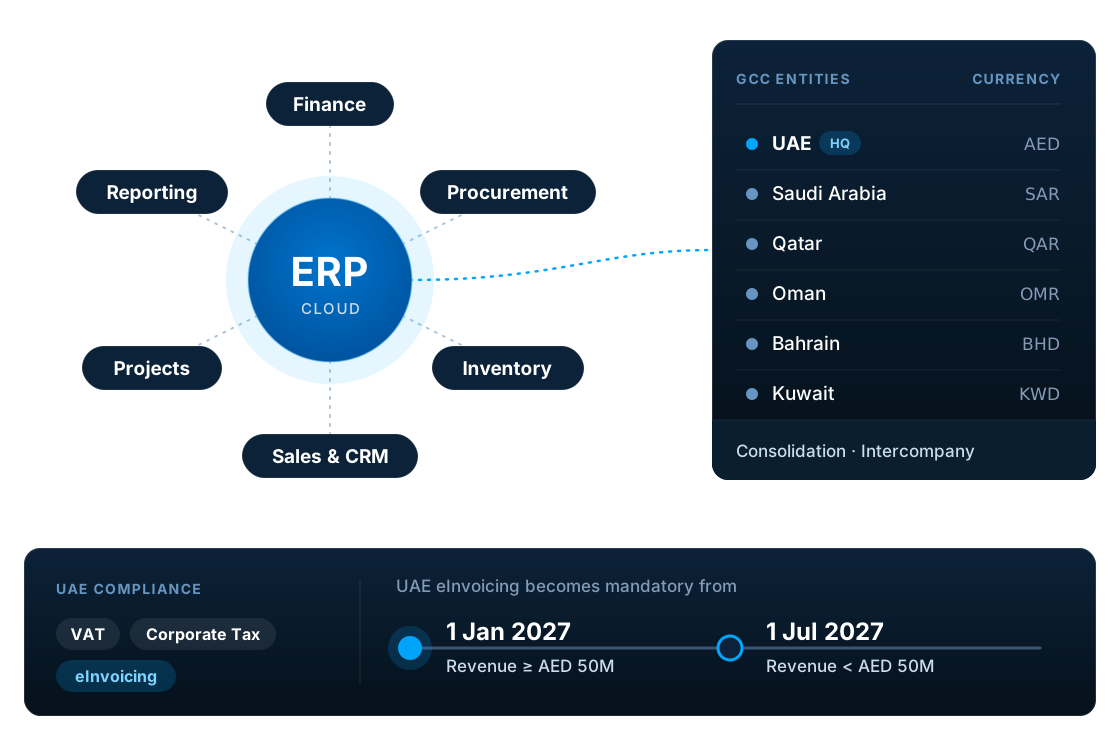
ERP implementation in the UAE is no longer simply about replacing spreadsheets or accounting software.
For growing businesses in Dubai, Abu Dhabi and across the GCC, an ERP system increasingly sits at the centre of finance, procurement, inventory, sales, projects, reporting, integrations, tax compliance and management decision-making.
At the same time, businesses have to consider UAE VAT, Corporate Tax, eInvoicing, multi-company operations, multiple currencies and increasingly complex regional operations. That makes choosing the right ERP important. But choosing the right ERP implementation approach and implementation partner is equally important.
This guide explains what ERP implementation actually involves, how long it can take, what affects ERP implementation cost in the UAE, what businesses should prepare before implementation and what to look for when selecting an ERP implementation partner in the UAE or GCC.
What is ERP implementation?
ERP implementation is the process of planning, configuring, integrating, testing and deploying an Enterprise Resource Planning system across a business. A typical ERP implementation connects areas such as:
- Finance and accounting
- Procurement
- Sales
- Inventory
- Warehouse management
- Order management
- Supply chain
- CRM
- Projects
- Fixed assets
- Manufacturing
- Reporting and analytics
- Approval workflows
- Banking and payment systems
- E-commerce
- Third-party applications
The objective is not simply to install ERP software.
A successful implementation creates a connected operating environment where different departments work from consistent data and management has greater visibility across the business.
Why are UAE businesses implementing ERP systems?
Many growing companies reach the same point.
- Finance is using accounting software.
- Sales maintains information somewhere else.
- Inventory is partly managed through spreadsheets.
- Approvals happen through email or WhatsApp.
- Management reports need to be assembled manually.
- Different branches maintain different information.
- And nobody is completely certain which report contains the latest numbers.
That may be manageable for a small organization. It becomes increasingly difficult when a business adds:
- More employees
- Additional warehouses
- New subsidiaries
- Multiple legal entities
- International customers
- E-commerce channels
- More complex procurement
- Regional operations
- Higher transaction volumes
An ERP system helps bring those activities into a more connected environment.
ERP implementation in the UAE: why local requirements matter
An ERP implementation in the UAE needs to take local business and regulatory requirements into account. Depending on the organization, these can include:
UAE VAT
Finance teams need appropriate tax configurations, transaction treatment, reporting and supporting records. See what a VAT-compliant ERP needs.
UAE Corporate Tax
Businesses increasingly expect their ERP and financial systems to provide the information required for financial reporting, tax analysis and audit support.
UAE eInvoicing
This has become an especially important ERP consideration.
The UAE Ministry of Finance is implementing a structured electronic invoicing system for in-scope business transactions.
Annual revenue AED 50 million or more
1 January 2027
Appoint an ASP by 30 October 2026
Annual revenue below AED 50 million
1 July 2027
Appoint an ASP by 31 March 2027
In-scope government entities
1 October 2027
Appoint an ASP by 31 March 2027
Mandatory implementation dates, subject to the applicable scope and requirements. An ASP is the Accredited Service Provider that exchanges and reports eInvoices on a business's behalf. In May 2026 the Ministry of Finance moved the ASP deadline for the AED 50 million group from 31 July to 30 October 2026, without changing its 1 January 2027 go-live (Ministry of Finance).
This is not simply the process of generating a PDF invoice. The UAE authorities describe an eInvoice as structured invoice data exchanged electronically and reported through the prescribed electronic invoicing framework.
For businesses implementing or upgrading ERP systems, this means eInvoicing readiness should be considered during system architecture, integration and finance-process design rather than being treated as an afterthought.
ERP implementation across the GCC
Companies headquartered in the UAE often operate beyond the UAE. A business may have entities or operations in:
Saudi Arabia
SAR
Qatar
QAR
Oman
OMR
Bahrain
BHD
Kuwait
KWD
This adds another layer to ERP implementation. A GCC ERP environment may need to handle:
- Multiple subsidiaries
- Multiple legal entities
- Multiple tax registrations
- Different currencies
- Intercompany transactions
- Consolidated financial reporting
- Country-specific invoicing requirements
- Local tax requirements
- Different approval structures
This is why businesses planning regional expansion should think beyond their immediate UAE requirements.
The ERP should be designed not only for where the business is today, but also for where it expects to operate over the next several years.
What are the main stages of ERP implementation?
Although every project is different, most successful ERP implementations follow several core stages.
Stage 1: ERP discovery and requirement analysis
The first stage is understanding the business. Before configuring an ERP system, the implementation team should understand:
- How sales orders are processed
- How purchases are approved
- How inventory moves
- How invoices are generated
- How revenue is recognized
- How payments are received
- How vendors are paid
- How management reporting works
- Which approvals are required
- Which systems currently exchange data
This is where ERP consulting becomes important. A strong ERP consultant should not begin by asking which screens to configure. They should begin by understanding how the business actually works.
Not this
“Which screens do you want us to configure?”
Instead
“How does your business actually work?”
Stage 2: Business process mapping
The existing processes are then mapped. This helps identify:
- Manual activities
- Duplicate data entry
- Spreadsheet dependencies
- Unnecessary approvals
- Missing controls
- Reporting gaps
- Integration requirements
- Opportunities for automation
This step can also reveal that some existing business processes should be improved rather than recreated exactly inside the new ERP.
Stage 3: ERP solution design
Once the requirements are understood, the implementation team defines how the ERP should be configured. This can include:
- Chart of accounts
- Subsidiary structure
- Departments
- Locations
- Classes
- Approval workflows
- Inventory structure
- Customer and vendor records
- Roles and permissions
- Tax configuration
- Financial reporting
- Dashboards
- Integrations
For regional businesses, the solution design should also consider future subsidiaries and GCC expansion.
Stage 4: ERP configuration
The ERP system is then configured based on the approved design. The goal should generally be to use standard ERP capabilities wherever practical, introducing customization where there is a genuine business requirement. Excessive customization can increase:
- Implementation time
- Project cost
- Testing requirements
- Upgrade complexity
- Long-term support requirements
The best ERP implementation is not necessarily the one with the most customizations. It is the one that solves the business requirement reliably.
Stage 5: ERP customization and automation
Some organizations have processes that cannot be handled efficiently using standard configuration alone. In those cases, ERP customization may include:
- Custom workflows
- Approval automation
- Custom records
- Custom forms
- Scripts
- Industry-specific business rules
- Automated calculations
- Custom dashboards
- Specialized reporting
For NetSuite environments, for example, this can include SuiteScript and SuiteFlow development. Customization should have a clear business reason rather than being introduced simply because it is technically possible.
Stage 6: ERP integration
Modern ERP systems rarely operate in isolation. A UAE or GCC organization may need to integrate ERP with:
- CRM platforms
- Banks
- Payment gateways
- E-commerce platforms
- Shopify
- Amazon
- Warehouse systems
- Point-of-sale systems
- Logistics providers
- Payroll systems
- HR platforms
- Expense management software
- Government or tax systems
- Business intelligence platforms
- Custom applications
Integration planning should happen early in the ERP implementation. Waiting until the end of the project to consider integrations can create unnecessary delays. See our NetSuite integration services for the connectors we build most often.
Stage 7: ERP data migration
Data migration is one of the most underestimated parts of ERP implementation. A business may need to migrate:
- Customers
- Vendors
- Items
- Employees
- Chart of accounts
- Opening balances
- Inventory
- Outstanding invoices
- Purchase orders
- Sales orders
- Fixed assets
- Historical transactions
The difficult part is often not moving the data. It is cleaning it.
Old systems frequently contain:
- Duplicate customers
- Duplicate vendors
- Inactive inventory
- Inconsistent naming
- Missing tax information
- Incorrect addresses
- Old accounts
- Incomplete master data
Migrating poor-quality data into a new ERP simply creates a new ERP containing old problems.
Our data migration services cover cleansing, mapping, validation and reconciliation from legacy systems.
Stage 8: User acceptance testing
User Acceptance Testing, commonly called UAT, gives business users the opportunity to verify that the ERP supports real business processes. Users should test complete scenarios. For example:
- Lead
- Quote
- Sales Order
- Fulfilment
- Invoice
- Payment
- Purchase Request
- Purchase Order
- Receipt
- Vendor Bill
- Payment
Testing individual screens is not enough. End-to-end processes need to work.
Stage 9: ERP user training
A technically successful implementation can still fail if people do not use the system correctly. Different employees need different training:
- Finance users
- Detailed accounting and reporting training
- Sales teams
- Order-management training
- Warehouse teams
- Receiving, picking and fulfilment training
- Management
- Dashboards and reporting
Good ERP training should reflect the actual processes configured for the organization.
Stage 10: ERP go-live
Once configuration, migration, integration, UAT and training are complete, the new ERP can go live. A go-live plan should cover:
- Final data migration
- Opening balances
- Outstanding transactions
- User access
- Integration activation
- Cut-off procedures
- Issue escalation
- Backup and rollback planning
- Post-go-live monitoring
Stage 11: Post-go-live ERP support
ERP implementation should not end on go-live day. The first few weeks frequently reveal practical questions that did not appear during testing. Businesses may require support for:
- User questions
- Reporting changes
- Workflow adjustments
- Integration monitoring
- Performance issues
- Additional automation
- New dashboards
The ERP can then continue to evolve as the business changes. If a live system isn't delivering, our post-implementation support and project recovery team can help.
How long does ERP implementation take in the UAE?
There is no universal ERP implementation timeline. A relatively straightforward implementation for one company will be very different from a multi-entity organization operating across the GCC. The timeline depends on factors such as:
- Number of entities
- Number of ERP modules
- Business complexity
- Data quality
- Integrations
- Customizations
- Reporting requirements
- Availability of internal stakeholders
- User testing
- Number of countries
A smaller implementation may be completed considerably faster than a complex regional rollout involving multiple entities, warehouses and integrations.
The better question is not:
Not this
“How quickly can we go live?”
Instead
“What needs to be completed correctly before we go live?”
How much does ERP implementation cost in the UAE?
ERP implementation cost in the UAE depends on the scope. Typical cost drivers include:
- ERP platform
- Software licensing
- Number of users
- Number of subsidiaries
- Modules
- Implementation consulting
- Customizations
- Data migration
- Integrations
- Training
- Reporting
- Support
Scope A
Finance, sales and purchasing for one UAE entity
Scope B: a regional company requiring
- UAE operations
- Saudi operations
- Five subsidiaries
- Multiple warehouses
- E-commerce integration
- Banking integration
- Advanced approvals
- Consolidated reporting
The first should not expect the same ERP implementation cost as the second. This is why ERP cost should be estimated after discovery rather than from a generic price list.
For NetSuite specifically, see our NetSuite implementation cost breakdown and NetSuite pricing in the UAE.
Need a realistic estimate for your ERP project?
Book a discovery callCloud ERP vs on-premise ERP in the UAE
Many organizations are now considering cloud ERP platforms. A cloud ERP can provide benefits such as:
- Remote access
- Reduced infrastructure management
- Easier regional access
- Centralized upgrades
- Scalability
- Integration capabilities
- Support for distributed teams
For growing UAE and GCC organizations, cloud ERP can be particularly useful where multiple offices, subsidiaries and countries need access to a common platform.
However, the correct deployment model depends on the organization's operational, security, integration and regulatory requirements. For smaller companies, we compare the trade-offs in cloud ERP for small businesses in the UAE.
Which ERP system is best for UAE businesses?
There is no single ERP platform that is best for every business. Common ERP platforms considered by organizations in the region include:
- Oracle NetSuite
- Oracle ERP
- SAP
- Microsoft Dynamics 365
- Odoo
- ERPNext
- Other industry-specific ERP platforms
The right choice depends on factors such as:
- Company size
- Industry
- Number of users
- Number of entities
- International operations
- Required integrations
- Transaction volumes
- Reporting requirements
- Customization requirements
- Budget
- Expected growth
For example, a growing multi-subsidiary organization may have very different requirements from a small local trading business. ERP selection should therefore begin with requirements rather than brand names.
For a side-by-side view of the platforms, read the top 10 ERP systems in the UAE compared or our guide to the best ERP software for UAE SMEs.
NetSuite ERP implementation in the UAE
Oracle NetSuite is one of the cloud ERP platforms considered by businesses operating across the UAE and GCC. A NetSuite implementation may include:
- Financial management
- Procurement
- Order management
- Inventory
- CRM
- Projects
- Fixed assets
- Multi-subsidiary management
- Multi-currency
- Consolidation
- Reporting
- Workflows
- SuiteScript customizations
- Integrations
For organizations with multiple legal entities or international operations, ERP architecture becomes particularly important. The initial configuration should consider future growth rather than solving only today's immediate requirements.
We go deeper into NetSuite specifically in NetSuite implementation in the UAE, and our NetSuite implementation services page covers how we run these projects.
Explore our NetSuite servicesERP implementation for different UAE industries
ERP requirements vary considerably by industry. Two sectors have their own guides: ERP for trading companies and ERP for manufacturers.
ERP for trading and distribution
- Procurement
- Inventory
- Multiple warehouses
- Landed cost
- Sales orders
- Customer credit management
- Item profitability
- Reordering
- Logistics integration
ERP for manufacturing
- Bill of materials
- Work orders
- Production planning
- Raw materials
- Finished goods
- Quality processes
- Inventory planning
- Costing
ERP for retail
- Point-of-sale integration
- E-commerce
- Inventory
- Multiple locations
- Customer data
- Pricing
- Promotions
- Omnichannel fulfilment
ERP for construction
- Project accounting
- Procurement
- Job costing
- Subcontractors
- Expense control
- Budget vs actual
- Revenue recognition
- Project profitability
ERP for professional services
- Project management
- Time tracking
- Expenses
- Resource management
- Project billing
- Revenue recognition
- Project profitability
ERP for multi-company and holding groups
- Consolidated financial reporting
- Intercompany transactions
- Centralized procurement
- Shared services
- Multi-currency
- Entity-level controls
- Group dashboards
Common ERP implementation mistakes
Many ERP problems can be traced back to a handful of decisions made early in the project.
- 01
Choosing software before understanding requirements
A successful ERP selection should start with the business requirements.
- 02
Recreating every old process
Implementing a new ERP is an opportunity to improve outdated processes.
- 03
Over-customizing the ERP
Customization should solve genuine business requirements.
- 04
Underestimating data migration
Poor data can delay implementation and reduce confidence in the new system.
- 05
Ignoring integrations until late in the project
Integrations should be considered during solution architecture.
- 06
Insufficient user testing
Users need to test real scenarios before go-live.
- 07
Weak change management
Employees need to understand not only how to use the system but why processes are changing.
- 08
Choosing an ERP partner based only on price
The lowest implementation quote can become expensive if the project requires extensive rework later.
How to choose an ERP implementation partner in the UAE
Choosing an ERP implementation company is a major decision. Consider asking potential ERP partners the questions below. For a NetSuite-specific version, see how to select a NetSuite implementation partner.
Do they understand your business processes?
ERP knowledge alone is not enough.
Do they have experience with your ERP platform?
A consultant who understands the platform can identify better implementation approaches and avoid unnecessary customization.
Can they handle integration?
Many ERP projects depend on external applications.
How do they approach data migration?
Ask who is responsible for cleaning, mapping, validating and reconciling data.
What is their testing methodology?
A good ERP implementation partner should have a structured testing process.
What happens after go-live?
Understand the post-go-live support model.
Can they support your GCC expansion?
If Saudi Arabia, Qatar, Oman, Bahrain or Kuwait are part of your future strategy, discuss those requirements before designing your ERP architecture.
UAE ERP implementation checklist
Before selecting or implementing an ERP system, consider this checklist.
Business requirements
- Finance requirements documented
- Procurement processes documented
- Sales processes documented
- Inventory requirements documented
- Reporting requirements documented
- Approval workflows documented
UAE requirements
- VAT requirements reviewed
- Corporate Tax reporting requirements considered
- UAE eInvoicing readiness assessed
- Currency requirements reviewed
- Entity structure defined
GCC requirements
- Regional subsidiaries identified
- Country requirements reviewed
- Multi-currency requirements identified
- Consolidation requirements documented
- Intercompany processes documented
Technology
- ERP platform selected
- Integrations identified
- Data sources identified
- Customization requirements reviewed
- Reporting tools identified
Implementation
- Implementation partner selected
- Project team assigned
- Data migration plan approved
- Testing plan created
- Training plan created
- Go-live plan prepared
- Post-go-live support agreed
ERP implementation in Dubai, Abu Dhabi and the wider GCC
ERP implementation in Dubai
Dubai businesses frequently operate across multiple markets, currencies and entities. For companies headquartered in Dubai, an ERP can provide a centralized platform for finance, operations, inventory, sales and reporting while supporting regional growth.
Organizations looking for an ERP implementation company in Dubai should evaluate both the technical platform knowledge and the implementation team's understanding of local and regional business requirements.
ERP implementation in Abu Dhabi
Organizations in Abu Dhabi may have requirements spanning enterprise finance, projects, procurement, asset management, reporting and integrations.
An ERP implementation in Abu Dhabi should begin with clear process mapping and stakeholder involvement rather than simply reproducing an existing legacy system in new software.
ERP implementation in Saudi Arabia and the wider GCC
For UAE companies expanding into Saudi Arabia or operating across several GCC markets, ERP architecture should be planned regionally. Saudi Arabia, for example, has its own tax and electronic invoicing requirements.
Trying to add each country as an afterthought can create unnecessary complexity. A regional ERP strategy should consider the full operating model from the beginning.
When should a company implement ERP?
An organization should consider ERP when existing systems begin limiting growth. Common signs include:
- Too many spreadsheets
- Duplicate data entry
- Difficulty closing accounts
- Poor inventory visibility
- Manual approvals
- Separate systems for each department
- Difficulty consolidating entities
- Inconsistent reports
- Increasing transaction volumes
- New subsidiaries
- International expansion
ERP should solve these problems rather than simply digitize them.
Still running on Tally or a basic accounting package? Our step-by-step guide to replacing Tally with a cloud ERP walks through the move.
ERP implementation: frequently asked questions
What is ERP implementation?
ERP implementation is the process of designing, configuring, integrating, migrating, testing and deploying an Enterprise Resource Planning system to manage business processes such as finance, procurement, sales, inventory and operations.
What is the best ERP software in the UAE?
There is no single best ERP for every UAE business. The right solution depends on company size, industry, entities, users, integrations, budget and future growth. Common options include Oracle NetSuite, SAP, Oracle, Microsoft Dynamics 365, Odoo and ERPNext.
How much does ERP implementation cost in Dubai?
ERP implementation cost varies according to software licensing, number of users, modules, legal entities, customization, data migration, integrations, training and implementation complexity. A discovery exercise should normally be completed before producing a reliable implementation estimate.
How long does ERP implementation take?
The timeline depends on project complexity. A straightforward single-company implementation may be much faster than a multi-country GCC implementation involving subsidiaries, integrations, warehouses, customizations and extensive data migration.
What does an ERP implementation partner do?
An ERP implementation partner can help with requirements analysis, solution design, configuration, customization, data migration, integration, testing, user training, go-live and post-implementation support.
Why is ERP data migration important?
ERP data migration determines the quality of information available in the new system. Duplicate or inaccurate customer, vendor, item and accounting data should be cleaned and validated before migration wherever possible.
Does ERP help with UAE VAT?
An appropriately configured ERP can support tax calculations, transaction records and financial information required for VAT processes. The exact configuration depends on the organization and applicable requirements.
What does UAE eInvoicing mean for ERP systems?
UAE eInvoicing introduces structured electronic invoice exchange and reporting requirements for in-scope transactions. Businesses should assess whether their ERP, invoicing processes and integrations are ready for the applicable implementation dates.
When does UAE eInvoicing become mandatory?
Under the current UAE Ministry of Finance timetable, businesses with annual revenue of AED 50 million or more must implement eInvoicing from 1 January 2027. Businesses below AED 50 million must implement it from 1 July 2027, and in-scope government entities from 1 October 2027. Businesses should always verify their specific obligations against the latest Ministry of Finance guidance.
When must a UAE business appoint an eInvoicing Accredited Service Provider?
eInvoices are exchanged through an Accredited Service Provider (ASP). Businesses with annual revenue of AED 50 million or more must appoint one by 30 October 2026, after the Ministry of Finance extended the original 31 July 2026 deadline in May 2026. Businesses below AED 50 million and in-scope government entities must appoint an ASP by 31 March 2027.
What is cloud ERP?
Cloud ERP is an ERP system delivered through cloud infrastructure rather than being maintained entirely on a company's own on-premise servers. It can provide centralized access for distributed and multi-country organizations.
Can one ERP manage multiple UAE and GCC companies?
Many enterprise ERP systems support multiple companies, subsidiaries, currencies and consolidated reporting. The capabilities depend on the ERP platform and implementation design.
What is the difference between ERP implementation and ERP customization?
Implementation covers the overall process of deploying the ERP. Customization involves modifying or extending standard functionality to support requirements that cannot be adequately handled through configuration alone.
How do I choose an ERP consultant in Dubai?
Evaluate platform experience, business-process knowledge, industry understanding, implementation methodology, integration skills, data migration capabilities, testing approach and post-go-live support rather than selecting solely on price.
Final thoughts: ERP implementation should start with the business, not the software
ERP projects succeed when technology follows a clearly understood business requirement.
Before deciding how many modules to buy or how much customization is required, businesses should understand:
- Where processes are inefficient
- Where information is duplicated
- Which reports management actually needs
- Which activities should be automated
- Which systems need to integrate
- How the organization expects to grow
For companies in the UAE and GCC, there is an additional consideration. ERP architecture now needs to account for an increasingly digital regulatory and operating environment, including UAE VAT, Corporate Tax, eInvoicing, multi-entity operations and regional expansion.
That makes ERP implementation more than an IT project. Done properly, it becomes part of the operating foundation of the business.
Planning an ERP implementation in the UAE or GCC?
LST Consultancy helps organizations assess, implement, customize and integrate ERP solutions, with deep experience around NetSuite, business-process automation, integrations and custom development.
Whether you are planning a new ERP implementation, replacing a legacy system, moving away from spreadsheets, expanding across the GCC or optimizing an existing NetSuite environment, the right starting point is a clear assessment of your current processes and future requirements.