

- April 22, 2026
- LST Consultancy
- 0
ERP for Trading Companies in UAE: Best Solutions Compared (2025)
Trading companies in the UAE don't get to run simple businesses. You're buying in one currency, selling in another, managing stock across a JAFZA warehouse and a Dubai showroom, dealing with customs documentation every other week, filing VAT on every transaction, and probably running at least two separate legal entities that someone is reconciling manually at month-end. It's operationally complex in a way that a lot of ERP systems — especially the generic ones — just weren't designed to handle.
We work with a lot of UAE trading and wholesale distribution companies, and the ERP decisions they get wrong tend to follow a pattern: they pick a system that handles one part of the problem well (usually financials or inventory) and then discover, six months in, that the multi-currency revaluation is manual, the JAFZA entity is managed in a separate system, or the VAT return still takes three days to build. That's an expensive lesson.
This guide gives you an honest comparison of the five ERP systems that come up most often for UAE trading businesses — what they're genuinely good at, where they fall short, and which type of trading operation each one actually fits.
🏆 Bottom Line Up Front For most UAE trading and wholesale distribution companies, Oracle NetSuite is the strongest fit in 2025 — multi-currency, multi-entity free zone support, real-time inventory across locations, and VAT built in. We'll explain when that's true and when something else might make more sense.
What Makes ERP for UAE Trading Companies Different
Trading businesses have a specific set of operational demands that don't always show up in generic ERP feature lists. Before you sit through a demo, it's worth being clear on what your ERP actually needs to solve — because the gaps only become visible after you've signed.
📦 Real-Time Inventory Across Multiple Locations
Stock levels across your JAFZA warehouse, Dubai showroom, and Sharjah storage — live, accurate, and updated the moment a goods receipt or sales shipment is confirmed. Not last night's snapshot.
💱 Multi-Currency That Actually Works
Buying in USD from a Chinese supplier, selling in AED locally, reporting in AED, and dealing with SAR for GCC customers — often on the same day. Auto-revaluation at period end. This needs to be native, not a workaround.
🏢 Free Zone Entity Management
JAFZA, DMCC, DAFZA, KIZAD — most UAE traders run a free zone entity alongside a mainland company. They need separate books, separate VAT registrations, intercompany invoicing, and consolidated reporting. In one system, not two.
📋 Purchase and Sales Order End-to-End
Supplier PO through goods receipt, customer order through shipment and invoice — with approval workflows, backorder management, and documentation that doesn't require someone to manually type things into two different places.
🧾 VAT on Every Transaction, Automatically
Imports, local sales, exports, intercompany supplies — VAT applies differently to each and gets calculated differently per entity. It needs to happen automatically, correctly, every time. Manual VAT calculation at trading volumes is just an error waiting to happen.
📊 Supplier and Customer Visibility
Credit limits, payment terms, aging reports, supplier performance — all connected to the same inventory and financial data. Not in a separate CRM that doesn't quite sync with the ERP.
The Five Main ERP Options for UAE Trading Companies
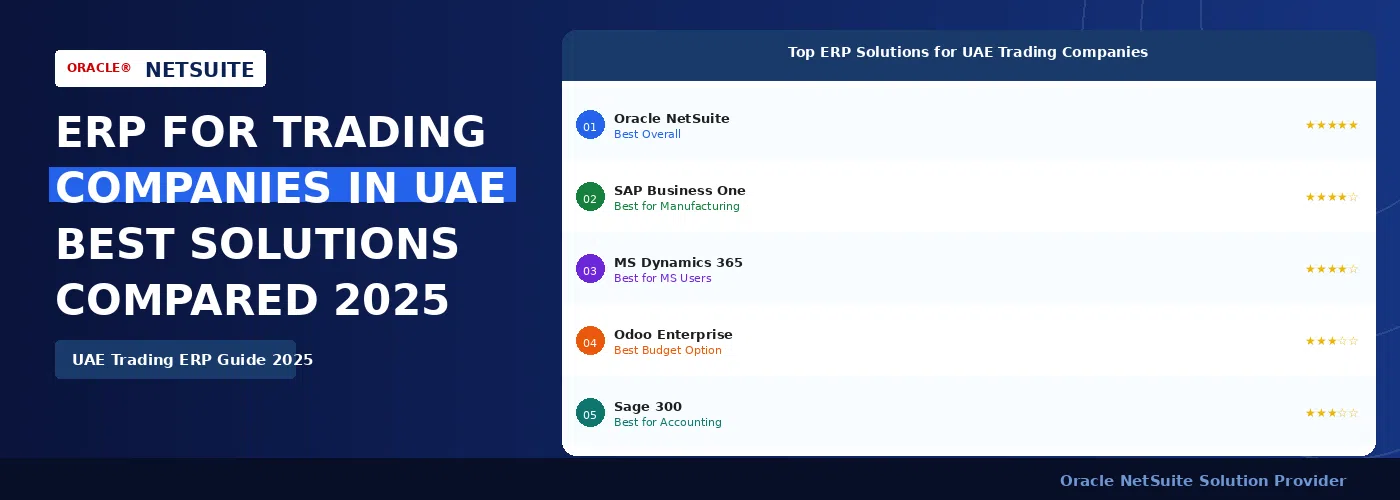
Here's the high-level view. We'll go into each one in detail below, including where the real limitations show up in practice:
| ERP System | Multi-Currency | Inventory Management | FTZ / Multi-Entity | UAE VAT | Cloud Native | Starting Price (AED/mo) | Best For |
|---|---|---|---|---|---|---|---|
| 🏆 Oracle NetSuite | ✔ Full native | ✔ Advanced WMS | ✔ OneWorld | ✔ Built-in | ✔ 100% SaaS | From AED 2,500 | Growing UAE traders |
| SAP Business One | ✔ Full | ✔ Strong WMS | ⚡ Limited | ✔ Via partner | ⚡ Hybrid | From AED 3,500 | Distribution-heavy traders |
| Microsoft Dynamics 365 | ✔ Full | ✔ Good | ✔ Yes | ✔ Full | ✔ Cloud | From AED 4,000 | Microsoft ecosystem users |
| Odoo Enterprise | ✔ Yes | ⚡ Basic | ✘ Limited | ⚡ Partial | ✔ Cloud | From AED 800 | Small budget traders |
| Sage 300 | ✔ Yes | ⚡ Moderate | ✘ No | ✔ Yes | ✘ On-premise | From AED 1,500 | Accounting-focused SMEs |
What Each ERP Actually Looks Like for a UAE Trading Company
🏆 Oracle NetSuite — Best Overall for UAE Trading Companies
Cloud ERP | Multi-entity | JAFZA/DMCC Ready | UAE VAT Native
NetSuite is the one we recommend to most UAE trading companies, and the reasons are pretty consistent across clients. It's not that it's perfect — it's that it handles the specific combination of problems UAE traders deal with better than anything else at this price point.
The multi-entity piece is the clearest differentiator. A JAFZA entity and a Dubai mainland company in the same NetSuite instance — separate books, separate VAT registrations, intercompany invoicing that creates on both sides automatically, and a consolidated group P&L that doesn't require a three-day Excel project. That setup is what most UAE traders need, and it's native in NetSuite rather than bolted on.
- Inventory: Multi-location tracking, bin management, lot and serial numbers, demand planning, automated reorder points — all live, all connected to financials
- Multi-currency: Real-time exchange rate feeds, auto-revaluation at period end, full multi-currency P&L — AED, USD, EUR, SAR, whatever you're dealing in
- FTZ support: OneWorld manages JAFZA, DMCC, DAFZA, KIZAD entities natively — no add-ons, no separate systems
- VAT: Automatic calculation on every transaction, FTA-compliant invoices, VAT return generated in minutes
- Order management: Full PO-to-receipt and SO-to-delivery with approval routing and backorder handling
✔ What UAE Traders Like About It
- 100% cloud — no server, no IT overhead
- FTZ multi-entity handled natively
- UAE VAT built in, e-invoicing ready
- Scales from 5 to 500+ users, same system
- Live inventory across all locations
- Arabic interface included, no extra cost
✘ Worth Knowing Before You Commit
- Higher starting price than Odoo
- Needs a certified partner for implementation — don't try to DIY this
- Customisation requires SuiteScript knowledge if you go beyond standard config
SAP Business One — Strong for High-Volume Distribution Operations
On-premise / Hybrid | Strong WMS | UAE VAT via partner
SAP Business One has been in the UAE market for a long time and has a well-earned reputation for warehouse management depth. If you're running a high-volume distribution operation with complex bin locations, detailed batch tracking, and very granular goods receipt processes, SAP B1 is genuinely good at that.
Where it struggles for UAE trading companies specifically is multi-entity free zone management — getting a JAFZA entity and a mainland entity to work together cleanly in SAP B1 typically requires additional tools and meaningful customisation work. Add the fact that most UAE SAP B1 deployments are still on-premise, and you're looking at server costs, IT maintenance overhead, and remote access that's more complicated than it needs to be.
✔ Where It Genuinely Earns Its Place
- Excellent WMS with detailed bin management and batch tracking
- Strong for high-volume distribution with complex warehouse ops
- Well-established UAE partner network with real local knowledge
- Solid procurement and MRP if you have light manufacturing mixed in
✘ The Real Limitations for UAE Traders
- Multi-entity FTZ management needs extra tools and custom work
- Mostly on-premise — server costs are real and ongoing
- Implementation takes longer and costs more than cloud alternatives
- UAE VAT needs partner configuration — not pre-built
Microsoft Dynamics 365 Business Central — Best If You're Deep in the Microsoft Ecosystem
Cloud | Full UAE VAT | Strong for Office 365 businesses
Dynamics 365 is a capable platform and the Microsoft integration argument is real — if your team lives in Teams and Excel, adoption is genuinely smoother. The Power BI reporting is also strong if you're already in that ecosystem. It handles UAE VAT properly and runs in the cloud.
The honest limitation for UAE trading companies: it's more expensive than NetSuite for comparable functionality, and its free zone multi-entity capabilities — while present — aren't as mature or as cleanly implemented as NetSuite OneWorld. If you're not already Microsoft-heavy, the integration argument weakens considerably and the price comparison gets harder to justify.
✔ Where It Makes Sense
- Deep Microsoft integration — Teams, Excel, Power BI all connect naturally
- Full UAE VAT compliance built in
- Cloud-native deployment
- Strong reporting via Power BI for management dashboards
✘ Where It Falls Short
- Costs more than NetSuite for equivalent trading functionality
- FTZ multi-entity less mature than NetSuite OneWorld
- Trading-specific inventory depth is less developed
- The Microsoft ecosystem argument only holds if you're already in it
Odoo Enterprise — The Honest Budget Option
Cloud | Low cost | Limited VAT & FTZ support
Odoo gets recommended a lot because the starting price looks great. And for a very small trading startup — under 10 people, simple product catalogue, single entity, not yet worrying about FTZ structures — it can work as a starting point. We've seen clients use it effectively at that scale.
The wall tends to arrive sooner than people expect. UAE VAT compliance needs paid add-ons and partner configuration — it's not pre-built. FTZ multi-entity isn't natively supported. Advanced inventory features for traders dealing in hundreds of SKUs across multiple locations start to feel thin. And customisation to fill those gaps adds up quickly, often to the point where the total cost approaches NetSuite anyway. Worth considering as a stepping stone. Not as a long-term platform for a growing UAE trading company.
✔ When Odoo Actually Works
- Very low entry cost — genuinely affordable for early-stage businesses
- Modular structure lets you start small and add features over time
- User-friendly interface — easier for teams without ERP experience
- Fine for small, simple product catalogues and single-entity setups
✘ Where the Cracks Show for UAE Traders
- UAE VAT compliance requires paid add-ons — not included
- No native FTZ multi-entity support
- Inventory features thin out as SKU counts and location complexity grow
- Customisation costs accumulate faster than most buyers expect
Sage 300 — Established Financials, Showing Its Age
On-premise | UAE VAT | Limited cloud & FTZ support
Sage 300 has been around in the UAE for years and plenty of businesses are running on it. The financial accounting is solid. VAT handling is reasonable for standard trading transactions. If you're a single-entity trading business that doesn't need multi-currency revaluation to be sophisticated or FTZ management to be seamless, and you're not planning significant growth, it can keep working for you.
The problem is what it doesn't do well. It's primarily on-premise, which means server costs, IT overhead, and remote access limitations that feel increasingly out of step with how UAE businesses actually operate. There's no meaningful FTZ multi-entity support. The interface feels dated compared to modern cloud platforms. And if you're planning to grow, you'll likely hit its ceiling within two to three years and need to migrate — which is never a fun project.
✔ Where It's Still Holding Up
- Strong financial accounting — the core is reliable
- UAE VAT support is there
- Established UAE partner network with long implementation experience
- Lower licence cost at entry level
✘ The Limitations That Matter
- On-premise architecture — server costs are real and the remote access story is poor
- No FTZ multi-entity support
- Interface and UX feels dated compared to cloud alternatives
- Growth ceiling arrives faster than most buyers plan for
Matching the Right ERP to Your Trading Business Profile
The comparison tables are useful but the real question is which of these fits your specific situation. Here's how we typically frame the decision with clients:
| Your Business Profile | Recommended ERP | The Honest Reason |
|---|---|---|
| Growing UAE trader, 10–100 employees, one or more FTZ entities | Oracle NetSuite | The multi-entity, multi-currency, cloud combination is unmatched at this scale — and the VAT compliance is built in rather than configured |
| High-volume distributor with complex warehouse operations — many SKUs, detailed bin tracking | Oracle NetSuite or SAP B1 | Both have strong WMS — NetSuite is preferred for cloud and FTZ; SAP B1 wins if your warehouse complexity is the primary concern and you're already on-premise |
| Already heavily invested in Microsoft — Teams, Office 365, Azure | MS Dynamics 365 | The integration argument is real when you're already in that ecosystem — adoption is smoother and reporting via Power BI is strong |
| Small startup trader, under 10 employees, tight budget, single entity | Odoo Enterprise | Lowest entry cost for a starting point — plan your migration to NetSuite before you need it, not after you're already constrained |
| Accounting-focused trading SME, single mainland entity, no FTZ, not planning rapid growth | Sage 300 | Does the job for straightforward single-entity operations — just know what you're accepting in terms of scalability limits |
| Trading across UAE plus Saudi Arabia, Qatar, or beyond | Oracle NetSuite | OneWorld handles multi-country, multi-currency, multi-tax natively — this is genuinely its strongest use case |
NetSuite for JAFZA, DMCC, and UAE Free Zone Trading Businesses
The free zone structure is where we see the most pain points for UAE traders who chose the wrong ERP. The most common scenario: a company runs a JAFZA entity for import/re-export and a mainland Dubai company for local distribution. Two separate QuickBooks or Tally instances. Intercompany invoicing done manually. Consolidated P&L built in Excel every month by someone who dreads month-end. VAT filed separately for each entity from data that took days to pull together.
NetSuite OneWorld is designed specifically to eliminate this problem:
- Separate legal entities — JAFZA, DMCC, DAFZA, KIZAD, mainland — each with its own books, VAT registration, and financial statements, all within one system
- Intercompany invoicing — when goods move between entities, the ERP creates both the sales invoice on one side and the purchase invoice on the other, automatically
- Intercompany eliminations — handled at consolidation without manual adjustments — the group P&L is clean from the start
- FTZ-specific VAT treatment — zero-rated, out-of-scope, and standard VAT applied correctly per transaction type and per entity, not relying on someone remembering the rule
- Customs documentation — standard reports and document formats aligned to FTZ customs requirements
- Consolidated real-time reporting — group P&L, balance sheet, and cash flow across all entities in one view, live
✅ NetSuite for UAE Trading Companies — What You Actually Get
- Real-time inventory across every UAE warehouse and location — not last night's figures
- Native multi-currency — AED, USD, EUR, SAR, GBP, whatever you're dealing in
- JAFZA, DMCC, DAFZA, KIZAD free zone entities managed in one system via OneWorld
- UAE VAT built in — automatic calculation, FTA invoices, return generated in minutes
- FTA e-invoicing Phase 2 — API integration ready
- Full purchase order to goods receipt, sales order to shipment and invoice — one connected workflow
- Arabic language invoices and RTL interface — included, no extra charge
- 100% cloud — warehouse team, showroom staff, finance, management, all on the same live system
Want to See How NetSuite Handles Your Trading Operation Specifically?
LST Consultancy specialises in ERP for UAE trading and distribution businesses — JAFZA, DMCC, Dubai mainland, multi-entity setups. We'll show you a demo configured for how you actually work.
Questions UAE Trading Companies Ask Us Most
What is the best ERP for a trading company in UAE?
Does ERP for UAE trading companies handle multi-currency properly?
Can ERP handle JAFZA and DMCC free zone structures?
How much does ERP cost for a UAE trading company?
Does a UAE trading company ERP handle import landed costs and customs?
How long does ERP implementation take for a UAE trading company?
Wrapping Up: ERP for UAE Trading Companies Is a Specific Problem
Trading companies in the UAE aren't just businesses that need accounting software with an inventory module bolted on. The combination of multi-currency, multi-entity FTZ structures, VAT on every transaction, and real-time inventory across multiple locations creates a specific set of requirements that generic ERP systems handle badly and purpose-built platforms handle well.
The businesses that get this decision right tend to start from the right question: not "what's the cheapest ERP?" or "what do other companies use?" but "what does our operation actually require, and which platform handles all of it in one place without significant customisation?" For most UAE trading companies, the answer to that question is NetSuite — but the reasoning matters as much as the recommendation.
LST Consultancy is a certified Oracle NetSuite Solution Provider with specific experience implementing ERP for UAE trading and wholesale distribution businesses — JAFZA setups, DMCC multi-entity structures, Dubai mainland operations, and everything in between. If you want a straight assessment of what your trading business actually needs and which system delivers it, we're the right people to talk to.
Ready to Get the Right ERP for Your UAE Trading Business?
Book a free consultation. We'll assess your trading operation — entities, inventory complexity, multi-currency setup — and show you exactly how NetSuite handles it.