

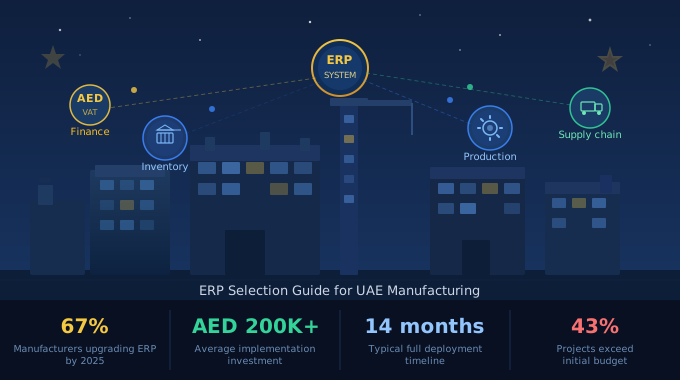
Choosing an ERP system for your manufacturing business in the UAE isn’t just a software decision — it’s a commitment that’ll shape how your entire operation runs for the next five to ten years. I’ve watched companies get this spectacularly wrong, and I’ve seen others nail it so perfectly that their competitors couldn’t figure out how they suddenly became so efficient. Here’s everything I’ve learned about making this choice the right way.
Why This Matters More Than Ever in the UAE Market
Let me tell you about a conversation I had with a factory owner in Sharjah back in 2022. He’d been running his operation on spreadsheets and a legacy system from the early 2000s. “It works,” he kept saying. Six months later, he lost a major contract because he couldn’t provide real-time inventory data to a potential client. That’s when he called me in a panic.
The UAE manufacturing sector has changed dramatically. We’re not just competing locally anymore — we’re competing with factories in China, India, Turkey, everywhere. And honestly? The companies winning aren’t necessarily the ones with the best machinery or the cheapest labour. They’re the ones with the best visibility into their operations.
Here’s what most people get wrong: they think ERP selection is about features. It’s not. It’s about fit. I’ve seen a small plastic injection moulding company in Jebel Ali absolutely thrive with a mid-tier system like Odoo, while a larger operation struggled with SAP because they didn’t have the internal capacity to manage it properly.
Understanding What Actually Drives ERP Success in Manufacturing
The Integration Reality Nobody Talks About
So here’s the thing. An ERP for manufacturing company UAE operations needs to do something that generic business software simply can’t handle — it needs to talk to your machines. And I don’t mean in some abstract, future-state kind of way. I mean right now, today, it needs to pull data from your CNC machines, your PLCs, your quality testing equipment.
I worked with a metal fabrication company in Dubai Industrial City last year. They’d bought a perfectly good ERP system — Oracle NetSuite, actually — but they hadn’t thought about integration with their shop floor equipment. The result? Their production managers were still manually entering data from paper sheets every evening. Completely defeated the purpose.
The fix wasn’t cheap. They ended up spending another AED 80,000 on middleware and custom connectors. Could’ve avoided the whole mess if they’d asked the right questions during the selection process.
VAT Compliance and UAE-Specific Requirements
This one catches people out constantly. The UAE introduced VAT in 2018, and the FTA requirements are specific. Your ERP needs to generate tax invoices in the correct format, handle the UAE’s unique return-to-supplier processes, and produce audit-ready reports that’ll satisfy inspectors.
But wait — it’s not just VAT. If you’re operating in a free zone (and many manufacturers are), you’ve got additional customs documentation requirements. JAFZA, DAFZA, KIZAD — each has slightly different reporting needs. An ERP that works brilliantly in, say, the UK market might be a nightmare for free zone operations here.
💡 Key Insight
Don’t assume a global ERP vendor has genuine UAE expertise. Ask specifically about their local implementation partners, how many UAE manufacturing clients they’ve deployed for, and whether their standard reports are FTA-compliant out of the box. If they hesitate or give vague answers, that’s a red flag.
Multi-Currency and Multi-Language Realities
Your workforce probably speaks Arabic, Hindi, Urdu, Tagalog, and English. Your suppliers might invoice in USD, EUR, CNY, and INR. Your customers might need documentation in Arabic for government contracts.
I’ll be honest — I was sceptical about how much this mattered until I saw a production line grind to a halt because a supervisor couldn’t read the work instructions in the ERP interface. True story. They’d deployed an English-only system in a facility where most floor workers had limited English proficiency.
How to Actually Choose the Right System: A Step-by-Step Approach
Right, let’s get practical. Here’s the process I’ve refined over years of helping UAE manufacturers through this decision.
Document Your Current Processes Before You Do Anything Else
This sounds obvious, but almost nobody does it properly. Spend two to three weeks mapping how things actually work — not how they’re supposed to work. Follow an order from receipt to delivery. Document every handoff, every spreadsheet, every WhatsApp group that’s being used to coordinate production. You’ll discover inefficiencies you didn’t know existed, and you’ll have a baseline to evaluate ERP capabilities against. I once found a client was using four different Excel files to track the same inventory because different departments didn’t trust each other’s data. That’s the kind of thing you need to surface.
Build a Requirements Matrix With Weighted Priorities
Not all requirements are equal. Create a spreadsheet with three columns: Must Have, Should Have, Nice to Have. Be ruthless about what’s actually critical. For a manufacturing operation in the UAE, your Must Haves probably include: UAE VAT compliance, multi-currency handling, production scheduling, BOM management, and inventory control. Your Should Haves might include: shop floor data collection, quality management, and maintenance scheduling. Nice to Haves could be things like advanced analytics or AI-powered demand forecasting. Weight each category and use this to score vendors objectively.
Request Demonstrations Using Your Actual Data
Here’s where vendors try to get away with murder. They’ll show you a slick demo with fictional data that makes everything look seamless. Don’t let them. Provide your actual BOMs, your actual customer list, your actual production schedules. Ask them to show you how the system handles your messiest scenarios — the customer who always changes orders mid-production, the supplier who delivers partial shipments, the quality hold that blocks finished goods. Any vendor who resists this is hiding limitations.
Talk to Reference Customers — And Not Just the Ones They Give You
Vendors will give you their three happiest clients. Great, talk to them. But also do your own research. Check LinkedIn for connections at other UAE manufacturers using the same system. Join ERP user groups on LinkedIn and ask about real experiences. Look for companies that implemented 2-3 years ago — they’ll have perspective on long-term support quality and upgrade headaches. I once saved a client AED 200,000 because a LinkedIn contact warned us about a vendor’s terrible post-implementation support in the region.
Negotiate Like Your Business Depends On It (Because It Does)
ERP pricing is notoriously opaque and almost always negotiable. Don’t accept the first quote. Ask for user licensing flexibility — what happens when you add 10 users next year? Push for implementation cost caps with penalty clauses for overruns. Request extended support periods at no additional cost. And critically, get escrow arrangements for source code access if the vendor disappears. In the UAE market, I’ve seen discounts of 15-30% achieved simply by having multiple vendors compete and being willing to walk away.
⚡ Pro Tip
Before signing anything, run a pilot with a subset of your operation. Two weeks, one production line, real data. You’ll learn more about the system’s fit in that fortnight than in six months of demos and meetings. Budget around AED 20,000-40,000 for this — it’s money incredibly well spent.
Common Mistakes That’ll Cost You Dearly
Underestimating Change Management
I’ve seen technically perfect implementations fail because nobody thought about the human side. Your production supervisors have been doing things a certain way for fifteen years. Your procurement team has relationships with suppliers built on handshakes and WhatsApp messages. An ERP disrupts all of that.
One client in Abu Dhabi — a packaging manufacturer — had to roll back their go-live date twice because floor staff were literally refusing to use the new system. They eventually hired a full-time change manager and extended the training programme by two months. Should’ve been planned from the start.
Choosing Based on Brand Name Alone
SAP is brilliant. Oracle is powerful. Microsoft Dynamics is solid. But none of that matters if you’re a 50-person operation that can’t justify the overhead. I remember working with a food processing company that insisted on SAP S/4HANA because “that’s what the big companies use.” They’re now paying AED 35,000 monthly in licensing alone and using maybe 20% of the functionality.
Meanwhile, their competitor across the road runs on Epicor ERP — at a third of the cost — and is genuinely getting better insights from their data.
Ignoring Industry-Specific Needs
A generic ERP won’t handle batch tracking for a pharmaceutical manufacturer. It won’t manage project-based costing for an ERP for construction company UAE scenario. It won’t optimise routing and freight consolidation for an ERP for logistics company UAE deployment.
Manufacturing has sub-sectors, and each has quirks. Process manufacturing (chemicals, food, plastics) needs different capabilities than discrete manufacturing (machinery, electronics, metal fabrication). Make-to-stock operates differently from make-to-order or engineer-to-order. Understand which category you’re in and prioritise systems with proven depth in that vertical.
Tools and Systems Worth Considering
Let me give you a realistic breakdown of what I’ve seen work in the UAE manufacturing context:
- ✓SAP Business One: Great for growing manufacturers with 20-150 employees. Expect AED 180,000-350,000 for implementation plus around AED 8,000-15,000 monthly. Strong UAE partner network.
- ✓Microsoft Dynamics 365 Business Central: Solid mid-market option, integrates beautifully with Office 365 if that’s your ecosystem. Similar pricing to SAP B1. Good for companies planning to scale.
- ✓Odoo: Open-source option that’s surprisingly capable. Much lower entry cost (AED 60,000-150,000 typical implementation). Needs more customisation but offers flexibility. Works well for companies with internal IT capability.
- ✓Oracle NetSuite: Cloud-native and excellent for multi-subsidiary structures. Popular with manufacturers who also have trading arms. Around AED 12,000-25,000 monthly depending on modules.
- ✓Epicor Kinetic: Manufacturing-specific, very strong in discrete manufacturing scenarios. Less common in UAE but the implementations I’ve seen have been solid.
For logistics-heavy operations or ERP for logistics company UAE requirements, I’d add WMS-focused systems like Infor CloudSuite to the evaluation. And for construction manufacturing — think precast concrete, steel fabrication for projects — systems with project costing like Acumatica deserve serious consideration.
Frequently Asked Questions
Q: How long does a typical ERP implementation take for a UAE manufacturer?
A: Plan for 8-18 months depending on complexity. A straightforward SAP Business One implementation for a small operation might be 8-10 months. A multi-site deployment with heavy customisation can stretch to 18-24 months. The biggest variable is data migration — if your existing data is messy, add three months to any estimate you’re given.
Q: Should we go with cloud-based or on-premise ERP?
A: For most UAE manufacturers, cloud is now the smarter choice. You avoid capital expenditure on servers, you get automatic updates, and disaster recovery is handled. The main exceptions: if you have extremely sensitive IP, if your site has unreliable internet, or if you need integration with legacy machinery that requires local servers. But honestly, I’d say 80% of new implementations should be cloud.
Q: What’s the realistic total cost of ownership for a mid-sized manufacturer?
A: For a manufacturer with 50-100 employees and 25-40 ERP users, budget AED 200,000-500,000 for implementation and first-year licensing, then AED 100,000-200,000 annually ongoing. That includes software, implementation services, training, and support. Customisation can add 30-50% to these figures. Always get quotes that include everything — vendors love to show low base prices then add modules later.
Q: Can we implement ERP in phases rather than all at once?
A: Absolutely, and I usually recommend it. Start with financials and core inventory/purchasing — get those stable before adding production planning and shop floor modules. This reduces risk and lets your team build confidence. Just make sure your contract includes the later phases at agreed pricing so the vendor can’t renegotiate when you’re locked in.
Q: How do we ensure data security with a cloud ERP?
A: Verify the vendor’s data centre locations — UAE data residency is increasingly important for compliance. Ask about encryption (both in transit and at rest), backup frequency, and security certifications like ISO 27001 and SOC 2. For UAE operations, check if the provider offers local data hosting options through AWS UAE, Microsoft Azure UAE, or Google Cloud’s Middle East regions.
Q: What if our current system vendor goes out of business or gets acquired?
A: This is why escrow arrangements matter. Ensure you have contractual access to source code if the vendor fails. Also, choose vendors with strong local partner ecosystems — even if the main vendor has issues, local partners can often continue support. And honestly? This is another point in favour of larger, established vendors despite their higher costs. They’re less likely to disappear.
📌 Summary
Selecting an ERP for manufacturing company UAE operations requires balancing local compliance needs (VAT, free zone requirements, Arabic language support) with operational requirements (production scheduling, BOM management, quality control). Don’t choose on brand name alone — fit matters more than features. Run a proper selection process: document current processes, build weighted requirements, demand real-data demos, talk to reference customers independently, and negotiate aggressively. Budget 8-18 months for implementation and AED 200,000-500,000 for initial deployment. Phase your rollout, invest heavily in change management, and always run a pilot before going live.
Final Thoughts: What I’d Do Differently If I Were Starting Over
Look, I’ve been involved in dozens of ERP implementations across the UAE, and if I could give one piece of advice it’s this: slow down the selection, speed up the implementation.
Most companies rush the selection because they’re eager to fix their problems. Then the implementation drags on for years because they chose the wrong system. Flip that. Take six months to really evaluate options. Then commit fully, resource properly, and push for an aggressive but achievable go-live.
And honestly? Involve your finance director, your production manager, AND your floor supervisors in the selection. The people who’ll use the system daily should have a voice. I’ve seen too many ERP decisions made in boardrooms by people who never touch the software themselves.
The UAE manufacturing sector is professionalising rapidly. Companies that get their ERP strategy right will have a genuine competitive advantage. Those that don’t will find themselves increasingly unable to compete — not just on price, but on responsiveness, quality, and data-driven decision making.
Your choice matters. Make it carefully.
Ready to Find Your Perfect ERP Solution?
LST Consultancy helps UAE manufacturers navigate ERP selection with independent, vendor-neutral guidance. We’ve helped companies save millions in avoided mistakes and accelerated ROI.