
Quick answer
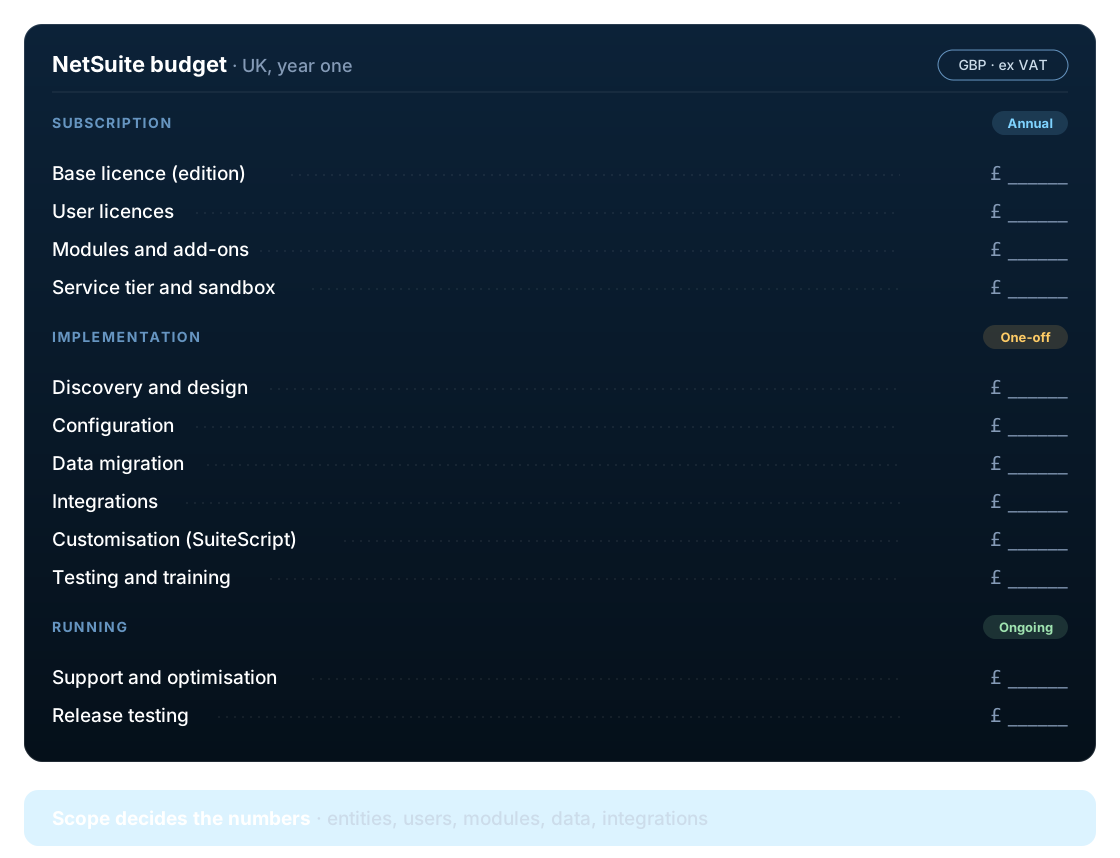
There is no public NetSuite price list for the UK. Your total cost has three parts: an annual subscription (base licence, user licences, modules and service tier), a one-off implementation fee that depends on your scope, and ongoing running costs such as support and release testing. A realistic budget comes from a scoped assessment, not a headline figure.
Key facts
- Oracle NetSuite does not publish a UK price list. Subscriptions are quoted for each customer.
- The subscription is built from a base licence (edition), user licences, optional modules and a service tier.
- Implementation is usually a separate, one-off professional services fee from Oracle NetSuite or a partner.
- UK business quotes are normally given excluding VAT. Confirm whether VAT applies to each line.
- NetSuite ships two major releases a year, so plan for regular release testing after go-live.
How much does NetSuite cost in the UK?
It is the first question most finance directors ask, and the honest answer is that NetSuite has no fixed UK price. Oracle NetSuite quotes each subscription individually, and implementation partners price services against a defined scope.
Every NetSuite budget is made of the same three parts:
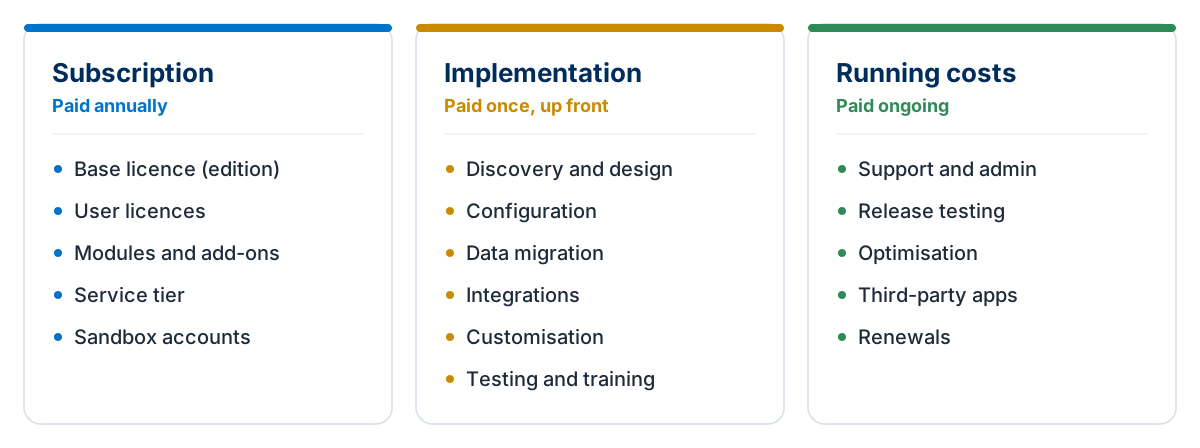
Figures quoted online without a scope behind them are rarely useful. Two UK companies of similar size can have very different costs because of their subsidiaries, data, integrations and processes. The rest of this guide shows what drives each part, so you can build a budget that holds up.
How NetSuite licensing works
The NetSuite subscription is an annual contract built from several components. Understanding them helps you read a quote and see where the licence cost comes from.
| Component | What it is | What changes the cost |
|---|---|---|
| Base licence (edition) | The core platform. Editions are aimed at different business sizes. | Company size, number of users and complexity |
| User licences | Named users who log in to NetSuite. Lighter licence types exist for employees who only need self-service tasks. | How many people need full access versus limited access |
| Modules and add-ons | Additional capability such as OneWorld (multi-subsidiary), advanced financials, inventory, warehouse management or billing. | Which processes you move into NetSuite now and later |
| Service tier | Sets platform capacity such as user limits, file storage, monthly transaction volume and concurrency. Tiers above the entry level also include a sandbox account. | Transaction volume, integrations and testing needs |
| Sandbox accounts | Separate test environments for development, training and release testing. | How much customisation and integration work you run |
You can license NetSuite directly from Oracle NetSuite or, in some cases, through a Solution Provider partner. Either way, ask for the edition, modules, user types and service tier to be listed line by line.
What drives NetSuite implementation cost?
Implementation is the part of the budget that varies most between businesses. These ten factors decide most of it.
Scope and modules
A finance-only project is very different from one covering order management, inventory, warehousing, manufacturing or projects. Each module adds process design, configuration, testing and training.
Subsidiaries and NetSuite OneWorld
UK groups with Irish or European subsidiaries need OneWorld design: subsidiary hierarchy, intercompany, currencies and consolidation. This is one of the largest scope multipliers.
Users and roles
More users mean more roles and permissions to design, more people to train and more participants in user acceptance testing.
Data migration
The volume matters, but data quality matters more. Duplicate customers, inconsistent item codes and incomplete VAT data must be fixed before migration, and someone has to reconcile opening balances.
Integrations
E-commerce, CRM, banks, warehouse systems, EDI and payroll can all connect to NetSuite. A simple one-way feed is very different from a real-time, two-way integration with error handling and monitoring.
Customisation
SuiteScript, workflows and custom records solve genuine gaps, but every customisation adds build, testing, documentation and long-term maintenance. A good partner tries standard features first.
Reports and dashboards
Management packs, KPI dashboards and consolidated reporting take real effort. Include them in scope early so that go-live is not followed by a reporting backlog.
UK compliance and banking
VAT configuration and Making Tax Digital submissions, Bacs payment files, bank reconciliation and payroll journals all need to be designed and tested.
Testing and training
Testing complete processes such as order-to-cash and procure-to-pay, and training each user group properly, takes time on both sides of the project.
Delivery model
Day rates, team mix, location and how much your own team does all affect cost. Compare proposals on scope and responsibilities, not only on the total.
UK-specific NetSuite cost considerations
A UK implementation has requirements that a generic estimate can miss. Make sure each is in scope, or deliberately out of it.
VAT and Making Tax Digital
Tax codes, reverse charge, partial exemption where relevant, and how VAT returns are submitted under Making Tax Digital. Validate the set-up with your accountants.
Bacs and bank payments
Supplier payment runs usually need Bacs or other bank file formats, plus bank statement import and reconciliation. Confirm which bank formats are in scope.
Payroll
UK payroll typically runs in a separate payroll system, with journals posted into NetSuite. Budget for the integration or import, not just the general ledger.
Multi-currency and EU trading
Selling or buying in EUR or USD, or running Irish and European subsidiaries, adds currency revaluation, intercompany and consolidation work.
Year-end and statutory reporting
Agree which reports come straight from NetSuite and which your accountants prepare in their own tools, so the chart of accounts supports both.
GDPR and data handling
Customer and employee data needs access controls, retention rules and, if your partner works outside the UK, appropriate transfer safeguards.
Check your VAT set-up against HMRC's Making Tax Digital software guidance, confirm which Bacs and bank formats your payment runs need, and if any of the delivery team works outside the UK, ask which UK GDPR transfer safeguards apply.
Three example NetSuite scopes
These examples show why a single price is misleading. All three are “NetSuite implementations”, but the work involved is very different.
Scope A
UK single entity
One UK company, finance and purchasing, standard reports, a bank feed and a small number of users.
Relative scope
Scope B
UK and Ireland group
Two or three subsidiaries on OneWorld, GBP and EUR, order management, inventory, a CRM or e-commerce integration.
Relative scope
Scope C
Multi-country operation
Several European subsidiaries, warehouse management, multiple integrations, intercompany trading and custom SuiteScript.
Relative scope
NetSuite total cost of ownership over three years
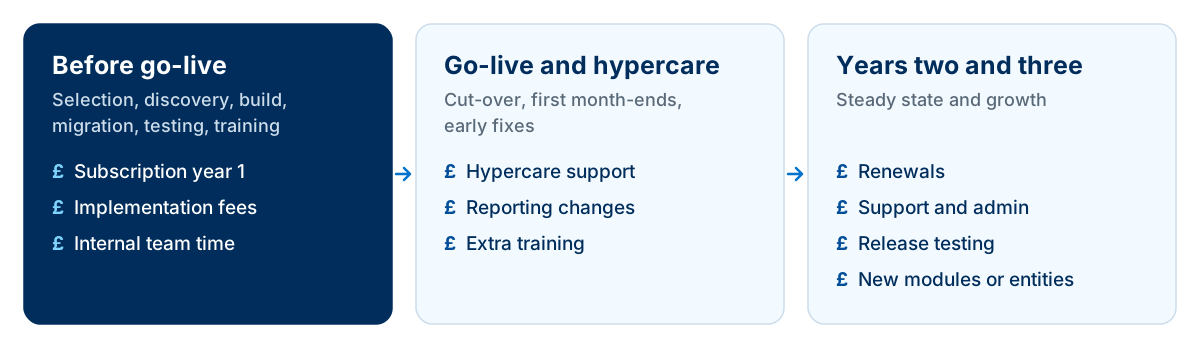
The implementation fee is only part of the picture. Budget for at least the first three years so that renewals, support and growth are visible from the start.
| Cost item | Type | When it is paid |
|---|---|---|
| Subscription (licences, modules, service tier) | Recurring | Annually from contract start |
| Implementation services | One-off | Before go-live |
| Internal team time | One-off | Mostly before go-live |
| Data cleansing and migration | One-off | Before go-live |
| Third-party apps and middleware | Recurring | Annually |
| Hypercare | One-off | First weeks after go-live |
| Support, admin and release testing | Recurring | Ongoing |
| New modules, entities or integrations | As needed | As the business grows |
The largest running cost after go-live is usually support and administration. See our NetSuite post-implementation support options.
How to build your NetSuite budget in five steps
Step 1: Define the scope
List the processes, entities, countries and reports that must be live on day one, and what can wait for a later phase.
Step 2: Map users, modules and service needs
Count full users and lighter users, list required modules and note transaction volumes and testing needs that affect the service tier.
Step 3: Inventory data and integrations
Record which data will move, its quality, and every system that needs to exchange data with NetSuite.
Step 4: Get scoped quotes
Request the subscription quote and the implementation proposal against the same scope document, so that options are comparable.
Step 5: Add running costs and contingency
Add third-party apps, middleware, support, release testing and internal time, then agree a contingency for scope changes with your leadership team.
How to reduce NetSuite implementation cost without cutting corners
Phase the rollout
Go live with a strong core first, then add modules or entities in later phases.
Use standard features first
Adapt processes to standard NetSuite where it makes sense, and customise only for genuine gaps.
Clean data early
Start de-duplicating and archiving before the project begins, not on migration weekend.
Confirm integrations up front
Surprises late in the project are the most expensive kind of change.
Assign internal owners
Named process owners make faster decisions, which keeps consultants productive.
Right-size licences
Give full licences only to people who need them, and review user types before signing.
Cutting testing or training to reduce the quote is a false economy. Both tend to come back later as support costs, rework and low user adoption.
Questions to ask about a NetSuite quote
Use these to compare subscription quotes and implementation proposals like for like.
- 1.Which modules, edition and service tier is this subscription quote based on?
- 2.How many full and limited users are included?
- 3.Is VAT included or excluded on each line?
- 4.What are the renewal terms after the first contract period?
- 5.Which processes, entities and reports are in the implementation scope?
- 6.Who owns data cleansing, mapping and reconciliation?
- 7.Which integrations are included, and how will they be monitored?
- 8.How much customisation is assumed, and who maintains it?
- 9.What hypercare and ongoing support is included?
- 10.What is excluded, and how are change requests priced?
Frequently asked questions
How much does NetSuite cost in the UK?
Oracle NetSuite does not publish a UK price list. The cost combines an annual subscription (base licence, user licences, modules and service tier), a one-off implementation fee and ongoing running costs. The total depends on your users, entities, modules, data and integrations, so the reliable route is a quote based on a defined scope.
How much does NetSuite implementation cost in the UK?
Implementation cost depends on scope: modules, subsidiaries, users, data migration, integrations, customisation, reporting, testing and training. A finance-only project for one UK entity is a very different budget from a multi-country OneWorld rollout. A discovery or assessment exercise is normally needed for a meaningful estimate.
How much does NetSuite cost per user?
There is no single per-user price. NetSuite pricing combines a base licence with per-user licences, optional modules and a service tier, so the cost per user depends on the whole subscription. Some user types cost less than full users, so mapping who needs which access can reduce the total.
How much does NetSuite cost per month or per year?
The NetSuite subscription is contracted and billed annually rather than month to month. Year one usually costs the most, because it combines the first subscription year with the one-off implementation fee. Later years are driven by renewals, support, release testing and any new modules, users or entities.
Is NetSuite pricing quoted with VAT?
Business quotes in the UK are normally given excluding VAT. Confirm with your supplier how VAT applies to the subscription and to implementation services.
What hidden costs should I expect with NetSuite?
Common costs outside the headline quote include internal staff time, data cleansing, third-party SuiteApps, integration platform fees, extra sandbox accounts, change requests, post-go-live support and changes to the subscription at renewal.
Can I implement NetSuite in phases to spread the cost?
Yes. Many UK businesses go live with core finance and operations first, then add modules, subsidiaries or integrations in later phases. Phasing reduces risk and spreads spend, though each phase needs its own testing and training.
Is it cheaper to implement NetSuite with Oracle or a partner?
It depends on scope and the partner. Compare Oracle NetSuite's own services and partner proposals against the same requirements, and look at what each includes, not only the total figure.
How can I get an accurate NetSuite quote?
Prepare a scope document covering entities, countries, users, modules, data to migrate, integrations, reports and must-have requirements, then request both the subscription quote and the implementation proposal against it.
Request a NetSuite project assessment
Before you commit to a budget, get your scope right. LST Consultancy can assess your processes, entities, data, integrations and technical requirements and turn them into an implementation plan you can price with confidence.