
Quick answer
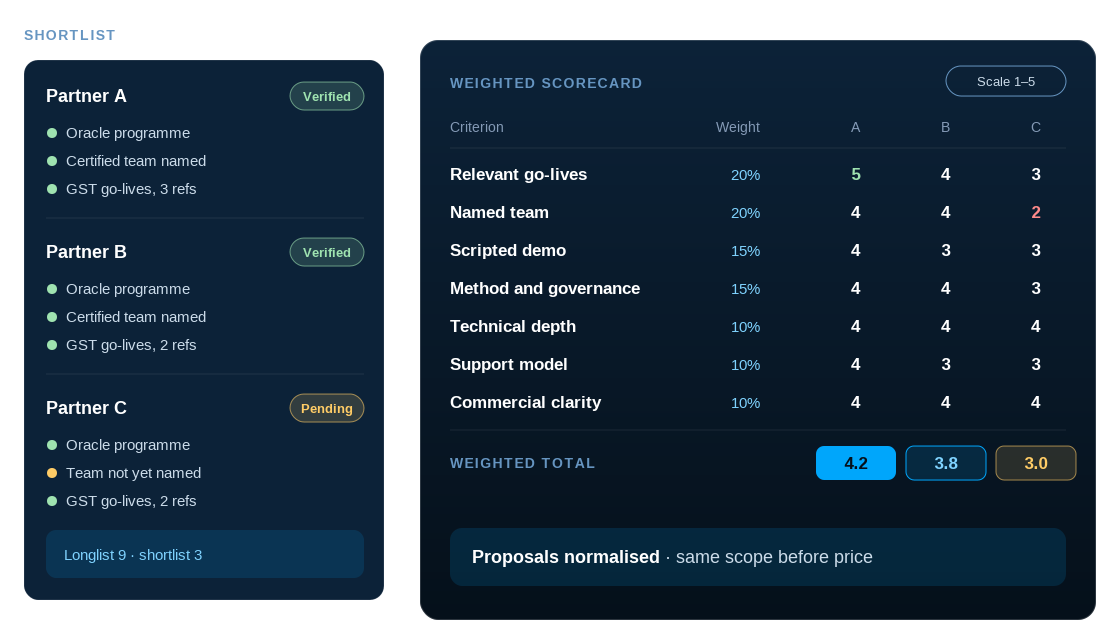
The top NetSuite implementation partners for your business are the ones that score best against your own requirements, not the ones at the top of a list. Verify each firm's Oracle NetSuite partner status and certified team, score three to five shortlisted partners on weighted criteria, test them with scripted demos and reference calls, and compare proposals like for like before price.
Key facts
- Oracle NetSuite runs separate partner programmes: Solution Providers resell licences and implement, Alliance Partners implement while you license from Oracle, and SuiteCloud Developer Network members build add-on SuiteApps.
- Oracle's partner listings group firms by programme and region; they are not a ranking of partners against each other.
- On Clutch, sponsored companies appear first on a directory page by default, while Clutch says its underlying rank is weighted most heavily on verified client reviews.
- NetSuite certifications now come in Associate, Specialist and Professional levels, and most Specialist and Professional credentials need annual recertification.
- NetSuite's India Localization SuiteTax Engine, which handles GST, TDS, e-invoicing and e-way bills, requires the SuiteTax feature, so it is a useful test of a partner's Indian experience.
What makes a top NetSuite implementation partner?
A top NetSuite implementation partner, for your project, is a firm in an Oracle NetSuite partner programme that has delivered projects like yours, will commit a named and certified team, works to a method you can see, supports you after go-live and prices its work transparently. It is a fit judgement, not a position on a list.
People searching for the top NetSuite implementation partners in India are usually building a shortlist. The honest answer is that no independent body ranks NetSuite partners by delivery quality. Oracle lists partners by programme and region, review directories sort them by their own methods, and many "top 10" articles are written by one of the firms they rank.
So this guide does not hand you a ranking. It gives you a method to rank your own shortlist: the criteria to compare, how to check what each firm claims, a weighted scorecard and a way to compare proposals that removes the guesswork from price. Use it on any partner, including us.
Which criteria should you compare NetSuite partners on?
Compare partners on evidence of delivery, not on size or marketing. These six criteria separate partners most clearly in our experience, and each can be checked before you sign.
Projects like yours
Live NetSuite go-lives in your industry and at your size, with the modules, integrations and Indian localisation you need, that you can verify by speaking to the customer.
The delivery team
The named project manager, functional lead and technical lead, their NetSuite certifications and how many other projects they will be running alongside yours.
Method and governance
Written phases, deliverables and sign-offs, a steering rhythm, a risk log and a change-request process that you can see before you sign.
Technical depth
SuiteScript, SuiteFlow and integration skills in-house, plus the judgement to tell you when standard features are enough.
Support after go-live
Hypercare, a support desk with response targets, and testing of your account before each twice-yearly NetSuite release.
Commercial clarity
A proposal whose scope, assumptions, exclusions and rate card are specific enough to compare line by line with the others.
For an Indian business, "projects like yours" must include GST, TDS and e-invoicing in production. Our guide to choosing a NetSuite partner in India covers what a partner has to configure for Indian compliance, the offshore and blended delivery models and the questions to ask before signing.
Are lists of top NetSuite implementation partners reliable?
Lists are useful for finding names and unreliable for ranking them. Each type of list answers a different question, so read it for what it can tell you and verify the rest yourself.
| Source | What it tells you | What it does not |
|---|---|---|
| Oracle NetSuite partner listings | That a firm is in a NetSuite partner programme, which programme, and where it operates | How well it delivers; Oracle does not rank listed partners against each other |
| Oracle Partner of the Year awards | That Oracle recognised the firm in a given year and category | Fit for your size, industry or region; categories vary by year |
| Review directories (Clutch, GoodFirms and similar) | Verified client reviews, project sizes and service focus | Default order can be bought: on Clutch, sponsors are shown first. Reviews may cover non-NetSuite work |
| Self-published "top 10" blog lists | Names to research | Independence: many are written by one of the firms listed, often ranking itself first |
| Peer and auditor recommendations | First-hand experience of a partner in a project like yours | Breadth: one experience, possibly with a different team |
Review directories deserve a closer look because they appear high in search results. Clutch, for example, says its rank is weighted most heavily on verified client reviews checked by an editor, and that sponsored companies appear first on a directory page by default, with sponsorship changing the order but not the underlying score. That is a fair disclosure, but it means the first names on a page are not necessarily the highest rated. Sort by reviews, read them, and check that they describe NetSuite work similar to yours.
Read every ranking with its author in mind. If a list of top NetSuite partners is published on a partner's own site, that partner is not a neutral judge, and this article is no exception. Use any list to build a longlist, then verify every claim directly.
How do you verify an Oracle NetSuite partner?
Confirm three things for every firm: which Oracle NetSuite programme it belongs to, which certifications its named consultants hold, and which live customers will speak to you. All three take a few days and remove most weak candidates.
Check the partner programme
Oracle NetSuite runs several partner programmes, and they mean different things for your contract. Ask each firm which one it is in, and confirm it on Oracle's partner listings.
| Programme | Licences from | Typical role | What to check |
|---|---|---|---|
| Solution Provider | Usually through the partner | Sells licences, implements and supports | Who holds your licence contract and renewal terms |
| Alliance Partner | Directly with Oracle NetSuite | Consulting, implementation and integration | How the partner and Oracle's account team coordinate |
| SuiteCloud Developer Network | NetSuite, plus the SuiteApp's own licence | Builds add-on SuiteApps; rarely full implementations | Who supports the app and tests it before each release |
| BPO partner | Varies by service | Runs outsourced accounting or back-office services on NetSuite | Whether you need an implementer, a service provider or both |
Check the certified team, not the logo
Partner status belongs to the firm; certifications belong to people. NetSuite's certification programme now has Associate, Specialist and Professional levels in role-based tracks, with SuiteFoundation as the common starting point, and most Specialist and Professional certifications need annual recertification. Ask for the certifications held by each consultant named in the proposal, with dates, and check they are current.
Check the go-lives
Ask for two or three customers live on NetSuite in your industry and at a similar size, and speak to them yourself. For Indian businesses, ask specifically for go-lives on Oracle's India Localization SuiteTax Engine. It requires the SuiteTax feature and covers GST, TDS, e-invoicing and e-way bills, so a partner who has delivered it can explain the set-up decisions and the workarounds in detail.
Which kind of NetSuite partner suits your project?
The firms on any list of top NetSuite partners in India fall into a few broad profiles. None is better in general; each suits a different kind of project, and your shortlist can mix them.
Large multi-ERP integrators
Deep benches, global delivery and programme governance suit large, multi-country rollouts. The trade-off: NetSuite may be a small practice, and senior names in the pitch may not run your project.
NetSuite-focused specialists
Firms whose main practice is NetSuite usually have more go-lives, SuiteApps experience and certified consultants per head. Check they have capacity for your timeline.
Boutique firms
Small teams give senior attention and flexible terms, and often know one industry well. Check holiday and attrition cover, and who supports you if a key consultant leaves.
Independent consultants
Useful for targeted work on a live account: scripts, reports, administration. Rarely the right choice to own a full implementation, data migration and support on their own.
A useful rule: match the partner's typical project to yours. A firm whose last ten go-lives were single-entity distributors will find a multi-state manufacturer with three GST registrations harder than one that does those every quarter, whatever its size.
How do you build a weighted scorecard for NetSuite partners?
Agree weighted criteria before any partner presents, score each partner from 1 to 5 on each, and multiply by the weight. Fixing weights in advance stops the best presenter or the lowest price from deciding the result by default.
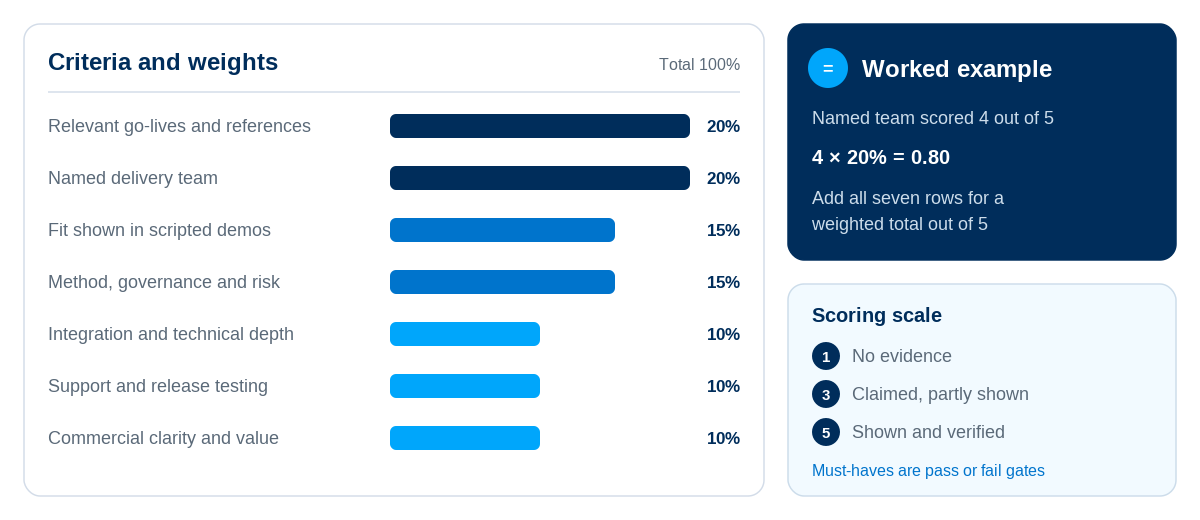
| Criterion | Weight | What earns a 5 |
|---|---|---|
| Relevant go-lives and references | 20% | Two or more verifiable go-lives of similar size and industry, including Indian localisation |
| Named delivery team | 20% | Certified leads named in the contract, met before signing, with a stated allocation |
| Fit shown in scripted demos | 15% | Your scenarios run end to end in NetSuite, with gaps stated honestly |
| Method, governance and risk | 15% | Written deliverables, sign-off gates, a change process and a sample project plan |
| Integration and technical depth | 10% | In-house SuiteScript and integration skills, with examples similar to your systems |
| Support and release testing | 10% | Defined hypercare, response targets, escalation and release-preview testing |
| Commercial clarity and value | 10% | Specific scope and assumptions, a clear rate card and a fair change-request process |
Write down what earns a 1, a 3 and a 5 for each criterion so that every evaluator scores the same way. Ask each member of your selection team to score independently first, then discuss the differences. Large gaps between scorers usually mean a partner explained something well to one audience and badly to another, which is worth knowing.
Add must-haves as pass or fail gates outside the weighted score. Examples: Indian GST go-lives in production, a named project manager, or an Oracle NetSuite programme membership. A partner that fails a gate leaves the shortlist, however well it scores elsewhere.
How should you compare shortlisted NetSuite partners, step by step?
Move from a longlist of eight to ten names to a decision in seven steps, giving every partner the same information, time and questions.
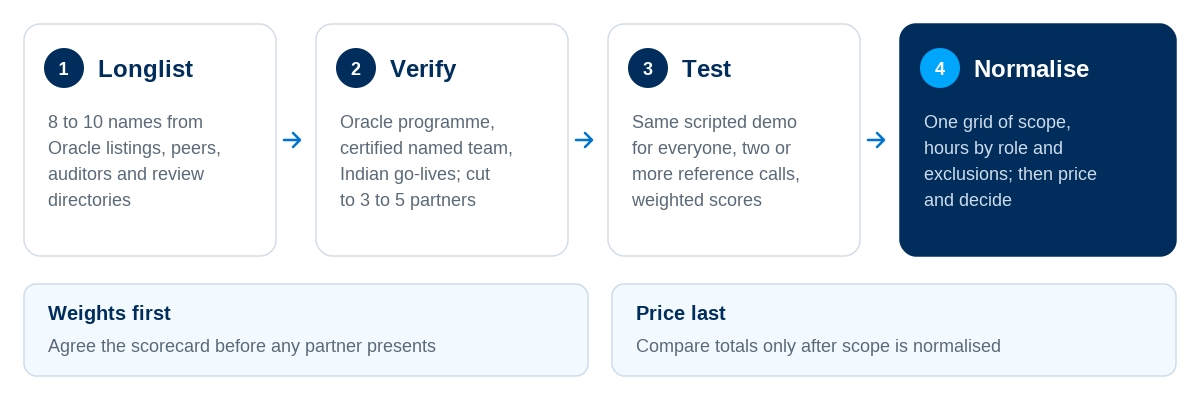
Fix your requirements and weights
Write down entities, GST registrations, processes, integrations and reports, then agree the scorecard weights before any partner presents.
Build a longlist
Draw eight to ten names from Oracle's partner listings, peers, your auditor and review directories, without trusting any single list.
Verify and cut to a shortlist
Confirm programme status, certified consultants and Indian go-lives, then keep the three to five firms that clear every must-have.
Run scripted demos
Give every shortlisted partner the same scenarios and the same time, and score each one on the day, before discussing it.
Call references
Speak to at least two customers per partner, chosen for similarity to you, and ask the same questions of each.
Normalise proposals
Put every proposal into one grid of scope, hours by role, assumptions and exclusions before you compare totals.
Score, negotiate and decide
Add up weighted scores, negotiate with the top two and write down why the winner won, for your board and for later.
For a mid-sized business the whole selection usually takes four to eight weeks. The step most often cut short is reference calls; it is also the one that most often changes the result.
How do you test NetSuite partners with demos and reference calls?
Give every shortlisted partner the same written scenarios from your own business and ask them to run each one in NetSuite. Then speak to their customers with a fixed set of questions. Together these show how a partner works, not just what it says.
Scenarios for a scripted demo
Send the scenarios two weeks ahead with sample data. For an Indian business, these six cover most of what separates partners:
- An inter-state sale from quote to e-invoice, with the IRN and e-way bill
- A vendor bill with TDS, then the payment and the TDS return data
- A credit note against an e-invoiced sale, and how the cancellation is handled
- Your month-end close, with the reports your finance team uses today
- One of your integrations, such as a bank, e-commerce store or payroll
- A role-restricted view for a branch or a second GST registration
Score what you see on the day. A strong partner shows the scenario working, says where standard NetSuite stops and a script or SuiteApp takes over, and asks questions about your process. A weak one returns to slides when the script gets difficult.
Questions for reference customers
- Did the people in the proposal do the work, and for how long?
- What slipped against the plan, and how did the partner handle it?
- How many change requests were raised, and were they fair?
- How did the first GST and TDS cycle after go-live go?
- How fast does support respond today, and who answers?
- Would you hire the same team again for the next phase?
Ask the partner for references of your size and industry, and where possible find one more through your own network. A reference who went live more than two years ago may have worked with a different team, so ask when they went live and who led the project.
How do you compare NetSuite implementation proposals like for like?
Put every proposal into one grid before you look at totals. Two quotes for "a NetSuite implementation" can differ by a wide margin simply because one includes data migration, reports or hypercare that the other assumes you will do.
| Item | Why quotes differ | How to normalise |
|---|---|---|
| Scope | One partner includes reports, print templates or a second subsidiary that another leaves out | List every requirement in rows and mark each proposal included, excluded or assumed |
| Hours by role | Totals hide the mix of senior and junior consultants | Ask for hours per phase and per role, and compare blended rates |
| Data migration | Number of trial loads, record types and who cleans data vary widely | Fix record types, history depth, trial loads and cleansing ownership for all |
| Integrations | "Integration included" can mean a connector licence or a custom build | Name each system, direction, volume and tool, and who maintains it |
| Testing and training | Some quotes include UAT support and train-the-trainer; others assume you run both | State who writes test scripts, who supports UAT and how many training sessions |
| Hypercare and support | Hypercare ranges from a few days to several weeks | Compare hypercare length, then year-one support on the same response targets |
| Licences and third-party apps | Some proposals bundle licences or SuiteApps; others quote services only | Separate licences, apps and services into their own lines |
Once scope is aligned, ask every partner to re-price against the same grid. The cheapest original quote is often not the cheapest normalised one. Then compare the change-request rate card and process, because that is what you pay for anything the grid did not foresee.
To sanity-check totals, our NetSuite implementation cost calculator gives a ballpark for your scope, and the NetSuite implementation cost breakdown explains where the money goes. Data migration and integrations are the two lines that vary most; see how we scope NetSuite data migration and NetSuite integration services.
What mistakes do buyers make when comparing NetSuite partners?
- Trusting a single list
- A self-published or sponsored ranking is a starting point for research, not evidence of delivery.
- Comparing day rates
- A lower rate with more hours, or a junior-heavy team, often costs more in the end. Compare hours by role and scope.
- Letting price set the weights
- If commercial value counts for more than about a quarter of the score, the cheapest assumption-heavy proposal tends to win.
- Scoring the sales team
- Presenters often do not deliver. Score the named consultants, and write their names into the contract.
- Accepting a product tour
- A polished generic demo shows NetSuite, not the partner's understanding of your processes.
- Skipping support in the comparison
- Year-one support and release testing cost money too. Compare them alongside implementation.
- Changing the criteria mid-way
- Weights agreed after the demos tend to favour whoever presented best. Fix them first.
What have we learned from NetSuite partner selections?
We sit on the other side of these selections regularly, and we also take over projects that another partner started. A few patterns come up again and again.
The biggest predictor of trouble is an unnamed team. In implementations we've rescued, the original proposal often named senior consultants who handed over to others within weeks. If you take one thing from this guide, write the project manager and lead consultants into the contract, with a replacement clause that gives you a say.
The second is a fixed price agreed before anyone understood the processes. It looks safe, but the risk moves into assumptions and exclusions, and the first change request arrives in week three. A short paid discovery, or a fixed price only after design sign-off, usually works out cheaper and calmer.
The third is Indian compliance left to the end. GST registrations, HSN codes, TDS sections and e-invoicing shape item, customer and vendor records, so they belong in design. A partner who mentions SuiteTax and e-invoicing unprompted in the first meeting has usually delivered them before.
What to check first: ask each partner to name the consultants who will run your project, then ask those people to walk you through one of their own recent go-lives. Ten minutes of that conversation tells you more than any ranking.
Where does LST Consultancy fit on your shortlist?
LST Consultancy is an Oracle NetSuite Solution Provider. Our NetSuite team in Nashik implements and supports NetSuite for Indian businesses and delivers offshore for clients in the UAE, the UK, the US and Australia. We are one option among several, and we would rather be compared properly than ranked by ourselves.
If we are on your shortlist, hold us to the same scorecard: we will name the consultants who would run your project, run your scripted scenarios in NetSuite, put you in touch with customers of a similar size and itemise scope, assumptions and exclusions so you can line us up against the other proposals.
See our NetSuite implementation services for how we run projects, or book a NetSuite consultation to talk through your requirements before you send them to anyone.
Frequently asked questions
Who are the top NetSuite implementation partners in India?
There is no official ranking. Oracle lists partners by programme and region but does not rank them, and many online top-10 lists are published by one of the firms they rank. The best partner for you is the one that scores highest against your requirements on verified go-lives, a named certified team, scripted demos, references and a clear proposal.
How many NetSuite partners should I shortlist?
Three to five is usually right. Fewer gives you little to compare and weak negotiating leverage; more makes scripted demos and reference calls impractical, so each partner gets less attention and you score them less carefully. Start from a longlist of eight to ten and cut it by verifying must-haves.
Is a Solution Provider better than an Alliance Partner?
Neither is better in general. A Solution Provider usually sells your licences as well as implementing, which gives you one accountable firm. With an Alliance Partner you license NetSuite from Oracle and contract the implementation separately. Choose on delivery quality, then decide which commercial arrangement suits you.
Can I check a NetSuite consultant's certification?
Yes. Ask each partner to list the certifications held by the consultants named in the proposal, with the dates achieved, and ask to see the credentials. Most Specialist and Professional certifications now need annual recertification, so check they are current, not only that they were passed once.
Are Clutch and GoodFirms rankings reliable for NetSuite partners?
They are useful for finding verified client reviews, but treat the order of a page with care. Clutch says sponsored companies appear first by default, and reviews may describe non-NetSuite work. Read the reviews themselves, check they mention NetSuite projects like yours, and verify through reference calls.
Should I pay for a discovery phase before choosing a partner?
A short paid discovery with your preferred partner is often worthwhile on complex projects. It produces a solution design and a firmer estimate, so the main contract rests on facts rather than assumptions. Agree that you own the outputs, so you can use them with another partner if needed.
Should a NetSuite partner be based in my city?
Not necessarily. Most NetSuite work can be delivered remotely, and Indian partners routinely deliver across cities. What matters is that design workshops, key user training and go-live support happen in a way your team can attend, and that the partner commits to on-site days where you need them.
What is a fair weight for price when comparing NetSuite partners?
Around 10 to 25 percent of the total score works for most projects. Above that, price tends to overwhelm delivery evidence. Compare price only after normalising scope, so you are weighing like-for-like proposals rather than rewarding the one with the most exclusions.
Can I switch NetSuite partners after go-live?
Yes. Your NetSuite account belongs to you, and another partner can take over support or later phases. A clean handover needs documentation of customisations, scripts and integrations, admin access, and the source for any custom SuiteScript. Ask for these deliverables in the original contract.
How long should a NetSuite partner selection take?
For a mid-sized business, four to eight weeks is typical: one to two weeks for requirements and the longlist, two to three weeks for demos and references, and one to two weeks to normalise proposals and negotiate. Rushing it usually costs more in change requests later.
Add LST Consultancy to your NetSuite shortlist
Send us your requirements and scenarios. We will name the team, run your scripted demo, connect you with references and send an itemised proposal you can compare line by line with the other partners on your list.
Sources
- Oracle NetSuite: Partners and Solution Providers (India)
- Oracle NetSuite: Alliance Partner Program datasheet
- Oracle NetSuite: NetSuite Certification Resource Center
- Clutch: Research methodology (how Clutch ranks service providers)
- Clutch Help Center: What position will my company have on pages it sponsors?
- Oracle NetSuite Help: India Localization SuiteTax Engine