
Quick answer
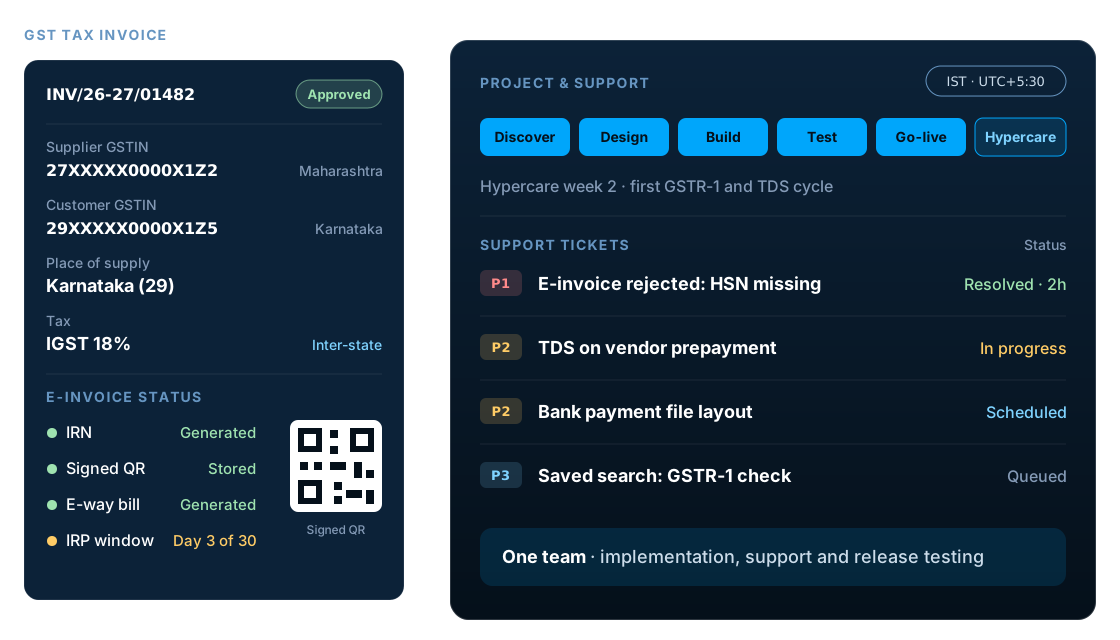
A NetSuite partner India-based businesses can rely on is an Oracle NetSuite partner with Indian go-lives on the India Localization SuiteApps for GST, TDS and e-invoicing, a named delivery team, a visible methodology and a post-go-live support plan with agreed response times. Overseas companies hiring an Indian partner should also confirm working-hour overlap, data-protection terms and who runs the design workshops.
Key facts
- NetSuite handles Indian GST and TDS through Oracle's India Localization SuiteTax Engine, which needs the SuiteTax feature and is set up through your NetSuite account manager.
- Oracle's India Localization SuiteTax Reports SuiteApp produces GSTR-1, GSTR-3B and GSTR-9, and TDS returns on Forms 26Q and 27Q.
- GST e-invoicing applies once aggregate turnover has exceeded ₹5 crore in any financial year since 2017-18, under CBIC Notification 10/2023, in force from 1 August 2023.
- Since 1 April 2025, taxpayers with AATO of ₹10 crore or more must report e-invoices to the IRP within 30 days of the document date, or the IRP will not accept them (GSTN advisory).
- NetSuite's India e-invoicing works through a GST Suvidha Provider, with ClearTax preconfigured, and does not cancel e-invoices: cancellation happens on the GSP or the IRP.
- India's Digital Personal Data Protection Rules were notified on 14 November 2025, with most operational duties applying from 14 May 2027.
What does a NetSuite partner in India do?
A NetSuite partner in India is a consulting firm that plans, configures, extends and supports Oracle NetSuite for its clients, usually with Indian GST, TDS and e-invoicing built into the design. Many also deliver offshore for companies in the UAE, the UK, the US and Australia.
The work runs from discovery and solution design through configuration, scripting, integrations, data migration, testing, training and go-live, then into support. For an Indian entity the partner also sets up Oracle's India localisation: GST calculation and returns, TDS, e-invoicing through a GST Suvidha Provider and the print templates your customers and auditors expect.
The partner is accountable for the whole project, not one task. That is the difference from hiring an individual NetSuite consultant for a report or a script. If you are comparing what a full engagement includes, our NetSuite implementation services page sets out the phases we run.
Which types of NetSuite partner can you hire in India?
Oracle runs several partner programmes, and the route you buy through decides who holds your licence contract and who delivers the work. Ask every firm on your shortlist which one applies to them.
| Route | Licence contract | Who delivers | Good fit when |
|---|---|---|---|
| Oracle NetSuite direct | Oracle NetSuite | NetSuite's own professional services | You want one vendor relationship and your processes fit NetSuite's standard approach closely. |
| Solution Provider | Usually through the partner | The partner | You want one firm accountable for licences, implementation and support. |
| Alliance Partner | Oracle NetSuite | The partner | You prefer to contract licences with Oracle and choose the consulting firm separately. |
| SuiteCloud Developer Network | NetSuite, plus the app's own licence | Builds SuiteApps; rarely full implementations | You need an add-on, such as a bank connector, a GST utility or an industry module. |
| Independent consultants | Not involved | Individuals or small teams, often for targeted work | You already run NetSuite and need extra hands for scripts, reports or administration. |
Programme status tells you a firm has a formal relationship with Oracle. It does not tell you whether the people on your project have delivered GST e-invoicing, a Tally migration or a multi-state rollout. Test that separately, with references and a scripted demo.
Which Indian compliance requirements must your NetSuite partner configure?
An Indian entity on NetSuite needs GST, GST returns, e-invoicing, e-way bills, TDS, an audit trail and personal data controls designed in from the start. Oracle covers most of the tax layer through its India Localization SuiteApps; the partner's job is to configure them, fill the gaps and prove it all works before go-live.
| Requirement | What it involves | How NetSuite handles it |
|---|---|---|
| GST on transactions | CGST and SGST or IGST by place of supply, GSTINs per state registration, HSN and SAC codes on items and services | India Localization SuiteTax Engine, with SuiteTax enabled |
| GST returns | GSTR-1 for outward supplies, GSTR-3B summary returns and the GSTR-9 annual return | India Localization SuiteTax Reports SuiteApp |
| E-invoicing | An IRN and signed QR code from the IRP on B2B invoices once turnover has crossed ₹5 crore | Electronic Invoicing SuiteApp through a GST Suvidha Provider |
| E-way bills | Movement of goods above the notified value needs an e-way bill, often generated from the IRN | The GSP connection used for e-invoicing, tested with your logistics flow |
| TDS | Tax deducted at source on vendor payments, with quarterly returns on Forms 26Q and 27Q | TDS in the SuiteTax Engine and SuiteTax Reports, plus a process for unsupported transactions |
| Audit trail | Company accounting software must keep an edit log that cannot be disabled, under the proviso to Rule 3(1) of the Companies (Accounts) Rules, 2014 | NetSuite system notes, plus a review of custom records, scripts and imports with your auditors |
| Personal data | Employee, customer and vendor data falls under the Digital Personal Data Protection Act and its 2025 Rules | Role-based access, a data processing agreement with the partner and controls on sandbox copies |
SuiteTax comes first
Oracle's India Localization SuiteTax Engine needs the SuiteTax feature enabled, and your NetSuite account manager sets the engine up. On a new account that is a configuration step. On an existing account still running legacy tax, it is a migration project in its own right, so a partner should raise it in the first conversation, not during testing.
Known gaps to plan around
Oracle documents limits that a partner should design around rather than discover later. The TDS engine does not calculate TDS on bill credits or vendor prepayments, and GSTR-3B does not cover supplies to UIN holders or imports of goods. Each needs an agreed manual or scripted process, reviewed with your tax adviser.
Tax rules and SuiteApps change. Treat this table as a planning checklist, not tax advice. Thresholds, return formats and Oracle's localisation features are revised regularly, so confirm your obligations with your chartered accountant and check Oracle's current release notes before you sign off the design.
How does GST e-invoicing work in NetSuite?
NetSuite sends each qualifying invoice to the government's Invoice Registration Portal (IRP) through a GST Suvidha Provider and stores the IRN and signed QR code it gets back. E-invoicing applies once aggregate turnover has exceeded ₹5 crore in any financial year since 2017-18, the threshold set by CBIC Notification 10/2023 from 1 August 2023.
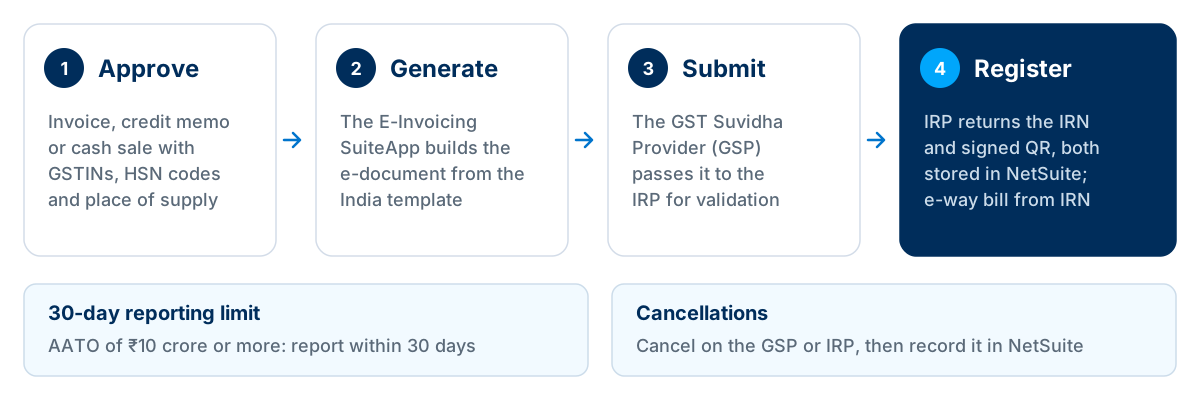
Approve the invoice
A sales invoice, cash sale, credit memo or vendor credit is approved in NetSuite with GSTINs, HSN or SAC codes and place of supply complete.
Generate the e-document
The Electronic Invoicing SuiteApp builds the e-invoice from the transaction using the India template.
Send through the GSP
The SuiteApp sends it to your GST Suvidha Provider. ClearTax is preconfigured; you supply its connection details.
Receive the IRN and QR
The IRP validates the invoice and returns the IRN and signed QR code, which NetSuite stores on the transaction and prints.
The 30-day reporting limit
Under GSTN's advisory, taxpayers with AATO of ₹10 crore or more have had to report invoices, credit notes and debit notes to the IRP within 30 days of the document date since 1 April 2025. After that the IRP will not accept the document. In NetSuite this means a daily saved search of approved transactions without an IRN, owned by someone in finance, not a quarterly clean-up.
Limits in Oracle's SuiteApp
Oracle's documentation sets a limit of 829 line items per transaction for e-document generation, and the SuiteApp does not cancel e-invoices: cancellation happens on the GSP's website or the IRP. Large distributors and anyone who cancels often should agree how those cases are handled, and how cancellations are recorded back in NetSuite, during design.
Should overseas companies hire a NetSuite partner in India?
It works well when the delivery model matches the work. India-based teams are a strong fit for configuration, SuiteScript development, integrations, data migration and ongoing support; design workshops and change management need either good time-zone overlap or a lead in your own region.
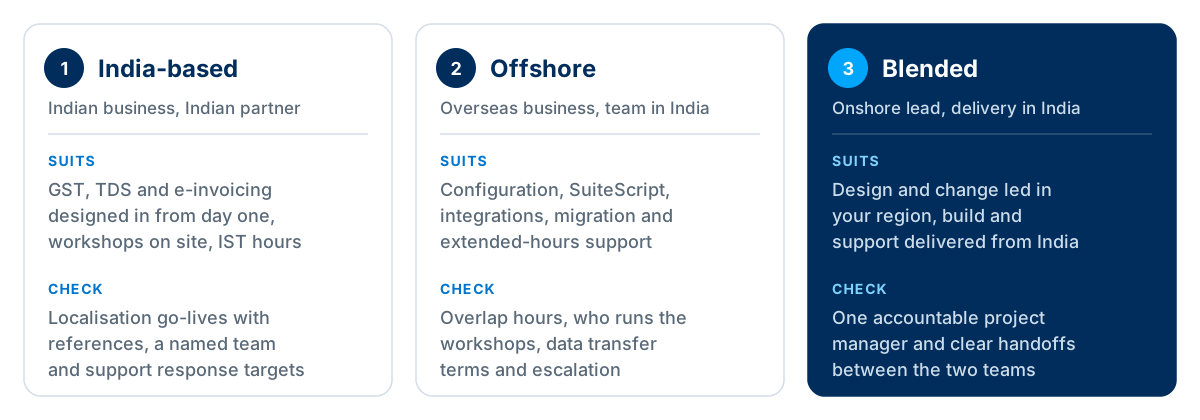
Overseas companies comparing offshore and nearshore NetSuite partners usually ask the same question first: how much of the working day will we share? India Standard Time is UTC+5:30 all year, with no daylight saving, so the overlap shifts when your own clocks change.
| Client region | Time difference | Practical overlap |
|---|---|---|
| UAE (Gulf Standard Time) | IST is 1 hour 30 minutes ahead | Almost a full shared working day |
| United Kingdom | IST is 4 hours 30 minutes ahead in summer, 5 hours 30 minutes in winter | UK mornings overlap with Indian afternoons |
| Australia (Sydney) | Sydney is 4 hours 30 minutes ahead of IST in winter, 5 hours 30 minutes in summer | Indian mornings overlap with Sydney afternoons |
| US East Coast | IST is 9 hours 30 minutes ahead in summer, 10 hours 30 minutes in winter | Short overlap; an Indian evening shift or a US-based lead is needed |
Data protection on both sides
An Indian partner processing your data works under India's Digital Personal Data Protection Act. Its Rules were notified on 14 November 2025 and phase in, with most operational duties applying from 14 May 2027, according to the government's PIB release. Your own law also applies: UK and EU companies need transfer safeguards under the GDPR, for example. Put access roles, sandbox data masking and a data processing agreement in the contract.
For partner selection specific to Europe and the UK, including GDPR transfers, see how to choose a NetSuite implementation partner in Europe. Consulting firms that want an Indian team to deliver under their own brand should read our guide to working with a NetSuite development partner.
How do you choose a NetSuite implementation partner in India?
Judge partners on evidence of comparable delivery, the team you will actually get and how clearly they define scope and support. Eight criteria separate them in practice:
Indian localisation go-lives
Ask for live projects on the India Localization SuiteTax Engine with GST returns, TDS and e-invoicing in production, not only demo accounts.
A named team
Meet the project manager, functional lead and technical lead who will work on your account, and confirm how much is subcontracted.
A methodology you can see
Phases, deliverables and sign-offs should be written down: discovery, design, build, testing, training, go-live and hypercare.
Integration skills
Most Indian projects connect NetSuite to banks, e-commerce, payroll, logistics or a GSP. Ask how each integration is built and monitored.
Data migration ownership
Moving from Tally, Zoho Books or SAP Business One means agreeing who cleans GSTINs, HSN codes and opening balances, and how many trial loads run.
SuiteCloud depth
A partner with SuiteScript and SuiteFlow skills can build what configuration cannot, and should also tell you when standard features are enough.
Support with response times
Hypercare, a support desk and release testing should be defined in the contract, with priorities, response targets and escalation.
Commercial clarity
Compare proposals on scope, assumptions and exclusions before price. A cheaper quote often leaves out migration, reports or training.
Two of these decide most timelines. See how we approach NetSuite data migration and NetSuite integrations for what good ownership looks like.
How should you run the partner selection?
A structured selection takes a few weeks and saves months later. Send every partner the same requirements and compare like with like.
Write down your requirements
List entities, GST registrations, processes, integrations, reports and must-have features. This is what every partner is measured against.
Build a shortlist
Use Oracle NetSuite's partner directory, peer references and industry contacts to shortlist three to five partners.
Run scripted demos
Ask each partner to demonstrate your own scenarios, such as an inter-state sale with e-invoice and e-way bill, rather than a product tour.
Check references
Speak to customers of a similar size and industry, including at least one Indian GST go-live, and ask what slipped and why.
Compare statements of work
Line up deliverables, assumptions, exclusions, responsibilities and the change-request process side by side.
Agree governance and support
Confirm the named team, steering meetings, escalation, hypercare length and the support model before you sign.
For the scripted demo, pick scenarios that expose Indian requirements: an inter-state sale with IGST, an e-invoice and an e-way bill; a credit note against it; a vendor bill with TDS and a vendor prepayment. A partner who has delivered these will walk through them without hesitation.
What NetSuite support should a partner in India provide after go-live?
Expect hypercare after go-live, then a defined support model with priorities, response targets and release testing. The first GST and TDS return cycles are when most Indian NetSuite accounts need their partner most.
Hypercare
Daily support for the first weeks after go-live, when the first GST returns, TDS returns and month-end close surface questions testing did not.
Support retainer
A monthly block of hours for tickets, small changes and reports, with priorities and response targets written into the agreement.
Managed administration
The partner runs user access, saved searches, workflows and integration monitoring as an extension of your team.
Release readiness
NetSuite updates twice a year. A good partner tests your scripts, localisation SuiteApps and integrations in the release preview before your upgrade date.
For a deeper comparison of Oracle's support tiers and partner support, read NetSuite support and maintenance after go-live. If an existing implementation is struggling, our post-implementation support and project recovery team starts with a review of what is configured and what is broken.
How much does a NetSuite partner in India cost?
There is no standard price. Oracle does not publish NetSuite licence prices, and partner fees depend on scope, so ask for a fixed or capped price per phase once discovery is done. Indian day rates are often lower than in the UK or the US, but the total depends far more on what is in scope.
These drive most of the difference between quotes:
- Number of subsidiaries, GSTINs and states
- Modules in scope beyond core financials
- Integrations with banks, e-commerce and logistics
- Data volume and the quality of legacy data
- Custom scripts, workflows and print templates
- Training, hypercare and ongoing support
For a first estimate based on your own scope, try our NetSuite implementation cost calculator, then compare partner proposals line by line against it.
What should you ask a NetSuite consultant before signing?
These questions get past the sales deck. Ask them of the people who will deliver, not only the account manager.
- Which Indian go-lives on the SuiteTax Engine can we speak to?
- Who will be our project manager and lead consultants?
- Which GSP do you connect for e-invoicing, and who owns that contract?
- How do you handle e-invoice cancellations and the 30-day IRP limit?
- How will TDS on vendor prepayments and bill credits be handled?
- Who cleans GSTIN, HSN and opening balance data before migration?
- Which of our requirements need scripts, and who maintains them?
- What hypercare is included, and how is support priced afterwards?
- How do you test our account before each NetSuite release?
- Where will our data be accessed from, and under what agreement?
If you would rather test your requirements with an independent view first, a NetSuite consultation can turn them into a scope you can send to every partner.
What are the red flags when hiring a NetSuite partner?
Any of these in a proposal or pre-sales meeting deserves a direct follow-up question.
- GST treated as a later phase
- GST, TDS and e-invoicing shape item, customer and vendor records. Leaving them until after go-live forces rework.
- No SuiteTax decision
- The India localisation needs SuiteTax. A partner who has not raised this in pre-sales has probably not delivered it.
- A fixed price before discovery
- A firm price with no understanding of your processes usually moves the risk into exclusions and change requests.
- Generic demos only
- A partner who cannot show your inter-state sale, credit note or vendor payment flow may not have understood it.
- Unnamed team
- If nobody will name the consultants, you cannot judge who will deliver or what happens when they move on.
- Support left undefined
- No response times, no escalation path and no release testing means gaps exactly when the first returns are due.
- Vague data access terms
- A partner who cannot say who will access your data, from where and under which agreement is a compliance risk.
What goes wrong in Indian NetSuite projects, and what should you check first?
In implementations we've run for Indian entities, the problems rarely come from NetSuite itself. They come from master data and from decisions made late.
The most common is GST master data. Customers and vendors arrive from Tally or spreadsheets with missing or mistyped GSTINs, wrong state codes and items without HSN codes. Every one of those blocks an e-invoice or puts a line in the wrong section of GSTR-1. Cleaning them before the first trial load costs days; cleaning them after go-live costs a filing cycle.
The second is treating the GSP as someone else's problem. The e-invoicing connection needs credentials, a contract with the provider and test runs against its sandbox. When nobody owns it, it is the last thing tested and the first thing to fail on day one.
The third is designing for one GSTIN when the business has several. Branches in different states, a warehouse registration or a planned subsidiary change how locations, nexuses and numbering series are set up. Adding them later touches every transaction form.
What to check first, before any configuration: the SuiteTax status of the account, a clean list of GSTINs and the states they cover, HSN and SAC coverage on items, who holds the GSP contract, how cancellations and the 30-day IRP limit will be monitored, and which TDS cases need a manual process. Get those six right and the rest of the project runs on familiar ground.
Frequently asked questions
Is NetSuite available in India?
Yes. Oracle sells NetSuite to Indian businesses and provides India localisation through its India Localization SuiteTax Engine and SuiteTax Reports SuiteApps, which cover GST, TDS and GST returns. Licences are bought from Oracle NetSuite directly or through a Solution Provider partner, depending on the route you choose.
Does NetSuite support GST in India?
Yes. The India Localization SuiteTax Engine calculates GST on transactions, and the SuiteTax Reports SuiteApp produces GSTR-1, GSTR-3B and GSTR-9. Oracle documents some gaps, such as supplies to UIN holders and imports of goods in GSTR-3B, so confirm your scenarios with your partner and tax adviser.
Do I need SuiteTax for NetSuite India localisation?
Yes. Oracle's India Localization SuiteTax Engine requires the SuiteTax feature, and your NetSuite account manager sets the engine up. Accounts still on legacy tax need a planned switch, which is easier at the start of an implementation than on a live account with history.
Can NetSuite generate e-way bills?
Yes, through the same GST Suvidha Provider connection used for e-invoicing, where an e-way bill can be generated from the IRN. Test the flow with your transporters and dispatch team, including part-shipments and changes of vehicle, before go-live.
How long does a NetSuite implementation take in India?
It depends on scope rather than location. A single-entity company on mostly standard processes is usually measured in months, not weeks, while groups with several GSTINs, integrations and custom builds take longer. Ask each partner for a phase-by-phase plan with named milestones and the assumptions behind it.
Can an Indian NetSuite partner support a US, UK or UAE company?
Yes, if the working hours, language and data terms suit you. Many overseas companies use India-based teams for configuration, development and support, with a lead available during their own business hours for workshops and escalations. Agree overlap hours and response times in the contract.
What is the difference between a NetSuite partner and a reseller in India?
A reseller sells licences. A partner may also implement, customise and support NetSuite. In Oracle's Solution Provider model the partner usually resells and implements; in the Alliance model you buy licences from Oracle and engage the partner for services. Ask each firm which arrangement applies.
Can we migrate from Tally to NetSuite?
Yes. Typical migrations bring across masters (customers, vendors, items with HSN or SAC codes, GSTINs), open transactions and opening balances, with history kept in an archive or summarised. Clean the masters before the first trial load and reconcile balances by GSTIN and ledger after each load.
Does NetSuite meet the Companies Act audit trail requirement?
NetSuite records changes to records in system notes, which is the starting point for the edit-log requirement in the Companies (Accounts) Rules. Review custom records, scripts and bulk imports with your auditors, because customisations can change data in ways your audit trail policy needs to cover.
How do I verify a NetSuite partner in India?
Check the firm in Oracle NetSuite's partner directory, ask which NetSuite certifications the proposed team holds, speak to customers with Indian GST go-lives and meet the consultants named in the proposal. A partner confident in its delivery will arrange all four without delay.
Talk to a NetSuite partner in India
LST Consultancy's NetSuite team in Nashik implements and supports NetSuite for Indian businesses and delivers offshore for clients in the UAE, the UK, the US and Australia. We scope GST, TDS and e-invoicing with your accountants and agree support terms before work starts.
Sources
- Oracle NetSuite Help: India Localization SuiteTax Engine
- Oracle NetSuite Help: India Localization SuiteTax Reports
- Oracle NetSuite Help: Electronic Invoicing for India
- GST Council: Notification No. 10/2023-Central Tax (e-invoicing threshold of ₹5 crore)
- GSTN advisory: 30-day time limit for reporting e-invoices on the IRP for AATO of ₹10 crore and above
- PIB: Digital Personal Data Protection Rules, 2025 notified (November 2025)