
Quick answer
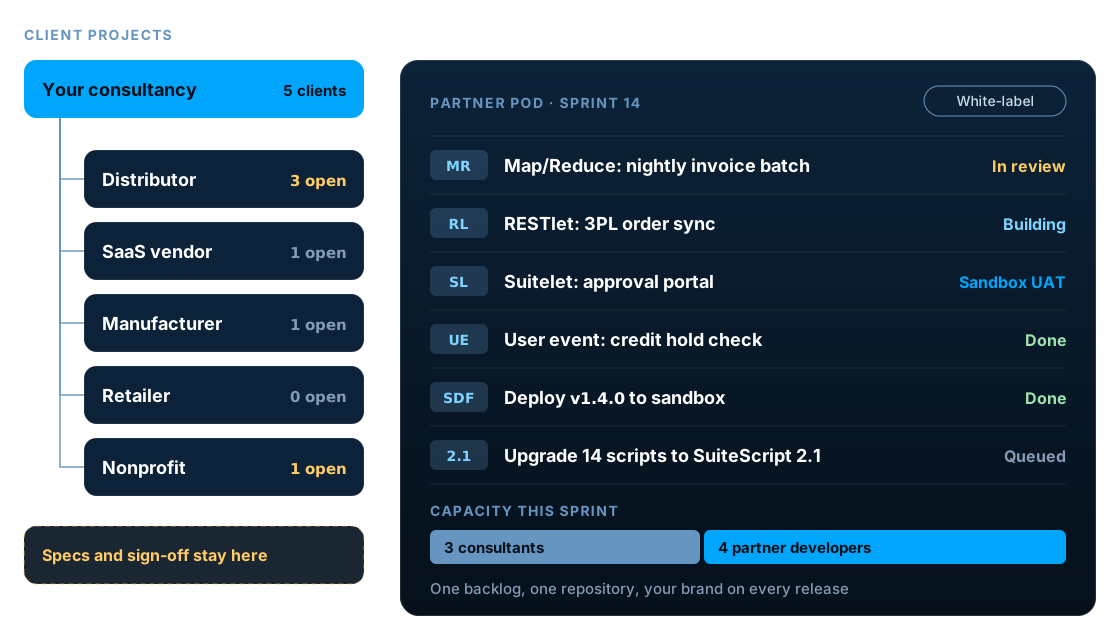
A NetSuite development partner is a specialist firm that builds SuiteScript, integrations and SDF deployments for another consultancy, usually under that consultancy's brand. It lets a NetSuite partner or accounting firm take on more technical work without hiring ahead of demand, while it keeps the client relationship, solution design and sign-off. The model works when specs, accounts, code ownership and review are agreed up front.
Key facts
- Oracle's NetSuite partner ecosystem includes Solution Providers, Alliance Partners and SuiteCloud Developer Network members, each with a different role in selling, delivering or extending NetSuite.
- The SuiteCloud Development Framework (SDF) packages customizations as projects that can be kept in version control and deployed to sandbox and production accounts.
- Oracle says NetSuite development accounts never contain production data, which makes them the natural place for a subcontracted team to build.
- Oracle asks customers to move scripts to SuiteScript 2.1 by the 2028.2 release, which is adding technical work to many partners' backlogs.
- Oracle retired the SuiteCloud Developer II exam on February 28, 2023; developer skills are now certified through the Application Developer and Web Services Developer exams.
What is a NetSuite development partner?
A NetSuite development partner is a technical delivery firm that builds scripts, integrations and deployments for another NetSuite consultancy. It supplies developers and engineering process, while the consultancy keeps the client, the design and the final say on what goes live.
The term covers a spectrum. At one end is white-label delivery, where the partner's developers work entirely behind your brand and the client never deals with them. At the other is staff augmentation, where individual developers join your team and you manage them day to day. Between them sits co-delivery, where two firms split a project by workstream and both are visible to the client.
Oracle's partner ecosystem already separates roles. Solution Providers sell and deliver NetSuite, Alliance Partners provide consulting, integration and implementation services alongside Oracle's own sales team, and SuiteCloud Developer Network members build applications that extend the suite. A development partner is a different arrangement again: a commercial relationship between two service firms, in which one buys technical capacity from the other.
When should a consulting firm use a NetSuite development partner?
Use one when technical demand is outrunning the developers you have, and hiring would either take too long or leave you with idle people between projects. These are the usual signs:
- Signed projects wait weeks for a developer to free up
- Functional consultants are writing scripts they shouldn't
- You turn down integration-heavy deals
- SuiteScript 1.0 and 2.0 upgrades are piling up
- One senior developer is a single point of failure
- Support tickets with code changes miss their SLAs
Demand for NetSuite technical work is uneven. A firm may need four developers during a run of integration-heavy go-lives and one the quarter after. Permanent hiring suits a steady baseline. A development partner suits the peaks above it, and the specialist skills, such as complex integrations or SuiteApp packaging, that you need occasionally but not every week.
The SuiteScript 2.1 deadline is adding to the pressure. Oracle asks customers to update scripts that use SuiteScript 1.0, or the 2.0 and 2.x version annotations, to SuiteScript 2.1 by the 2028.2 release. For a partner with dozens of clients, that is a large block of technical work with a fixed date, on top of normal project demand.
White-label, co-delivery or staff augmentation: which model fits?
Choose white-label for steady overflow, co-delivery when a large project has a separable technical stream, and staff augmentation for short peaks where you already have strong technical leads. The difference is who manages the work and who answers for its quality.
| Area | White-label delivery | Co-delivery | Staff augmentation |
|---|---|---|---|
| Who the client sees | Only your firm; the partner works under your brand | Both firms, with defined roles | Your firm; individuals join your team |
| Who manages the work | The partner's lead, reporting to your project manager | Each firm manages its own scope | Your project manager directly |
| Unit of delivery | Tickets or work packages with acceptance criteria | A defined workstream, such as integrations | Hours or days of named people |
| Quality accountability | Partner for code; you for the solution | Each firm for its workstream | Your firm for everything |
| Best for | Steady overflow and support backlogs | Large projects with a separable technical stream | Short peaks where you have strong technical leads |
Many firms end up with a mix: a white-label pod handling a steady flow of support and enhancement tickets, plus co-delivery for the occasional large integration project. Whatever the model, decide it explicitly. Most friction in these relationships comes from each side assuming a different one.
What work can you hand to a NetSuite development partner?
Hand over work that is technical, can be specified in writing and can be tested against clear acceptance criteria. That covers most of what slows a functional team down.
SuiteScript 2.1 development
User event, client, scheduled, Map/Reduce and Suitelet scripts written to a functional spec, with governance usage and error handling designed in from the start.
Integrations
RESTlets, SuiteTalk REST and SOAP web services and middleware flows that connect NetSuite to e-commerce, 3PL, banking, payroll and CRM systems.
Script upgrades
Moving SuiteScript 1.0 and 2.0 scripts to 2.1 ahead of Oracle's 2028.2 deadline, including regression testing in a sandbox.
SDF packaging and deployment
Turning account customizations into SDF projects with a deploy file, version control and a repeatable route from development to sandbox to production.
Advanced forms and reports
Advanced PDF/HTML templates, complex saved searches and SuiteQL queries that functional consultants specify but rarely have time to build.
Data migration tooling
Scripts and CSV import templates for cleansing, transforming and loading data, plus reconciliation reports to prove the load.
SuiteApp and bundle work
Packaging repeatable IP, or converting legacy bundles into SuiteApp projects, when you have an SDN publisher ID.
Post-go-live code support
Fixing defects, tuning slow scripts and handling release-related breakages for your managed services clients.
If you are deciding whether a requirement needs code at all, our guide to when to customize NetSuite with SuiteScript covers the trade-offs, and our NetSuite integration services page describes the connectors we build most often.
What should stay with your firm?
Keep everything that defines the client relationship and the solution. A development partner builds what you design; it should not be deciding what the client needs.
- The client relationship, commercial terms and escalation
- Requirements, process design and the solution blueprint
- Functional configuration that the client's team will maintain
- User acceptance testing with the client and go-live sign-off
- Production change approval and release timing
- Training and the client-facing handover
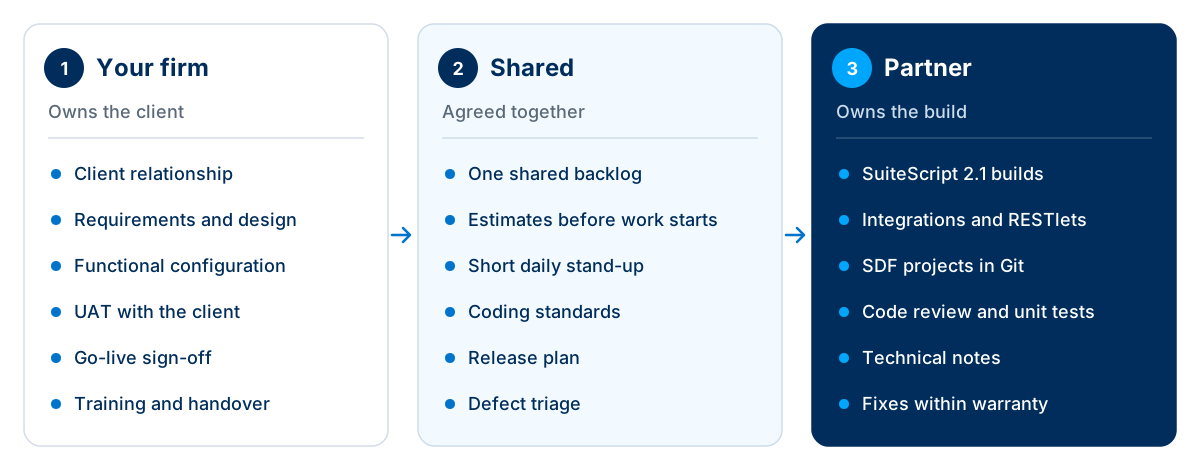
The shared column is where engagements succeed or fail. A joint backlog, agreed estimates before work starts and a short daily stand-up keep both teams working from the same picture, without your consultants having to manage individual developers.
How does a NetSuite delivery partnership work, step by step?
Each piece of work moves from a written spec to a production release through the same six steps, and your firm controls the first and the last.
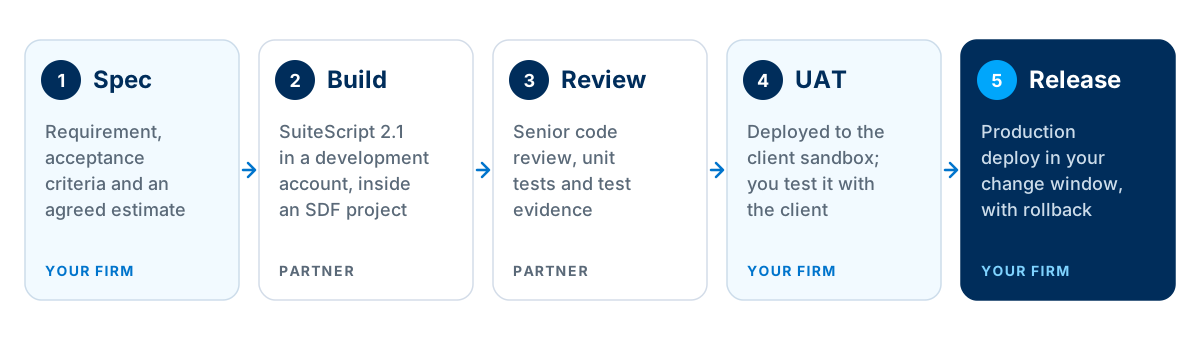
Write a buildable spec
Your consultant writes the requirement, the record types and fields involved, the trigger, the expected outcome and the acceptance criteria. A ticket the developer can't test is not ready.
Estimate and agree the slot
The partner returns an estimate, assumptions and questions within an agreed time. You approve it before work starts, so scope and cost stay visible to you.
Build in a development account
The partner builds in a development account or a dedicated sandbox, inside an SDF project held in a repository both firms can see.
Review and unit test
A senior developer reviews the code against your standards, governance limits and naming rules, and the build ships with test evidence.
Deploy to sandbox for UAT
The SDF project is deployed to the client's sandbox. Your consultant runs functional testing with the client, and defects go back to the same developer.
Release under your change control
Production deployment happens in an agreed window, with your approval, a rollback plan and technical notes for your support team.
Accounts, SDF and code ownership
Build outside production, package every change as an SDF project, and keep the repository where your firm can always reach it. Those three rules make subcontracted code reviewable, repeatable and recoverable.
Where the partner builds
Oracle describes NetSuite development accounts as isolated from production and says they never contain production data, so a refresh cannot overwrite work in progress. Oracle also warns that a development account is not a sandbox: invoices can be created and email sent from it, so only test data belongs there. Sandboxes are for integration and user acceptance testing before anything reaches production.
How the code is packaged
The SuiteCloud Development Framework lets developers build customizations outside the NetSuite UI and deploy them as SuiteCloud projects. Account customization projects are meant for accounts you own, such as production, development and sandbox accounts, and need no publisher ID. SuiteApp projects are for SuiteCloud Developer Network members and need one. Oracle caps a project at 50 MB when it is zipped for deployment.
For client work, an account customization project in a Git repository is the default. It gives your firm a history of every change, makes code review practical and lets another developer, inside or outside your firm, pick up the work later.
Access is the main risk. Give each developer a named user in each client account, with a role limited to the work, two-factor authentication on and an end date. Never share your own consultants' logins, and check your client contracts for subcontracting and data access clauses before anyone from a partner logs in.
How to vet a NetSuite development partner
Judge a development partner on its people, its engineering process and a small paid trial, in that order. Brochures and logos tell you little about the code you will put your name on.
| Check | What good looks like |
|---|---|
| Certified developers | Named people holding the SuiteCloud Developer certification, or the Application Developer and Web Services Developer exams |
| Code samples | Anonymized scripts that show SuiteScript 2.1 syntax, governance handling, logging and comments |
| SDF and source control | Every build delivered as an SDF project in a Git repository, not edited in the File Cabinet |
| Review process | A second developer reviews every change before it reaches your sandbox |
| Time-zone overlap | At least two or three working hours of overlap with your project team for stand-ups and questions |
| Security practice | Named users per developer, least-privilege roles, two-factor authentication and no shared logins |
| Trial project | A small paid ticket before any volume commitment, judged on the code and the communication |
On certification, note that Oracle retired the SuiteCloud Developer II exam on February 28, 2023 and replaced it with two standalone exams: Application Developer, which covers SuiteScript 2.1 and SDF, and Web Services Developer, which covers SuiteTalk SOAP and REST. Full SuiteCloud Developer certification now needs both, plus SuiteFoundation. Developers certified under the old exam keep their credential, so expect to see both on a good partner's team.
Certification shows a baseline. The code sample and the trial show the rest: whether the developer handles governance usage, logs sensibly, avoids hard-coded internal IDs and asks the right questions about a vague spec.
What should a NetSuite subcontracting agreement cover?
The agreement should protect your client relationship, settle who owns the code and make sure you can walk away with everything you need. These six clauses do most of that work.
Confidentiality and white-label
The partner never contacts your client directly unless you allow it, and its name stays out of client deliverables, emails and code headers.
Non-solicitation
Neither firm hires the other's staff or approaches the other's clients for an agreed period after the engagement.
Intellectual property
Code written for a client is assigned to you or the client on payment. Any reusable library the partner brings is licensed, not transferred, and is listed.
Data protection
A data processing agreement covers access to client accounts, where data may be viewed from, and what happens to credentials when the work ends.
Warranty and defects
A defect window after go-live during which the partner fixes its own bugs at no charge, with response times that support your client SLAs.
Exit and handover
Repositories, documentation and account access come back to you in an agreed format if the relationship ends.
Have your own legal adviser review the terms, particularly the data processing agreement if client accounts hold personal data from more than one country. The commercial clauses are standard; the data clauses depend on where your clients and the partner's developers are.
How are NetSuite development partners priced?
Development partners usually charge by time and materials, by fixed-price work package or by a monthly retainer for a set amount of capacity. Rates vary widely with location, seniority and commitment, so compare proposals on total cost per delivered ticket rather than on the day rate alone.
| Model | How it works | Fits best |
|---|---|---|
| Time and materials | Hourly or daily rates against an estimate | Unclear or changing requirements, support work |
| Fixed price per work package | An agreed price for a specified ticket or integration | Well-specified builds you can resell at a fixed fee |
| Monthly retainer or pod | A set number of developer days or a named team each month | Steady overflow and managed services backlogs |
| Hybrid | A retainer for capacity, with larger builds quoted separately | Firms with both a support book and new projects |
Your margin depends less on the partner's rate than on rework. A cheaper developer who needs three review rounds and a second UAT cycle costs more than a senior one who gets it right first time. Track estimate accuracy and defects per ticket for the first few months, and you will know what the partner really costs.
For the client-side budget these builds sit inside, see our NetSuite implementation cost calculator.
What goes wrong with NetSuite development partners in practice?
In delivery partnerships we've run, problems rarely come from the code itself. They come from specs, environments and ownership that nobody agreed up front.
- Thin specifications
- Most rework we see traces back to a ticket that described the outcome but not the records, fields and edge cases. Spend the hour on the spec.
- Building in production
- Quick fixes made directly in a client's production account skip review and leave no trail. Every change should go through a project and a sandbox.
- No coding standards
- Two firms writing code for one client in two styles makes support harder. Share your standards on day one, or adopt the partner's.
- Treating review as optional
- Code review is the step that catches governance limits, hard-coded internal IDs and missing error handling before the client does.
- Unclear ownership of defects
- Agree who fixes what after go-live, and how quickly, before the first release, not during the first incident.
- Committing volume too early
- Start with one or two tickets, then grow. A trial shows how the partner communicates, which matters as much as the code.
What to check first
Before the first ticket, confirm three things: that the partner can log in to a development account or sandbox for the client with a named user, that a shared repository exists with your coding standards in it, and that one person on each side owns the backlog. Most early delays trace back to one of these.
If an engagement has already gone wrong and a client project is behind, our NetSuite project recovery service starts with an audit of the code and configuration before anything else changes.
Frequently asked questions
What is the difference between a NetSuite development partner and a NetSuite implementation partner?
An implementation partner sells and runs the full project for the end customer: design, configuration, data, training and go-live. A development partner focuses on the technical build, such as scripts, integrations and deployments, and often works for the implementation partner rather than the end customer.
Is white-label NetSuite development allowed by Oracle?
Subcontracting technical work is a commercial arrangement between two firms, and many NetSuite partners use it. Check your own partner agreement with Oracle and your client contracts for any subcontracting or data access clauses, and make sure every developer uses a named NetSuite login under the client's control.
Does a NetSuite development partner need to be an Oracle partner itself?
Not necessarily. What matters is that its developers are skilled and certified and that it follows sound delivery practice. Membership of the SuiteCloud Developer Network is needed if it publishes SuiteApps with its own publisher ID, which a partner building client-specific customizations usually does not.
How quickly can a development partner start?
With an agreement in place, a first ticket can usually start within days. The slower part is set-up: contracts, NetSuite user access in each client account, repository access and agreeing coding standards. Do that once, before you have an urgent ticket.
Can a development partner work in my clients' accounts securely?
Yes, if each developer has a named user with a role limited to what the work needs, two-factor authentication is on, and access is removed when the work ends. Build in development accounts or sandboxes, and keep production deployment under your approval.
Who owns the code a white-label partner writes?
Whoever the contract says. The usual arrangement is that client-specific code is assigned to your firm or the client once paid for, while any reusable framework the partner brings remains its property and is licensed for use. Put this in writing before work starts.
What time-zone setup works best for an offshore NetSuite development partner?
A few hours of daily overlap is enough for a stand-up and quick questions, and the rest of the time difference can work in your favor: specs written in your afternoon can be built overnight and ready for review the next morning.
How do I keep quality consistent across several clients?
Use one set of coding standards, one review checklist and one repository structure for every client, and ask the partner to keep the same developers on the same clients. Consistent people and conventions matter more than any single tool.
Can a development partner help with the SuiteScript 2.1 deadline?
Yes. Script upgrades are well suited to a partner because they are technical, repeatable and easy to test against the existing behavior. Oracle asks customers to move SuiteScript 1.0 and 2.0 scripts to 2.1 by the 2028.2 release, so many firms are batching this work now.
What should a first trial project with a NetSuite development partner look like?
Choose a real, contained ticket, such as a user event script or a small RESTlet, with a written spec and acceptance criteria. Judge the questions the partner asks, the estimate, the code, the test evidence and how it handles your review comments.
Add NetSuite development capacity to your firm
LST Consultancy works as a white-label NetSuite development partner for consulting firms: certified developers building SuiteScript 2.1, integrations and SDF deployments to your specs, reviewed before they reach your client's sandbox. Start with a single trial ticket.
Sources
- Oracle NetSuite Help: SuiteCloud Development Framework
- Oracle NetSuite Help: SuiteCloud Project Types
- Oracle NetSuite Help: The Development Account
- Oracle NetSuite Help: Enabling SuiteScript 2.1 at the Account Level
- Oracle NetSuite: Certification Program Announcements
- Oracle NetSuite: Become a NetSuite Partner
Related reading
NetSuite SuiteScript: When to Customise Your ERP and When to Use Standard Features
NetSuite SuiteScript 2.1 Migration: What You Need to Know Before 2028.2
NetSuite Integration Guide: Connecting Your ERP with E-commerce, CRM and Business Systems
NetSuite Support and Maintenance: What to Do After Go-Live