
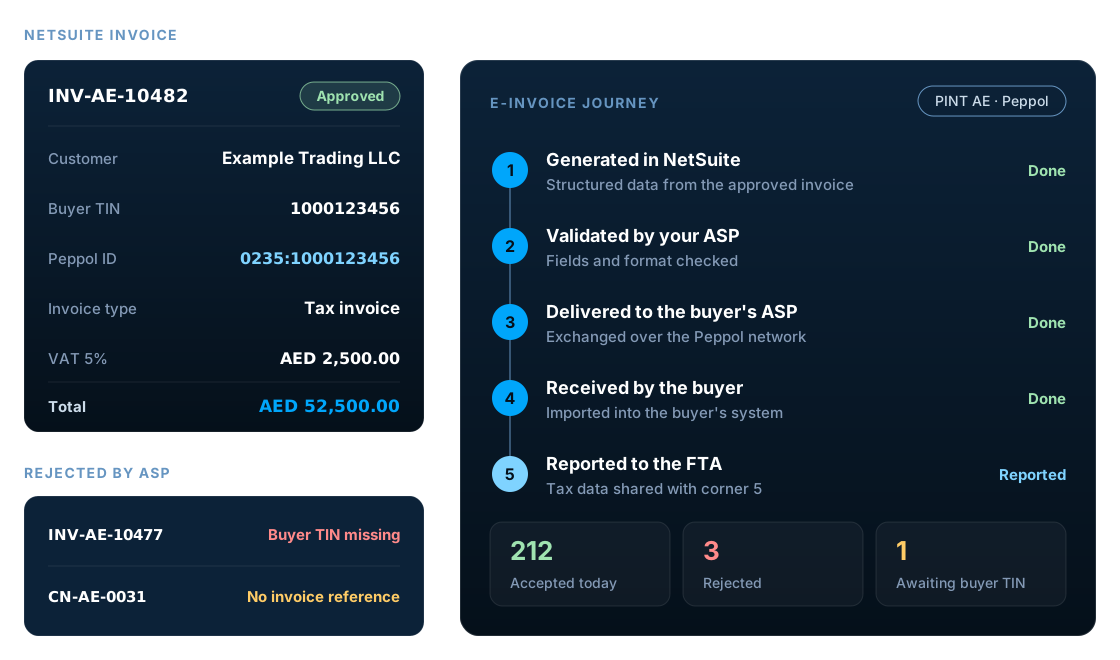
Quick answer
UAE e-invoicing requires in-scope businesses to exchange B2B and B2G invoices as structured PINT AE data through an Accredited Service Provider (ASP), which reports them to the Federal Tax Authority. Businesses with revenue of AED 50 million or more go live on 1 January 2027, others on 1 July 2027. In NetSuite, the usual route is an ASP connector fed by clean customer, item and tax data.
Key facts
- Businesses with annual revenue of AED 50 million or more had to appoint an ASP by 30 October 2026 and must go live on 1 January 2027, under Ministerial Decision No. 66 of 2026.
- Businesses below AED 50 million must appoint an ASP by 31 March 2027 and go live on 1 July 2027. In-scope government entities go live on 1 October 2027.
- The system uses a Peppol-based five-corner model and the UAE's PINT AE specification, with the Federal Tax Authority receiving tax data as the fifth corner.
- Your e-invoicing identifier is your TIN, the first 10 digits of your Corporate Tax registration number, and your Peppol participant ID is 0235 followed by that TIN.
- Under Cabinet Decision No. 173 of 2026, failing to implement on time costs AED 5,000 plus AED 5,000 for each further month, capped at AED 50,000 in any 12 months.
What is UAE e-invoicing?
UAE e-invoicing is the national system under which businesses issue and receive invoices as structured electronic data, exchanged through Accredited Service Providers on a Peppol-based network, with tax data reported to the Federal Tax Authority. A PDF sent by email is not an e-invoice under this system.
The Ministry of Finance sets the rules and the Federal Tax Authority (FTA) receives the data. The legal framework sits in Ministerial Decisions No. 243 and No. 244 of 2025, which define who is in scope and when each group must comply, with later amendments to the timetable and a separate Cabinet Decision on penalties.
For a finance team on NetSuite, the practical change is simple to describe and harder to deliver. Every in-scope invoice and credit note must leave NetSuite as complete, valid data that your service provider can convert and send within the rules, and every supplier e-invoice must arrive in NetSuite without retyping.
When is e-invoicing mandatory in the UAE?
Mandatory e-invoicing starts on 1 January 2027 for the largest businesses and is phased in through 2027. As of November 2026, these are the dates under Ministerial Decision No. 244 of 2025, as amended by Ministerial Decision No. 66 of 2026:
| Who | Appoint an ASP by | Mandatory from |
|---|---|---|
| Annual revenue of AED 50 million or more | 30 October 2026 | 1 January 2027 |
| Annual revenue below AED 50 million | 31 March 2027 | 1 July 2027 |
| In-scope government entities | 31 March 2027 | 1 October 2027 |
The original ASP deadline for large businesses was 31 July 2026. In May 2026 the Ministry moved it to 30 October 2026 after assessing market readiness, but it kept the 1 January 2027 go-live. A pilot phase began in July 2026.
For a NetSuite project, the date that matters is not the go-live itself but the date your ASP integration must be tested and signed off, which is several weeks earlier. If you are in the first phase and have not started, the build, testing and data clean-up now share a window of a few weeks.
For the wider picture of how the timetable fits into ERP planning, see our guide to ERP implementation in the UAE and GCC.
Which businesses and transactions are in scope?
Every business conducting B2B or B2G transactions in the UAE is in scope unless a specific exclusion applies. That includes businesses that are not VAT-registered, because commercial invoices are covered as well as tax invoices.
In scope
B2B and B2G sales by businesses in the UAE, including non-resident businesses with UAE transactions. Transactions between members of the same VAT group are in scope too, with a 24-month grace period from 1 January 2027 under the Ministry's guidelines.
Excluded or deferred
B2C transactions, until further notice. Government entities acting in a sovereign capacity, certain international airline passenger services and certain exempt financial services are also excluded, although excluded businesses may join voluntarily.
In NetSuite terms, you need to be able to tell an in-scope invoice from an out-of-scope one on every transaction. A retailer that sells to consumers and to trade customers, for example, will e-invoice its trade sales and not its consumer sales, so the customer record or the transaction form must carry that distinction.
How does the UAE five-corner e-invoicing model work?
The UAE uses a decentralised five-corner model on the Peppol network. You never send an invoice straight to your customer or to the FTA: your ASP sends it to your customer's ASP, and both providers report the tax data to the FTA.
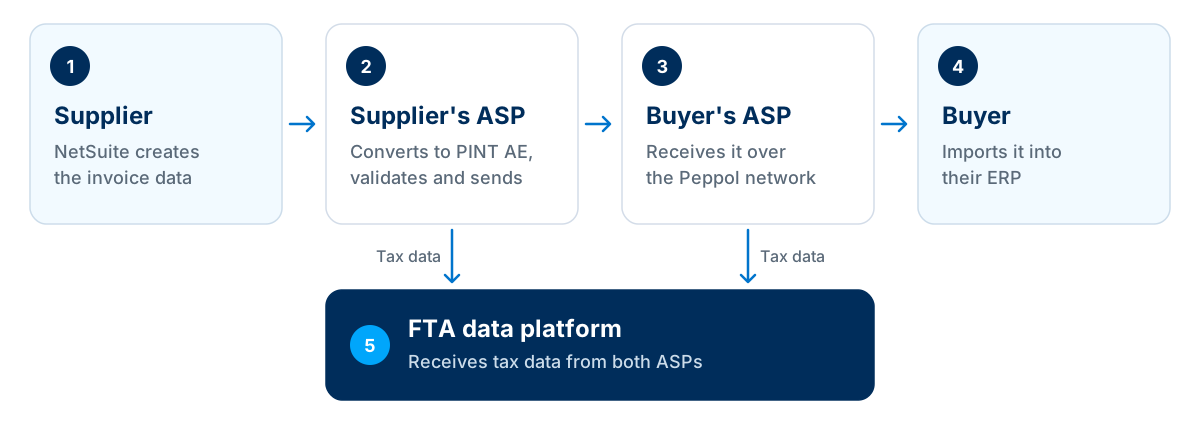
The format on the network is PINT AE, the UAE's national version of the Peppol PINT invoice specification. The Ministry of Finance publishes the mandatory fields for tax invoices and commercial invoices; the current version, V1.1, is dated 28 October 2026. Your ASP handles the conversion, but it can only convert the data NetSuite gives it.
Each business is identified by its TIN, the first 10 digits of its Corporate Tax registration number. Its Peppol participant ID is 0235 followed by that TIN, and that is the address your ASP uses to reach a customer. Each member of a tax group uses its own TIN, not the representative member's.
What changes for businesses running NetSuite?
NetSuite keeps doing what it does today: sales orders, invoices, credit memos and vendor bills. What changes is the data each record must carry and what happens to it after approval.
The invoice becomes data
The e-invoice is the structured file your ASP exchanges, not the PDF NetSuite prints. You can still send a PDF to the customer for convenience, but it no longer stands in for the e-invoice.
Every customer needs an identifier
Each business customer's TIN, and the Peppol participant ID built from it, must be on the customer record before you can address an e-invoice to them.
Credit notes follow the same route
Credit memos must go out as electronic credit notes that point back to the original invoice. Cabinet Decision No. 173 of 2026 fines a missed credit note the same as a missed invoice.
Supplier invoices arrive electronically
Your suppliers' e-invoices reach you through your own ASP. Accounts payable needs a way to turn them into vendor bills and credits instead of retyping PDFs.
Rejections need an owner
When the ASP's validation fails, the invoice comes back with an error. Someone has to fix the data in NetSuite and resend it, ideally the same day.
Master data changes reach the ASP
If your registered details change, your ASP must be told. Under Cabinet Decision No. 173 of 2026, failing to do so costs AED 250 a day, capped at AED 5,000 a month.
These changes sit on top of your existing VAT set-up, so it is worth checking that first; our page on VAT-compliant ERP in the UAE covers what a sound configuration looks like.
Does NetSuite support UAE e-invoicing?
NetSuite supports UAE e-invoicing through an integration with your ASP rather than as a ready-made country feature. Oracle's Electronic Invoicing SuiteApp provides a general framework for generating and receiving e-documents, but Oracle states that it does not include native support for country-specific requirements on its own.
The SuiteApp generates XML or JSON from supported transactions using templates you can build, sends them by email or through custom sending methods such as web services or scripts, and converts inbound XML into vendor bills, vendor credits or sales orders. As of November 2026 we found no Oracle-published UAE localisation for it, so check the SuiteApp marketplace and your ASP's offer before you design anything.
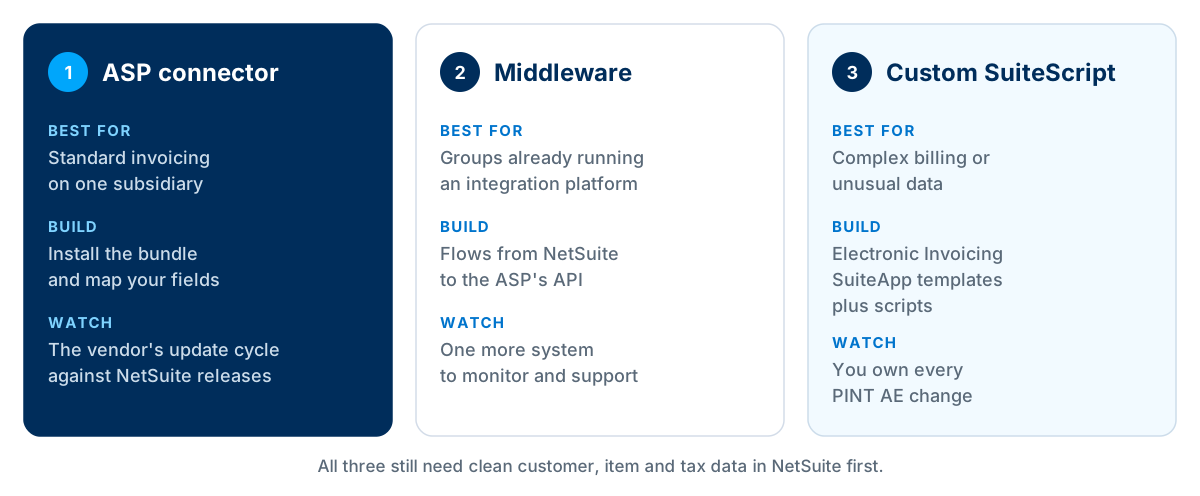
| Route | How it works | Best fit | What to watch |
|---|---|---|---|
| ASP connector or SuiteApp | The ASP supplies a bundle that reads approved NetSuite transactions, sends them for conversion and validation, and writes the status back. | Standard invoicing, one or a few subsidiaries, the fastest route to go-live | The vendor's release cycle and compatibility with each NetSuite release |
| Middleware or integration platform | Your existing integration layer maps NetSuite records to the ASP's API and handles retries, logging and status updates. | Groups already running middleware for banks, EDI or e-commerce | Another system to monitor, license and support |
| Electronic Invoicing SuiteApp with custom work | Oracle's SuiteApp generates XML or JSON from templates you build, and a custom sending method or script passes it to the ASP. | Complex billing, heavy customisation or unusual transaction types | You maintain the PINT AE mapping each time the specification changes |
Whichever route you choose, treat it as an integration project with monitoring and error handling, not a form change. Our NetSuite integration services team builds and supports these connections, and the NetSuite integration guide explains the underlying options.
Which NetSuite data needs fixing before go-live?
Most rejected e-invoices fail on data, not on the connection. Before mapping anything, check that each piece of information the e-invoice draws on exists in NetSuite, in one place, for every in-scope customer and transaction.
| Data the e-invoice needs | Where it usually lives in NetSuite |
|---|---|
| Your TIN and TRN | Subsidiary record (or company information in a single-entity account) and its tax registrations |
| Buyer TIN and Peppol participant ID | Customer record, usually in custom fields or the entity's tax registration |
| Buyer TRN | Customer tax registration. Needed on tax invoices; the Ministry says it is not mandatory on commercial invoices or exempt and out-of-scope supplies |
| Invoice type | Transaction form or a custom field that distinguishes tax invoices from commercial invoices |
| VAT treatment per line | Tax codes on item and expense lines, which must map cleanly to the UAE VAT categories |
| Item description, quantity and price | Item lines and the item record |
| Currency and AED amounts | Transaction currency, exchange rate and base-currency amounts |
| Original invoice on a credit note | The credit memo's created-from link, which must be populated rather than typed into a memo field |
Treat this table as a starting checklist, not the full specification. The Ministry's mandatory fields document lists every required element and its rules, and your ASP will confirm which of them it derives automatically and which it expects from you.
If you are unsure how clean your account is, a free NetSuite health check is a quick way to find duplicate customers, inconsistent tax codes and unused forms before they turn into rejections.
How to get NetSuite ready for UAE e-invoicing
Work through these steps in order. Data and decisions come first, the build comes after.
Confirm your phase
Work out your revenue band, your ASP deadline and your go-live date for every UAE legal entity. If you are in the first phase and have not appointed an ASP, do it now.
Appoint an accredited ASP
Choose from the Ministry's list of approved providers. Ask how they connect to NetSuite, whether they handle inbound invoices, and how they support several entities in one account.
Get a TIN for every entity
Your TIN is the first 10 digits of your Corporate Tax registration number. An entity that is not registered for Corporate Tax must register with the FTA to receive one.
Clean customer and vendor data
Collect TINs from business customers, fix legal names and addresses, and close duplicate records. This usually takes longer than the technical build.
Map NetSuite to PINT AE
Work through the Ministry's mandatory fields document with your ASP and agree where each field comes from in NetSuite, including defaults and exceptions.
Design the inbound flow
Decide how supplier e-invoices become vendor bills and credits, how they are matched to purchase orders and who approves them.
Test end to end in a sandbox
Run invoices, credit notes, foreign-currency sales, zero-rated and exempt lines, and deliberate errors through the ASP's test environment.
Cut over with monitoring
Agree the first transaction date, switch numbering and forms, and set up a daily rejections queue with a named owner before go-live.
If e-invoicing is part of a wider change, such as a new subsidiary or a move onto NetSuite, plan it inside the main project; our NetSuite implementation services cover both.
How does e-invoicing work for NetSuite OneWorld groups and VAT groups?
In a OneWorld account, each UAE legal entity is a separate e-invoicing participant with its own TIN, its own Peppol participant ID and its own phase, based on its revenue. A group can therefore have one subsidiary going live in January 2027 and another in July 2027.
Store identifiers on each subsidiary, not in one company-wide field, and make sure your ASP and your connector can handle several senders from one NetSuite account. Check, too, how intercompany invoices between UAE subsidiaries will be issued, because they are business transactions like any other.
Members of a VAT group each use their own TIN. Transactions between members of the same VAT group are in scope, but the Ministry's guidelines give them a 24-month grace period from 1 January 2027, which buys time for intercompany flows without removing the need to plan them.
For how subsidiaries, intercompany and consolidation work in NetSuite generally, see our guide to NetSuite OneWorld, and for finance process design, our NetSuite financial management services.
What are the UAE e-invoicing penalties?
Cabinet Decision No. 173 of 2026, announced in October 2026, sets the current UAE e-invoicing penalties and replaces Cabinet Decision No. 106 of 2025. The main fines are:
| Violation | Penalty |
|---|---|
| Failing to implement e-invoicing by your deadline, including not appointing an ASP | AED 5,000, then AED 5,000 for each month or part month it continues, capped at AED 50,000 in any 12 consecutive months |
| Failing to issue and transmit an e-invoice | AED 100 per invoice, up to AED 5,000 per calendar month |
| Failing to issue and transmit an electronic credit note | AED 100 per credit note, up to AED 5,000 per calendar month |
| Failing to notify your ASP of changes to your data | AED 250 per day, up to AED 5,000 per calendar month |
The new decision also removed the earlier penalty for failing to notify the authority of a system failure, made it explicit that buyers who stop meeting their obligations as recipients can be penalised, and applies only one penalty where the same business is both issuer and recipient for the same violation. The guidelines state that penalties apply only from the date a business is required to implement.
Rules and dates can change. This article reflects the Ministry of Finance publications as of November 2026 and is not tax advice. Confirm your scope, phase and obligations with your tax adviser, and check the Ministry's latest decisions and guidelines before you finalise your plan.
What goes wrong in NetSuite e-invoicing projects?
In implementations we've run, the connector is rarely what delays go-live. The delays come from customer data nobody owned, credit memo habits nobody questioned and an accounts payable team that was not in the room.
- Starting with the connector
- The connector is the easy part. Missing TINs, inconsistent tax codes and duplicate customers are what cause rejections, so clean the data first.
- Credit memos as an afterthought
- Credit memos created without a link to the original invoice are a common cause of rejections. Fix the process that creates them, not just the template.
- Forgetting accounts payable
- Teams focus on sales invoices and only discover at go-live that supplier e-invoices are arriving with nowhere to go.
- One TIN field for a whole group
- In a OneWorld account each UAE subsidiary has its own TIN and its own e-invoicing obligations. Store identifiers per subsidiary.
- Nobody owns rejections
- A rejected invoice that sits in a queue for a week is an invoice that was not issued on time. Name an owner and a daily routine.
- Testing only the happy path
- Test the awkward cases: foreign currency, mixed VAT lines, partial credits, edited invoices and a customer with no TIN.
What to check first
Run a saved search of active business customers without a TIN, a list of tax codes used in the last twelve months, and a count of credit memos created without a source invoice. Those three numbers tell you more about your readiness than any vendor demo, and they show where the clean-up effort will go.
The trade-off between routes is mostly about who maintains the mapping. A connector moves that work to the vendor but ties you to its release schedule; a custom build gives you control but makes every PINT AE update your job. For most single-entity accounts with standard billing, the connector is the pragmatic choice.
If you want a second opinion on your plan, book a NetSuite consultation with our team.
Frequently asked questions
Is a PDF invoice still valid under UAE e-invoicing?
Not as the e-invoice. For in-scope transactions, the e-invoice is the structured PINT AE file exchanged through Accredited Service Providers and reported to the Federal Tax Authority. You can still send a PDF copy to your customer for convenience, but sending only a PDF does not meet the requirement.
What is PINT AE?
PINT AE is the UAE's national version of Peppol PINT, the international invoice specification used on the Peppol network. It defines the structure and fields of a UAE e-invoice. The Ministry of Finance publishes the mandatory fields aligned with PINT AE, and your ASP converts your NetSuite data into that format.
What is an Accredited Service Provider in UAE e-invoicing?
An Accredited Service Provider (ASP) is a company approved by the UAE authorities to validate, exchange and report e-invoices on behalf of businesses. Every in-scope business must appoint one. Your ASP is corner 2 when you send invoices and corner 3 when you receive them.
Can NetSuite send e-invoices directly to the FTA?
No. The UAE uses a five-corner model in which businesses exchange e-invoices through their Accredited Service Providers, and the providers report the tax data to the Federal Tax Authority. NetSuite connects to your ASP, not to the FTA.
What is a TIN in UAE e-invoicing?
Your TIN is the first 10 digits of your Corporate Tax registration number. It identifies your business in the e-invoicing system, and your Peppol participant ID is 0235 followed by the TIN. Each member of a tax group uses its own TIN, not the representative member's.
Do I need e-invoicing if my business is not registered for VAT?
Possibly. The mandate covers B2B and B2G transactions, not only VAT-registered businesses, and commercial invoices are part of the system. The Ministry's field rules say a TRN is not mandatory on commercial invoices, but you still need a TIN. Confirm your position with your tax adviser.
What happens when the ASP rejects an invoice from NetSuite?
The ASP returns the invoice with a validation error, such as a missing buyer TIN or an invalid VAT category. You correct the data in NetSuite and resend it. Rejections need fast handling, because an invoice that is not issued and transmitted on time can attract a penalty of AED 100.
How long does a NetSuite e-invoicing project take?
It depends far more on your data than on the connector. A single entity with clean customer and tax data and standard invoicing can usually be ready in weeks. Groups with several subsidiaries, custom billing, many credit notes or poor master data should plan for longer and start immediately.
Will the UAE e-invoicing timeline change again?
It has changed once already: Ministerial Decision No. 66 of 2026 moved the large-business ASP deadline from 31 July to 30 October 2026, while keeping the 1 January 2027 go-live. Plan against the current dates and check the Ministry of Finance's announcements regularly.
What does UAE e-invoicing cost for a NetSuite user?
There is no official price. Costs usually include the ASP's subscription or per-document fees, any connector or middleware licence, data clean-up, mapping and testing effort, and ongoing support. Ask ASPs for pricing based on your monthly invoice and credit note volumes in both directions.
Get your NetSuite account ready for UAE e-invoicing
LST Consultancy's certified NetSuite consultants review your master data, map your transactions to PINT AE with your chosen ASP, build and test the integration, and set up rejection handling before your go-live date. We work alongside your tax advisers on scope questions.
Sources
- UAE Ministry of Finance: Ministerial Decision No. 66 of 2026 amending the eInvoicing implementation timeline
- UAE Ministry of Finance: Cabinet Decision No. 173 of 2026 on eInvoicing violations and administrative penalties
- UAE Ministry of Finance: UAE Electronic Invoice Mandatory Fields, V1.1 (28 October 2026)
- UAE Ministry of Finance: UAE Electronic Invoicing Guidelines
- KPMG: UAE phased implementation of e-invoicing beginning January 1, 2027 (July 2026)
- Oracle NetSuite Help: Electronic Invoicing Overview