

- February 19, 2026
- Nilesh Sanura
- 0
ERPNext Implementation: Step-by-Step Process, Cost & Timeline
In the fast-paced world of business today, companies need to find ways to reduce time and improve the quality of their outputs. And one of the solutions that makes a real difference is ERP (Enterprise Resource Planning) software. There are many great ERP solutions to choose from, but if you want to avoid hefty licensing costs and rigid schemes, an open-source alternative could work for your business. ERPNext Implementation is a gamechanger for your business operations, whether you are a small-scale or a large enterprise. With us at LST Consultancy, you are in professional hands, with both implemented systems and the long-term success of ERPNext-using companies.
What is ERPNext?
Before we get ahead and discuss ERPNext Implementation, let’s know what ERPNext is. ERPNext is an open-source enterprise resource planning ERP software that targets the manufacturing, retail, distribution, trading, services, education, and not-for-profit sectors. This robust system combines all aspects of business – including accounting, sales, inventory, human resources, and project management into one platform.
With ERPNext, organizations can automate most of their processes, enabling better data management and control. Since it’s cloud-based software, the system can be accessed from anywhere, making it perfect for businesses with remote teams or those that need flexibility.
Why Choose ERPNext for Your Business?
There are many reasons businesses choose to implement ERPNext. Here’s a look at some of the benefits:
- Affordability: As an open-source software solution, ERPNext is available at no cost to end users, significantly reducing licensing costs. There are implementation costs, but, as with other things, Open-Source solutions like Linux and Apache are more cost-effective than proprietary ERPs.
- Customization: ERPNext can be customized to meet your specific business requirements. From tasks to pipelines, the system offers high flexibility.
- Ease of Use: The clean, well-designed user interface means users can ramp up quickly without being weighed down by extensive introductory training.
- Scalable: ERPNext is suitable for businesses of all sizes. Whether you are a one-person company or a multinational enterprise, ERPNext is scalable to your business requirements.
- Open Source: You own the code and can modify it to meet your needs.
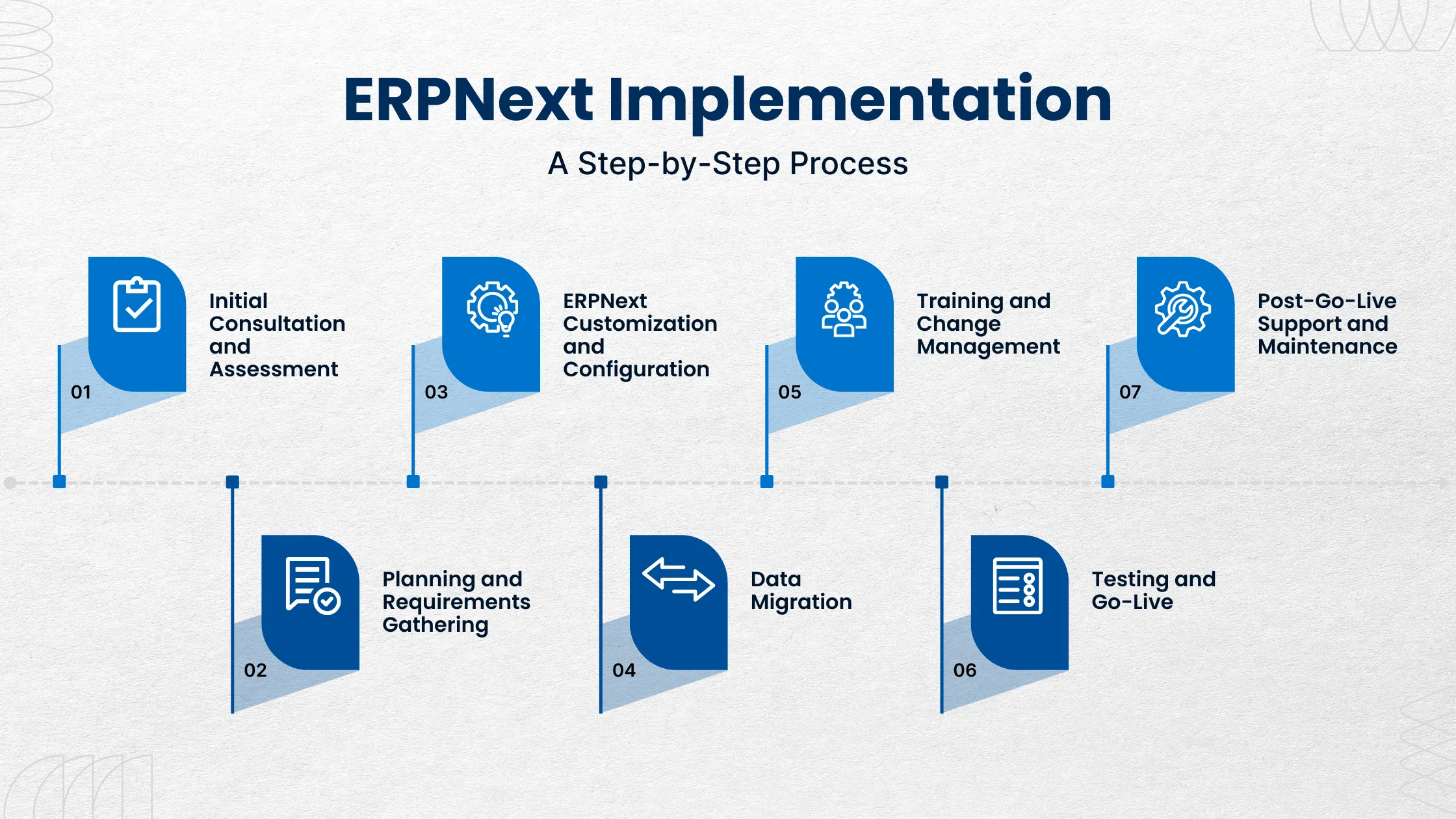
ERPNext Implementation: A Step-by-Step Process
The ERPNext implementation process has multiple phases to ensure the system is configured properly, customized to your specifications, and seamlessly integrated into your company’s operations. We adopt a best-practice approach at LST Consultancy to ensure our clients have a smooth implementation. The following are the typical stages of ERPNext Implementation. These are general steps we might follow during ERPNext Implementations.
1. Initial Consultation and Assessment
Ideally, during the first step of ERPNext Implementation, we organise a meeting to document your business requirements and objectives. We will review your current situation, problems, and what you are trying to achieve with our team at LST Consultancy. In this phase, we engage with your key stakeholders to map the processes and identify where ERPNext can deliver the most value.
We ask questions about their company’s operations and existing systems/processes to help us frame a solution that aligns well with operations.
2. Planning and Requirements Gathering
After we establish your needs, planning is next. This is the phase when we gather more detailed requirements and scope. We will also figure out which ERPNext modules you require for your business, such as accounting, inventory management, sales, or customer relationship management (CRM).
We will also define the project timeframes, key milestones, and the resources required for a successful ERPNext Implementation during this stage.
3. ERPNext Customization and Configuration
ERPNext is extremely customisable, so we can make it fit your business perfectly. At LST Consultancy, we have a dedicated team of ERPNext specialists who will integrate your system to complement and align with your existing processes.
Customization may involve adding custom fields, reports, and dashboards, or configuring integrations with other software your business is using.
4. Data Migration
Importing data from your current systems into ERPNext is a key aspect of the implementation process. At LST Consultancy, we implement a meticulous data migration plan so that all your data, including customer records, financial transactions, and stock levels, is migrated securely and precisely.
We are assisted in cleaning and preparing the data to replicate with your ERP Next system. We do full tests before moving.
5. Training and Change Management
The presence of trained staff is key to a successful ERPNext implementation. We provide in-depth training to all users, so everyone knows how to use the platform and its features successfully.
We also offer change management to help your team transition smoothly to a new system. This would involve identifying who was resisting the change and why, while also communicating the value of the new product.
6. Testing and Go-Live
It’s important to fully test the system before rolling it out and going live. Our team performs battery testing at the functional, integration, and performance levels to detect and address any issues.
When the system clears all tests, we go live, and the ERPNext system is in use.
7. Post-Go-Live Support and Maintenance
Even after ERPNext Implementation, the work doesn’t stop. At LST Consultancy, we support your ongoing needs to help you get the most out of ERPNext. This includes performance monitoring, diagnosing system issues, and upgrading and enhancing existing applications.
We can also provide maintenance to keep your ERPNext system up to date and secure.
ERPNext Implementation Cost: What to Expect
The cost of ERPNext implementation depends on factors such as the complexity of your business, the number of required modules, the level of customisation, and the size of your team. The average Implementation cost of ERPNext can range from $10,000 to $100,000, or even higher for large organisations.
Quality, affordable solutions for organizations of all sizes. At LST Consultancy, we support businesses of every size, which is why we offer flexible pricing to match your budget. We keep our pricing upfront and make sure you know exactly what you’re paying for every step of the way!
Factors Affecting ERPNext Implementation Costs:
- Requirements for Customization: The greater the degree of customization, the more expensive it is to implement. Specialization will require more resources to serve your specific business needs.
- Data Migration: The cost is influenced by the size and complexity of the migration. The migration could be slower, or even longer, if your company has much larger data.
- Training: It is an integral part of the ERPNext Implementation process to train your employees adequately. Training costs will be based on the required number of users and the level of support.
- Ongoing Support and Maintenance: After go-live, you will most certainly require support and maintenance. How much these costs will also depend on how much help you need.
ERPNext Implementation Timeline: How Long Does It Take?
The timeline for ERPNext Implementation can vary depending on factors such as the scope of your project and the complexity of your business processes. She says the process generally takes between 3 months and 6 months. Bigger, more complicated jobs could take longer.
Typical ERPNext Implementation Timeline:
- Initial Appointment and Planning 2-4 weeks.
- Customization and Configuration: 4-8 Weeks
- Data Migration: 2-4 weeks
- Training: 2-4 weeks
- Testing & Go-Live: 2-4 weeks
At LST Consultancy, we strive to simplify this and minimize the impact on your business. We closely coordinate with you to align the ERPNext implementation timeline with your business requirements and objectives.
Conclusion
The ERP Next Implementation process is complex and demanding; however, with the right approach, it can bring exponential change to your business. If you want to systematize operations, cut costs, or monitor real-time activity, ERPNext is the tool for you. At LST Consultancy, we can help you with your ERPNext implementation at every stage. Your Success is Our Success, and we will bring our years of experience, dedication, and bespoke approach to design your ERPNext system around what you really require for the success of your business.
When you are ready to install ERPNext and transform your business’s processes and operations, Contact LST Consultancy for professional ERPNext setup services.