

- January 30, 2026
- LST Consultancy
- 0
NetSuite EDI Integration: A Complete Guide for Businesses Looking to Automate B2B Transactions
In today’s hurried digital environment, companies never have enough time to move quickly and keep pace, as they need to process faster, minimize mistakes, and comply with trading partner criteria. But with purchase orders, invoices, and shipping documents managed manually, operations are now not only slow but also risky.
This is where NetSuite EDI Integration plays a vital role for businesses that are already managing their operations on NetSuite.
At LST Consultancy, we enable fast-growing and large businesses to simplify B2B data exchange with robust, scalable, & 100% automated EDI solutions on NetSuite. This blog post delves deeper into the concept, outlines its real-world benefits, and explains how the right integration partner can help transform EDI from a compliance mandate into a competitive weapon.
What is Electronic Data Interchange (EDI)?
Electronic Data Interchange (EDI) has driven B2B communication for many years. However, legacy EDI systems typically operate in isolation, leading to data silos and manual reconciliation. When your EDI is deeply embedded in your ERP, it becomes an automation advantage rather than an operational negative.
NetSuite EDI Integration is the mechanism by which predefined EDI documents are automatically transformed into NetSuite transactions and vice versa. This means that sales orders, invoices, shipping notices, and inventory updates are moving back and forth between your ERP system and your trading partners without the need for a human intermediary.
Key Business Benefits of NetSuite EDI Integration
Improved Operational Efficiency
With automated document exchange, time is saved by avoiding cumbersome tasks such as uploading files, validating data, or entering orders manually. Your teams can focus on value-driven pursuits rather than exception management.
Enhanced Data Accuracy
As a result, the chances of duplicate entries or discrepancies in pricing and quantities are significantly reduced when EDI data streams into your NetSuite. This minimizes conflicts and leads to better partner relations.
Faster Order Processing and Fulfilment
EDI orders are generated immediately in NetSuite, so that pick, pack, and ship can take place more quickly. This has a direct impact on customer satisfaction and on-time performance.
Scalability for Business Growth
As more operations are performed, manual effort doesn’t scale. A well-designed EDI integration will scale to high volumes without additional operational overhead.
Industries That Commonly Rely on NetSuite EDI Integration
While EDI applies to any industry, some industries use it more than others because of the need for compliance and volume:
- Manufacturing and industrial distribution
- Wholesale and B2B commerce
- Retail suppliers and vendors
- Logistics and third-party fulfilment providers
- High-volume eCommerce operations
If your trading partners require EDI, its proper integration with NetSuite is critical for future success.
Common EDI Transactions Automated Inside NetSuite
Strong integration must generally allow for a variety of transaction types, such as:
- Purchase Orders (850): Auto-Generate sales orders in NetSuite
- Order Acknowledgment (855): Confirm received and accepted
- Advance Shipping Notices (856): Share shipment information throughout the day
- Invoices (810): Ensure accurate billing and faster payments
- Inventory Advice (846): Share stock between partners
The automatic flows speed up processing, reduce errors, and provide end-to-end transparency.
Challenges Businesses Face Without the Right Integration Partner
Today, most organizations trying to address EDI do so with a combination of point solutions and subset integrations. This often leads to:
- Frequent EDI transaction failures
- Lack of insight into errors and acknowledgements
- Heavy dependency on technical teams
- Difficulty onboarding new trading partners
- Compliance risks and chargebacks
Without expert support, EDI can become not a vehicle for efficiency but a barrier to getting things done.
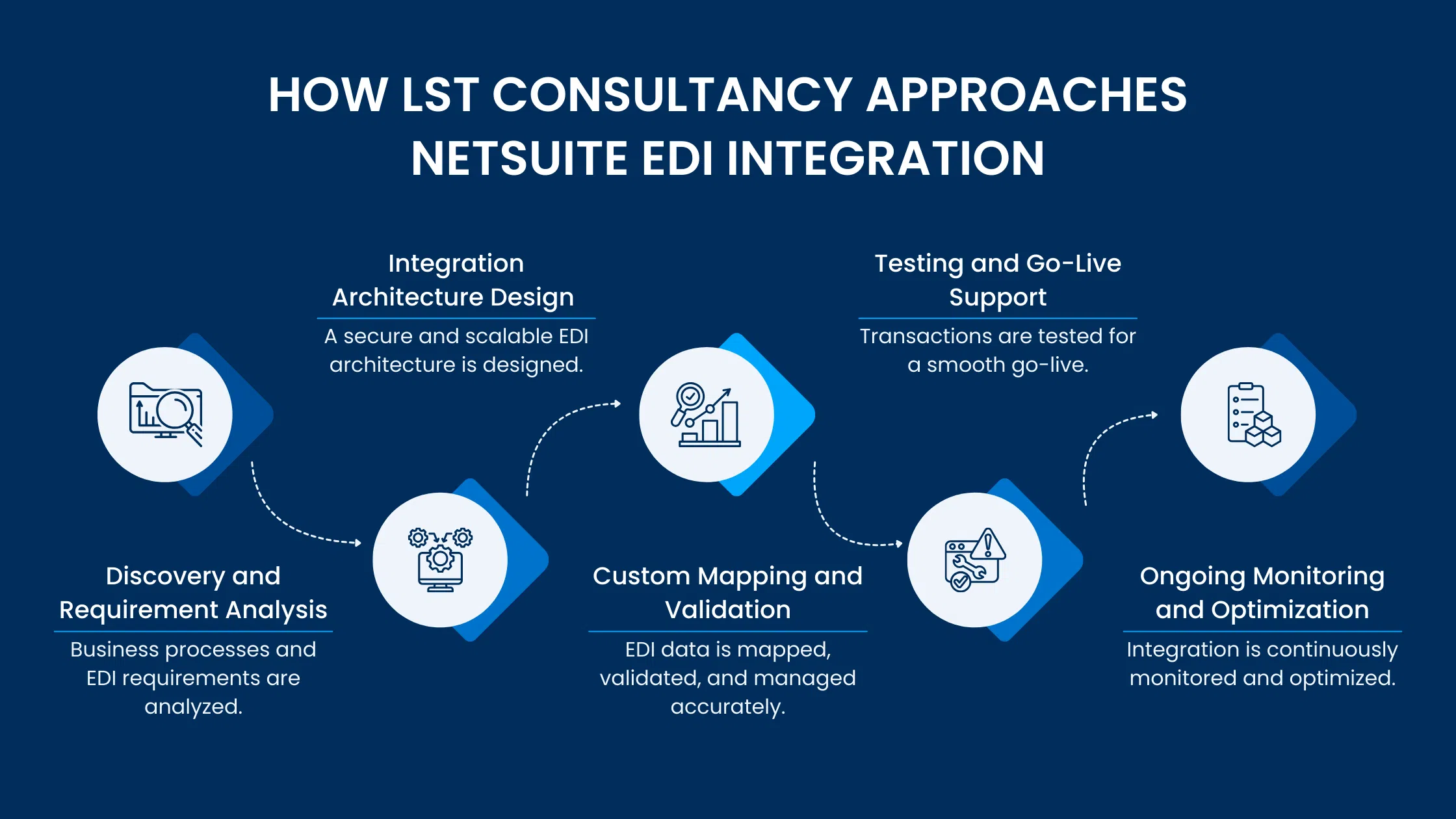
How LST Consultancy Approaches NetSuite EDI Integration
At LST Consultancy, we start with a consultative, business-first mindset. We are not simply connecting systems to a network; we are also adapting EDI workflows to your operating environment.
Discovery and Requirement Analysis
We begin by learning your business processes, the flow of trading partner requirements, the integration transaction types, and the NetSuite setup.
Integration Architecture Design
We create a secure, scalable integration architecture that meets your needs, whether large or small, with persistent data exchange and futureproofing.
Custom Mapping and Validation
Every platform has different needs. We manage EDI mapping, validation rules, and exception management to optimize the entire operation.
Testing and Go-Live Support
This can ensure that all your transactions are compliant, accurate, and ready for production before deployment.
Ongoing Monitoring and Optimization
After go-live, we support you dynamically and continue to monitor and optimize as your business and partner network evolve.
Why Businesses Trust LST Consultancy
Our customers select LST Consultancy because we offer technical expertise and are ‘the Business’, having lived and worked in the world of ERP and supply chain. Our deep knowledge of not only NetSuite but also EDI standards enable us to deliver integrations that are rock-solid and maintainable.
We optimize for long-term value—never short-term wins—and are committed to helping businesses reduce costs, improve partner relationships, and scale confidently.
NetSuite EDI Integration as a Strategic Advantage
When done well, NetSuite EDI Integration moves beyond compliance. It then becomes a strategic enabler that helps the business grow more quickly, run more smoothly, and make better decisions. When leaders have a clear view of transactions and inventory in real time, they can better manage supply chain performance and customer promises.
Your company can be a proactive manager of relationships rather than react to EDI errors and delays. You can expand your markets with confidence.
Conclusion: Simplify EDI, Strengthen Your NetSuite Investment
EDI doesn’t have to be complicated or disruptive. With the right approach and partner, it can become a natural extension of your NetSuite ERP. And by automating data sharing, improving accuracy, and enforcing compliance, organizations can achieve tangible operational and financial gains.
If you are considering deploying or improving your NetSuite EDI Integration, LST Consultancy can support you. Our highly skilled and experienced professionals provide secure, flexible, and business-relevant EDI solutions for your long-term success.
👉 Get in touch with LST Consultancy today to discuss your requirements and take the next step toward a fully automated, future-ready NetSuite ecosystem.