

- February 16, 2026
- Nilesh Sanura
- 0
NetSuite ERP Implementation Cost Breakdown: Realistic Budgeting Guide
A NetSuite ERP Implementation is not just a software upgrade; it’s a transformational project that changes the way your company runs finance and operations, and even how it makes decisions. For expanding businesses, ERP is a digital spine that powers scalability, visibility, and productivity.
One of the first questions most leaders ask themselves is: How much does a NetSuite ERP Implementation cost?
If you’ve explored NetSuite Implementations and NetSuite Reimplementation, you’ve likely noticed wide pricing variations. The Quality vs. Speed Paradox, and that’s because ERP is a transformation, not a fixed-price product; it’s the transformation you map to your processes, data, and integrations and growth goals.
In this budgeting resource, we dissect crucial line items and segment spend components to shed light on how they affect costs, reveal hidden costs, and provide actionable advice to help you plan smarter and drive better ROI.
Understanding NetSuite ERP Implementation: What Are You Actually Paying For?
A NetSuite ERP Implementation is much more than simply purchasing software. Running on Oracle NetSuite’s cloud platform, NetSuite integrates financials, CRM, inventory, projects, procurement, and analytics into a single system.
Organizations purchasing NetSuite typically budget for a set of related areas: licensing, professional services, customization, integrations, data migration, training, and post–go-live optimization.
Each company is different and has its own workflows, compliance requirements, and growth strategies. That’s why NetSuite implementations are never identical. Knowing these elements in advance brings transparency to the table, avoids unpleasant surprises, and cements your industrial ERP effort’s connection to business results—not just test-and-tune goals.
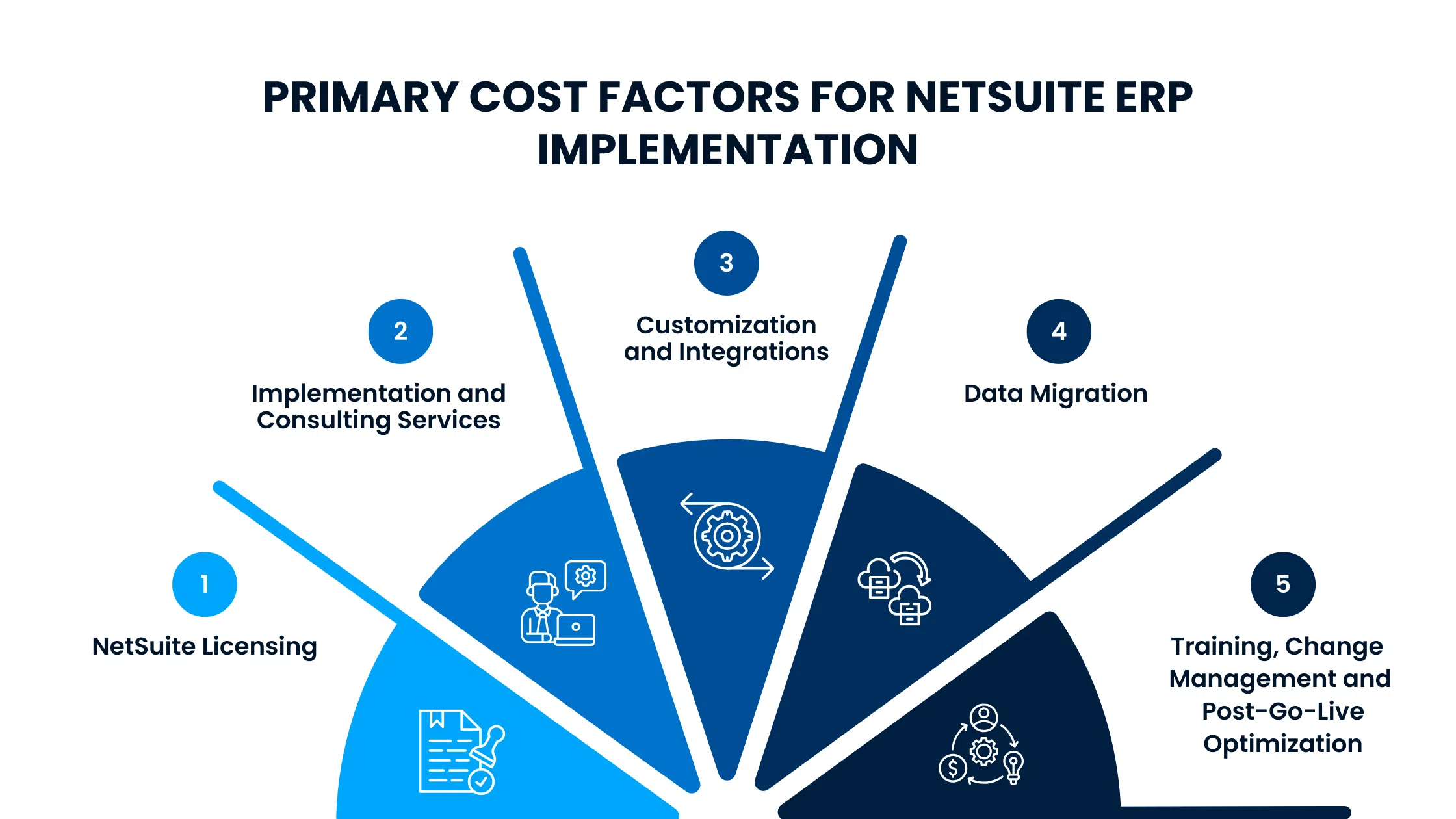
Primary Cost Factors for NetSuite ERP Implementation
Some key factors will affect what you pay for your project and directly impact how well your NetSuite ERP Implementation performs.
1: NetSuite Licensing
Licensing is the foundation of all NetSuite ERP Implementations. Costs are based on selected modules, the number of users, and sophisticated features such as analytics, planning, or warehouse management. Industry-specific characteristics can also drive costs in manufacturing, retail, and service businesses.
Licenses are annual and scale with your company’s growth. Choosing undersized modules can result in process modifications as the project progresses, while procuring too many licenses upfront could place a financial strain. When it comes to your NetSuite implementations, being flexible without being overly complicated, it’s essential that you couple licensing decisions with current needs and realistic growth roadmaps.
2: Implementation & Consulting Services
Services typically make up a big portion of your budget. This step transforms NetSuite into a tailored system for your company by analyzing, planning, configuring, testing, and providing launch support.
Small projects can be easy, while larger NetSuite Implementations often involve multiple subsidiaries, approval processes, revenue recognition, and complex reporting options. Ensuring the right consulting expertise reduces rework (doing things over), accelerates implementation, and ensures that your NetSuite ERP Implementation delivers long-term ROI.
3: Customization and Integrations
Most brands use several tools, and you will inevitably need to customize or integrate them. This can include automated workflows, dashboards, approval processes, and integrations with CRM, eCommerce, HR, or payment systems.
Adding value is not the only thing customization does; it also adds complexity. Its implementation can be staged, with you implementing the base ERP and adding further automations as needed. This step-by-step approach to automation enables a digital transformation while remaining mindful of costs.
4: Data Migration
Data Migration is not just Data Migration, and NetSuite ERP Implementations rarely account for this properly. Effort is a function of legacy systems, historical data volume, and quality. Erratic or low-quality data adds complexity to migration.
Competent teams push data cleansing and validation to ensure accurate reporting, smooth operations, and adoption. Clean data is also a major factor in the success/failure of your NetSuite Implementations.
5: Training, Change Management & Post-Go-Live Optimization
ERP success depends on people. Training helps you learn your role, and change management is how you do it. Companies that invest in this area see faster productivity gains and lower support costs post-go live.
The journey doesn’t end at launch. Once operational stability is established in post-go-live hyper care, performance improvement and continuous optimization can stabilize operations and introduce new capabilities over time. This continuous improvement ensures that your NetSuite ERP Implementation remains effective throughout the lifetime of your business.
Typical NetSuite ERP Implementation Cost Ranges
Although each project is unique, these general benchmarks aid in planning:
- Small businesses: Typically begin in the tens of thousands, depending on scope and licensing.
- Mid-market companies: Typically fall in the mid-five-figure to low-six-figure range due to integrations and custom workflows.
- Enterprise: A large, entity-rich NetSuite Implementation can run into the high six figures and up.
True cost is less a function of company size and more a function of operational complexity, the range of data types, and scalability objectives.
Hidden Costs That Can Impact Your Budget
Even with the best planning, there are a few things that can drive your costs skyward in stealth mode:
- Scope creep from unplanned customizations
- Additional integrations were added mid-project
- Bad (data) quality is making migrations drag on
- Limited availability from internal teams
- Poor training followed by the costs of re-work and additional support
Clear scope definition and expert guidance will help unstick your NetSuite ERP Implementation.
Smart Budgeting Strategies for NetSuite Implementations
The organizations with whom it works best, in general:
- Instead, begin with business outcomes (timelier close, more visibility, automation)
- Implement ERP in stages, not all at once
- Invest in proper discovery upfront
- Leverage standard NetSuite functionality where possible
- Collaborate with an experienced implementation partner.
These practices contribute to a high success rate in NetSuite implementations while controlling costs.
Why Your Implementation Partner Makes All the Difference
Your partner has a direct impact on timelines, budgets, and long-term ROI.
At LST Consultancy offers a full-service NetSuite ERP Implementation solution to companies in the USA, UAE, Australia, and the Middle East.
Our services include:
- Full-cycle NetSuite ERP Implementation
- Reimplementation and optimization
- Third-party integrations
- Secure data migration
- Ongoing NetSuite consulting
The difference at LST Consultancy: we are practical and results oriented. We balance technical expertise with real business understanding to provide customised NetSuite implementations—not generic ones.
Final Thoughts: Make Your NetSuite ERP Implementation a Strategic Investment
Budgeting your NetSuite ERP Implementation isn’t about finding the lowest price point— it’s about investing today so you can grow tomorrow, achieve even greater efficiency, and make smarter decisions.
By addressing each cost driver, accounting for unexpected costs, and teaming up with experienced consultants, your business should have strong sales potential.
If you’re considering NetSuite implementations or reviewing your ERP roadmap, LST Consultancy is ready to help.
👉Ready to Begin Your NetSuite ERP Implementation Process?
Reach out to LST Consultancy today for a tailored cost analysis and implementation roadmap to help ensure efficiency, scalability, and high-quality business growth.