

- April 30, 2026
- LST Consultancy
- 0
NetSuite Implementation in UAE: What It Actually Costs and How Long It Takes (2025)
You've done the evaluation. You've sat through demos, compared NetSuite against the alternatives, and decided it's the right platform for your UAE business. Now comes the question that everyone asks at this stage and nobody gives a straight answer to: how long, and how much?
We run NetSuite implementations in the UAE week in, week out, so we can give you real numbers — not the kind of ranges that are so wide they're basically useless. The honest answer is that implementation cost and timeline depend on a handful of specific factors, and once you know what those are, the numbers get a lot more predictable. This guide walks through all of it: what happens in each phase, what drives the cost up or down, what the common overruns look like and how to avoid them, and what to look for in a UAE implementation partner.
📌 The Numbers Up Front A typical NetSuite implementation for a UAE small-to-mid-size business takes 10–17 weeks from kickoff to go-live. Implementation costs (professional services, separate from the licence) run from AED 30,000 for a small business to AED 200,000+ for a complex multi-entity deployment. The breakdown below explains what drives those ranges.
Why UAE NetSuite Implementations Are More Complex Than a Standard Deployment
ERP implementation horror stories are common enough that most business owners come into this nervous. And some of that reputation is deserved — but a lot of the projects that went badly went badly for specific, avoidable reasons. Usually it was scope creep, dirty data discovered late, or a partner who didn't understand the local context well enough to configure things correctly the first time.
In the UAE specifically, there are layers of complexity that a generic NetSuite implementation methodology doesn't automatically handle. If your partner hasn't done this before in the UAE, you'll discover them mid-project — which is expensive and stressful. These are the ones that matter:
- UAE VAT configuration — it's not just switching VAT on. FTA-compliant invoice templates, tax codes per supply type, VAT return structure, Phase 2 e-invoicing readiness — all needs to be right from day one, not corrected after your first filing
- Arabic language setup — RTL interface, bilingual invoice templates, Arabic chart of accounts labels. Not complicated if you know what you're doing; surprisingly disruptive if you discover it after go-live
- Free zone multi-entity configuration — JAFZA, DMCC, or DAFZA entities alongside a mainland company require specific intercompany rules, entity-level VAT treatment, and consolidation setup. Each entity needs to be independently correct
- Historical data migration — the state of your data in Tally, QuickBooks, or your legacy ERP is almost always messier than expected. Duplicate customer records, inconsistent VAT codes, missing fields. Data cleansing takes real time and can't be rushed
- UAE-specific workflows — trading businesses with LCs and customs documentation, construction businesses with retention billing, hospitality with service charge handling — these need a partner who's seen them before
This is why the partner choice matters as much as the platform. A NetSuite implementation done by a team that's never worked in the UAE will cost you more in corrections than a UAE-experienced team would have charged upfront.
What Actually Happens in Each Phase — Week by Week
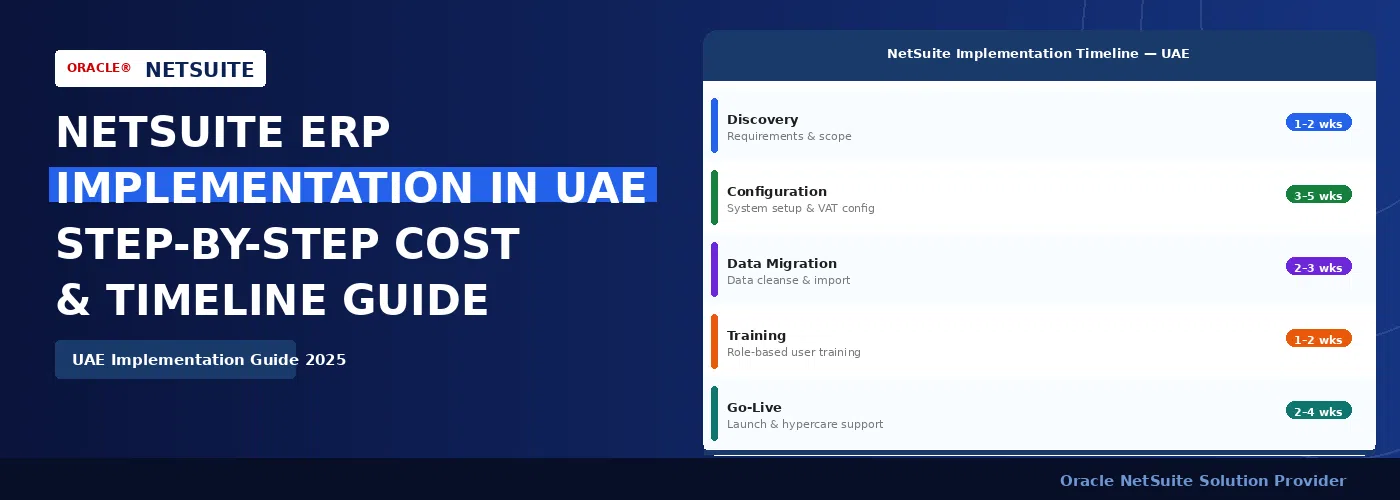
NetSuite implementations follow five defined phases. Here's what each one actually involves for a UAE business, not the brochure version:
Discovery & Scoping
1–2 WeeksThis is the phase that determines whether everything else goes smoothly. We run workshops with your finance, operations, and IT teams — not a questionnaire, actual conversations — to understand how your business works, what's broken in your current setup, and what NetSuite needs to do differently.
In the UAE context, this includes mapping out your entity structure (mainland, free zone, or both), your VAT obligations, whether you have Arabic invoice requirements, what data lives where, and what integrations you're running or need to run. Everything decided here becomes the scope document that protects your budget later.
- Current process mapping — finance, inventory, procurement, HR
- UAE-specific requirements confirmed — VAT structure, FTZ entities, Arabic language
- Module selection finalised based on actual needs, not assumptions
- Data migration scope agreed — what to migrate, how much history, from which systems
- Integration requirements documented — bank feeds, customs platforms, third-party tools
- Go-live date locked and project plan issued with milestone dates
What you get at the end: A signed Statement of Work with a fixed scope. This is your protection against scope creep — don't proceed without it.
System Configuration
3–5 WeeksThe longest and most technically intensive phase. Your NetSuite system gets built to match your UAE business — not a generic template. This is where most of the UAE-specific work happens, and where an inexperienced partner typically costs you the most time later.
- Chart of accounts — structured for UAE accounting standards and Corporate Tax reporting, not a global default
- UAE VAT configuration — tax codes, FTA invoice templates, VAT return structure, e-invoicing readiness checked and confirmed
- Arabic language and RTL — bilingual invoice templates, Arabic chart of accounts labels, interface RTL testing
- Multi-entity setup — mainland and FTZ entities with intercompany rules, separate VAT registrations, elimination rules at consolidation
- Workflow automation — purchase order approvals, expense routing, invoice authorisation — built to match how decisions actually get made in your business
- Module configuration — inventory locations, item categories, customer and vendor record structure
- User roles and permissions — role-based access so people see what they need and nothing they shouldn't
- Consultant-led testing (SIAT) — every configured process tested before it goes anywhere near your team
What you get at the end: A fully configured sandbox environment — your business in NetSuite, ready for your team to test.
Data Migration
2–3 WeeksHonest assessment: this is the phase that most commonly causes delays, and almost always for the same reason — the data is messier than anyone expected. Duplicate customer records, VAT codes applied inconsistently, item catalogues with missing fields, financial data that doesn't reconcile. The earlier you start cleaning your data, the better this phase goes.
We run a structured migration process that's been refined across dozens of UAE implementations:
- Data extraction — pulling records from Tally, QuickBooks, legacy ERP, or Excel exports
- Data cleansing — finding and fixing duplicates, correcting VAT codes, filling mandatory fields. This is where client team involvement makes a real difference
- Data mapping — aligning your old data structure to how NetSuite organises information
- Test migration — running a trial import into the sandbox with validation reports, so we catch errors before they hit production
- Client sign-off — your finance team validates the migrated data is accurate before we touch the live system
- Opening balances — financial balances as at cutover date, reconciled and confirmed
- Master data — customers, suppliers, items, fixed assets, employees
What you get at the end: Clean, validated data loaded into the production environment and signed off by your team.
User Acceptance Testing and Training
1–2 WeeksUAT is your team's chance to break the system before it goes live — and we encourage them to try. Running your actual business scenarios through the configured sandbox is how you find the edge cases that weren't in the requirements document. Better to find them now than on go-live day.
- UAT sessions — your finance, operations, and management teams run end-to-end scenarios in the sandbox: raise a PO, receive goods, match an invoice, run the VAT return
- Issue resolution — anything that surfaces in UAT gets fixed before you go live, not after
- Role-based training — separate sessions for finance, ops, management, warehouse — each team learns what they need to do, not a generic system walkthrough
- UAE-specific training — VAT invoice generation, VAT return processing, Arabic language use, intercompany invoicing if relevant
- Training materials — UAE-specific quick reference guides your team can actually use on the floor
- Go-live readiness sign-off — formal confirmation from your team and ours that the system is ready
What you get at the end: Signed UAT approval and a team that knows how to use the system before the pressure of real transactions.
Go-Live and Hypercare
2–4 WeeksGo-live is not the end of the project. It's when the real test starts. No matter how thorough the UAT, real transactions in a live environment surface things that sandbox testing doesn't. The hypercare period is specifically designed to make sure your team isn't left to figure it out alone when that happens.
- Cutover — final data load, go/no-go decision made deliberately, system switched on
- Day one support — LST consultant available on-site or on-call throughout go-live day. Not just reachable by email
- Parallel run option — for some UAE businesses, running old and new systems side-by-side for 2–4 weeks makes sense as a safety net. We discuss this during scoping
- Issue triage — anything that comes up in real usage gets resolved fast, not logged into a queue
- First VAT period support — we walk your finance team through the first UAE VAT return run in NetSuite. This is included as standard; it's not an add-on
- Hypercare sign-off — formal transition to ongoing support once everything is stable and your team is operating independently
What you get at the end: A live, stable system with your team running it confidently — and a clear handover into ongoing support.
The Real Cost Breakdown — Implementation and Licence
Implementation cost has two parts that people sometimes conflate: the one-time professional services fee (what your implementation partner charges) and the ongoing annual licence (what Oracle charges). They're separate. Here's what both look like for UAE businesses in 2025:
Implementation Cost — One-Time Professional Services
| Business Size | Users | Modules | Complexity | Est. Implementation Cost (AED) | Timeline |
|---|---|---|---|---|---|
| Small Business | 5–15 | Financials + basic inventory | Low | AED 30,000 – 70,000 | 10–12 weeks |
| Mid-Market | 15–50 | Financials, CRM, inventory, multi-entity | Medium | AED 70,000 – 150,000 | 14–18 weeks |
| Complex Mid-Market | 30–75 | Full ERP + manufacturing or e-commerce | High | AED 150,000 – 250,000 | 18–30 weeks |
| Enterprise | 75+ | All modules + custom integrations | Very High | AED 250,000+ | 30–52 weeks |
Annual Licence Cost — What Goes to Oracle
| Cost Component | Small Business (AED/year) | Mid-Market (AED/year) | Enterprise (AED/year) |
|---|---|---|---|
| Base Platform Licence | AED 40,000 – 80,000 | AED 80,000 – 200,000 | AED 200,000+ |
| Per-User Licences | AED 18,000 – 40,000 | AED 40,000 – 120,000 | AED 120,000+ |
| Module Add-ons | AED 0 – 40,000 | AED 40,000 – 100,000 | AED 100,000+ |
| Total Annual Licence | AED 58,000 – 160,000 | AED 160,000 – 420,000 | AED 420,000+ |
What the 3-Year Total Actually Looks Like
| Business Size | Implementation (one-time) | Licence (×3 years) | Support (×3 years) | 3-Year TCO |
|---|---|---|---|---|
| Small Business | AED 50,000 | AED 270,000 | AED 45,000 | AED 365,000 |
| Mid-Market | AED 120,000 | AED 720,000 | AED 90,000 | AED 930,000 |
| Enterprise | AED 300,000+ | AED 1,500,000+ | AED 180,000+ | AED 1,980,000+ |
⚠️ Where Implementation Costs Overrun — and How to Prevent It The most common cause of cost overruns isn't the partner's day rate — it's scope creep. Requirements that weren't documented in the SOW get added mid-project, and each addition extends the timeline and the bill. The fix is straightforward: insist on a fixed-scope SOW with clear change control before you sign anything. Also: start your data cleansing early. Dirty data discovered late in the migration phase is the second most common reason projects slip. Both of these are preventable with the right approach from the start.
What Actually Drives Your Implementation Cost Up or Down
The ranges above are wide because the variables are real. Here's what moves the number in each direction — and what you can do about it:
| Factor | How It Affects Cost | What You Can Do |
|---|---|---|
| Number of Users | More users means more training sessions, more role configurations, more licences — all add to cost and time | Right-size your user count honestly. Use Employee Centre licences for staff who only need self-service access — they cost a fraction of a Full Access licence |
| Number of Modules | Each module you add brings configuration, testing, and training time with it | Phase your rollout — go live on core financials and inventory first, add CRM or HR in a second phase when the team is settled |
| Number of Entities | Adding a free zone entity to a mainland setup roughly doubles the configuration complexity — intercompany rules, separate VAT, consolidation setup | Map your entity structure clearly before kickoff — mid-project changes to entity design are expensive |
| Data Volume and Quality | Dirty data is the single biggest source of migration delays. Thousands of duplicate records or a decade of uncleaned data significantly extend this phase | Start data cleansing before the implementation kicks off. Allocate internal staff time for it — it can't be entirely outsourced |
| Custom Integrations | Connecting to third-party systems — banking platforms, customs portals, e-commerce tools — adds significant development and testing cost | Use NetSuite's pre-built connectors where they exist. Custom API work is worth doing, but cost it properly in the SOW |
| Customisations (SuiteScript) | Custom workflows and scripts are expensive to build and maintain. Every customisation is a future maintenance cost too | Question every customisation request. Ask whether standard configuration can achieve the same outcome — usually it can with a small process change |
| Partner's UAE Experience | An experienced UAE NetSuite partner charges more per day but gets things right the first time — no UAE VAT configuration errors discovered at filing time, no FTZ setup reworked post go-live | Don't optimise purely on day rate. Total cost is almost always lower with an experienced partner than with a cheaper one who bills more hours correcting mistakes |
How to Choose a NetSuite Implementation Partner in UAE — What Actually Matters
There are multiple certified NetSuite partners operating in the UAE. They're not all the same, and the differences matter more than most buyers realise until they're mid-project. Here's what to ask about before you commit:
🏅 Oracle Certification Level
Ask specifically about their Oracle certification tier — not just "are you certified?" but which tier and how recently they demonstrated it. Higher certification levels require demonstrating real implementation competency, not just completing a course.
🇦🇪 Hands-On UAE Experience
Ask for UAE-specific case studies. Not case studies from the region — UAE case studies, specifically covering VAT configuration, FTA e-invoicing, Arabic setup, and FTZ multi-entity structures. If they can't produce these, they're learning on your project.
🏭 Your Industry, Specifically
A partner who's implemented NetSuite for UAE trading companies knows things about LC documentation and landed cost configuration that a partner who's only done services businesses doesn't. Ask about their experience in your sector.
📋 Fixed-Scope SOW — Non-Negotiable
Insist on a fixed-scope Statement of Work with clearly defined deliverables and a documented change control process. Time-and-materials billing with no fixed scope is how implementations become twice the original estimate. Don't accept it.
🔧 Post Go-Live Support Structure
Implementation ends at go-live. The relationship shouldn't. Ask what the post-go-live support looks like — specifically: first VAT return assistance, month-end close support, new user training, and how quickly issues get resolved after hypercare ends.
👥 A Team That's Actually in the UAE
Some partners quote UAE projects with offshore teams who are unfamiliar with UAE regulations and work in different time zones. Ask specifically whether the consultants assigned to your project are based in the UAE and have local regulatory knowledge.
How LST Consultancy Approaches UAE NetSuite Implementations
We're a certified Oracle NetSuite Solution Provider based in the UAE. We implement NetSuite specifically for UAE businesses — trading, construction, retail, hospitality, professional services — and our team understands the local regulatory context as deeply as the platform itself.
A few things that differentiate how we work:
✅ What to Expect When You Work With LST Consultancy
- UAE VAT specialists on every project — configured correctly before go-live, including FTA e-invoicing Phase 2 readiness and Corporate Tax reporting
- Free zone experience that's real — we've implemented JAFZA, DMCC, DAFZA, and KIZAD multi-entity structures many times. We know what goes wrong and how to prevent it
- Arabic language done properly — bilingual invoice templates, RTL interface configuration, Arabic chart of accounts labels — tested and working before your team touches it
- Fixed-scope SOW, always — your budget is protected by a clear scope document and change control process from day one
- UAE-based team — the consultants on your project are in Dubai, working your time zone, with UAE business and regulatory knowledge
- Industry experience that translates — trading, construction, retail, hospitality, professional services — we've done it in the UAE context, not just on paper
- First VAT return included — we walk your finance team through their first NetSuite VAT return. This isn't an optional extra; it's part of what we deliver
Want a Fixed-Scope Quote for Your UAE NetSuite Implementation?
Tell us about your business — entity structure, user count, modules you're considering — and we'll give you a transparent implementation proposal with a realistic cost and timeline. No ballpark estimates.
Questions We Get Asked Most About NetSuite Implementation in UAE
How long does NetSuite implementation take in UAE?
How much does NetSuite implementation cost in UAE?
What's included in a UAE NetSuite implementation?
What data gets migrated during NetSuite implementation?
Can I implement NetSuite without a partner in UAE?
What happens after NetSuite go-live?
How do I avoid implementation cost overruns?
The Short Version: What Makes UAE NetSuite Implementations Succeed
The businesses whose NetSuite implementations go smoothly tend to have a few things in common. They did thorough discovery before configuration started. They cleaned their data before migration, not during it. They chose a partner with genuine UAE experience rather than the cheapest option. And they protected their scope with a fixed SOW rather than leaving things loosely defined.
None of this is complicated — but it does require making the right decisions at the beginning of the project, not reacting to problems in the middle of it. A 14-week implementation that goes well is worth considerably more than a 30-week one that needed reworking.
LST Consultancy has delivered successful NetSuite implementations for UAE businesses across trading, construction, retail, hospitality, and professional services. We bring real local expertise, a methodology that protects your budget, and a team that's genuinely available in your time zone when something needs sorting. If you're at the stage of evaluating implementation partners, we'd be glad to give you a straight assessment of what your specific project would involve.
Get a Transparent NetSuite Implementation Quote for Your UAE Business
Talk to our Dubai-based team. We'll give you a fixed-scope proposal with realistic costs and timeline — no surprises, no hidden fees.