

- April 15, 2026
- LST Consultancy
- 0
NetSuite vs SAP Business One: An Honest Comparison for UAE Companies (2025)
We get asked this one a lot. A UAE CFO or IT director is evaluating ERP options, they've narrowed it down to NetSuite and SAP Business One, and they want someone to just tell them which one to pick. The truthful answer — and we'll give you the full version below — is that it depends on what your business actually does.
Both platforms are legitimate. Both have real track records in the UAE. But they were built for different kinds of companies, they handle the UAE's specific regulatory requirements differently, and over three years, the total cost gap between them is often larger than people expect. This comparison cuts through the vendor noise and gives you a clear picture of where each system wins, where it falls short, and which type of UAE business each one is genuinely right for.
We're a NetSuite partner, so we'll say that upfront. We've tried to be straight here — including pointing out where SAP Business One is actually the better choice.
🏆 The Short Answer For most UAE businesses — trading, retail, services, free zone setups — NetSuite comes out ahead. For heavy manufacturers with complex production planning, SAP Business One still has an edge. The details below explain why.
At a Glance: What You're Actually Comparing
Before getting into the detail, here's a quick orientation on both platforms:
| Factor | Oracle NetSuite | SAP Business One |
|---|---|---|
| Founded | 1998 (acquired by Oracle in 2016) | 1972 (SAP Group) |
| Deployment | ✔ 100% Cloud / SaaS | ⚡ On-premise + SAP HANA Cloud |
| Target Company Size | SME to Enterprise (5–2,000+ employees) | SME to Mid-Market (10–500 employees) |
| Global Customers | 37,000+ worldwide | 70,000+ worldwide |
| UAE Market Presence | Strong — growing rapidly | Strong — well-established |
| Starting Price (UAE) | From AED 2,500/month | From AED 3,500/month |
| LST Recommendation | ✔ Recommended | Suitable for manufacturing |
How They Stack Up on UAE-Specific Requirements
Generic ERP comparisons miss the point for UAE businesses. The real questions are about FTA compliance, Arabic language, free zone structures, Corporate Tax readiness — things that most global ERP comparison articles don't bother going into. Here's where each platform actually stands:
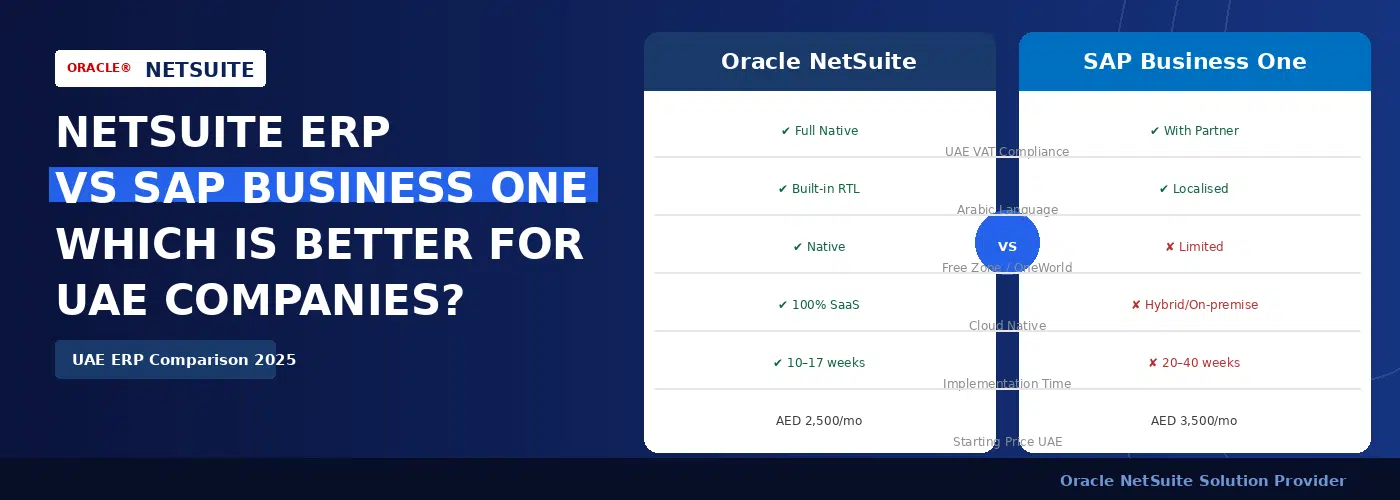
| UAE Factor | Oracle NetSuite | SAP Business One | Winner |
|---|---|---|---|
| UAE VAT Compliance | Fully built in — automatic VAT calculation, FTA audit trail, return reports out of the box | Available via localisation pack — works, but needs partner configuration to set up properly | NetSuite |
| FTA E-Invoicing | API-first architecture makes Phase 2 integration clean — no bolted-on workaround | Available through SAP partner add-ons — functional but less seamless | NetSuite |
| Arabic Language | Full Arabic UI with right-to-left formatting, included in the standard licence | Arabic UI exists, RTL support is there — but the polish isn't quite at the same level | NetSuite |
| Free Zone / Multi-Entity | NetSuite OneWorld handles multiple legal entities natively — intercompany, consolidated P&L, FTZ-ready | Multi-entity functionality is limited out of the box — usually needs extra SAP tools or custom work | NetSuite |
| Multi-Currency (AED, USD, SAR) | Full native multi-currency with live exchange rates | Full multi-currency — well-established and reliable | Tie |
| UAE WPS Payroll | SuitePeople HR module — WPS-compatible | Available through partner localisation — WPS compliance is there | Tie |
| Corporate Tax Readiness | UAE Corporate Tax module built in — automated reporting | Available with updates but requires partner configuration | NetSuite |
The pattern here is consistent. NetSuite was updated for the UAE market at a platform level — VAT, Arabic, Corporate Tax are built in rather than layered on top. SAP Business One's localisation works, but it's more partner-dependent. For a business that wants to go live quickly and stay compliant without heavy customisation, that's a meaningful difference.
Cloud vs On-Premise — Why This Matters More Than People Think
This is arguably the most important structural difference between the two platforms, and it affects everything from implementation cost to how your team actually uses the system day-to-day.
NetSuite — Built in the Cloud, Not Ported to It
NetSuite has been cloud-only since day one. There's no on-premise version — that's not a limitation, it's a deliberate architectural choice. In practical terms for a UAE business, it means:
- No server hardware to buy, host, or maintain — your IT team doesn't become ERP support staff
- Updates happen automatically twice a year — you don't have to plan upgrade projects or pay your partner to run them
- Your finance team in Dubai, your operations manager in Sharjah, and you travelling through Abu Dhabi Duty Free all access the same live system from a browser
- Predictable annual cost with no surprise infrastructure bills in year two or three
- Faster implementation — no hardware setup, no server provisioning, no waiting for IT procurement
SAP Business One — On-Premise Roots, Cloud Catching Up
SAP Business One was originally designed for on-premise deployment, and that's still how most UAE installations run. SAP HANA Cloud is the newer cloud version, but it's a more recent pivot and it shows — the cloud offering is less mature than NetSuite's. For on-premise deployments:
- You need dedicated server infrastructure — that's an upfront capital cost, often AED 20,000–60,000+ depending on spec
- Updates are manual and partner-managed — they cost time and money every time
- Remote access requires additional setup and is more complex to manage securely
- Your total cost in year two and three is higher than the licence alone suggests, once you factor in maintenance
Cloud Architecture: NetSuite Wins Clearly
For UAE businesses that don't want to own and manage server infrastructure — which is most of them — NetSuite's cloud-native setup is a real advantage. SAP HANA Cloud is improving but NetSuite has 25+ years of cloud-only operation behind it. That gap doesn't close overnight.
Financial Management and Reporting
Both systems handle the financial fundamentals well. The gaps start to show when you need more than a basic GL — real-time dashboards, multi-entity consolidation, revenue recognition at scale:
| Financial Feature | Oracle NetSuite | SAP Business One |
|---|---|---|
| General Ledger | ✔ Advanced multi-book GL | ✔ Solid standard GL |
| Real-Time Dashboards | ✔ Fully customisable, role-based — finance, ops, and management each see what's relevant to them | ⚡ Available, but less flexible to configure |
| Financial Consolidation | ✔ Multi-entity consolidation built into OneWorld — no extra tools needed | ⚡ Requires the SAP Intercompany add-on — additional cost and setup |
| Revenue Recognition | ✔ ASC 606 / IFRS 15 compliant natively | ⚡ Available but requires configuration work |
| Budgeting & Forecasting | ✔ Built-in planning module included | ⚡ Basic budgeting only — SAP Analytics Cloud needed for anything advanced, at extra cost |
| Fixed Asset Management | ✔ Included in the base licence | ✔ Included |
For a UAE CFO who wants live visibility into their numbers — not reports that come out of a scheduled overnight job — NetSuite's real-time dashboard capability is a genuine differentiator. The SAP Business One dashboards work, but customising them to show what you actually want to see takes more effort.
Inventory, Supply Chain, and Operations
This is the section where SAP Business One genuinely earns its stripes — specifically for manufacturers. SAP has decades of deep manufacturing functionality, and for a UAE company running complex production with multiple BOMs, routing, and MRP requirements, that depth is real.
That said, NetSuite has closed the gap significantly for most SME manufacturers. Where the difference really shows up is at the heavy end — process manufacturing, complex production scheduling, highly granular shop floor control. For light to medium manufacturing, NetSuite handles it well.
| Operational Feature | Oracle NetSuite | SAP Business One | Winner |
|---|---|---|---|
| Inventory Management | Multi-location, lot and serial tracking, demand planning | Strong warehouse management, batch tracking | Tie |
| Manufacturing (BOMs, Production) | NetSuite Manufacturing handles most SME needs well — BOMs, work orders, production planning | Very strong — deep MRP, production routing, capacity planning. This is SAP B1's home turf. | SAP B1 |
| Procurement | Full purchase order, vendor management, approval workflows | Full procurement suite | Tie |
| Warehouse Management | Advanced WMS module available | Strong WMS with bin management — well-established | Tie |
| E-commerce Integration | ✔ SuiteCommerce is native — B2B and B2C online store built into the platform | ✘ No native e-commerce — needs a third-party integration | NetSuite |
📌 The Situations Where SAP Business One Wins on Operations
- Heavy manufacturing with intricate BOMs, production routing, and MRP at scale
- Businesses already running other SAP tools who need tight integration across the stack
- Companies that need very granular production floor visibility and control
- Process manufacturing sectors — food and beverage, chemicals — particularly in UAE industrial zones like KIZAD and Jebel Ali
Implementation: Time, Cost, and What Can Go Wrong
Every week your ERP project runs over is a week of continued manual processes, compliance risk, and staff frustration. Implementation speed is worth thinking about before you sign, not after.
The honest reality: NetSuite implementations in the UAE run significantly faster than SAP Business One. Part of that is the cloud setup — no hardware to provision. Part of it is that UAE VAT, Arabic language, and the chart of accounts come pre-configured rather than needing to be built from scratch. Here's how they typically compare:
| Implementation Factor | Oracle NetSuite | SAP Business One |
|---|---|---|
| Typical UAE Timeline | ✔ 10–17 weeks | ⚡ 20–40 weeks |
| UAE Implementation Cost (SME) | AED 30,000 – 80,000 | AED 50,000 – 150,000 |
| Infrastructure Required | ✔ None — cloud handles it | ⚡ Server hardware required for on-premise deployments |
| UAE VAT Setup | Pre-configured for FTA requirements — included in scope | Requires partner localisation work — adds time and cost to the project |
| Data Migration Tools | SuiteCloud migration tools — structured, well-documented | Data Transfer Workbench — effective but more technical to run |
| Post Go-Live Updates | ✔ Automatic — twice a year, no project needed | ⚡ Manual upgrade — managed by your partner, billed separately |
The implementation timeline gap matters for cost too. A 30-week SAP Business One implementation versus a 14-week NetSuite go-live isn't just a project management preference — it's roughly 16 weeks of professional services fees, internal staff time, and delayed ROI. Add the server infrastructure cost for on-premise SAP and the gap widens further.
Pricing: What UAE Businesses Actually Pay for Each
On paper, the licence costs look closer than the real numbers turn out to be. Once you add infrastructure, longer implementation, and ongoing maintenance into the SAP Business One picture, the 3-year total cost of ownership typically lands 20–30% higher than NetSuite for a UAE SME. Here's how it breaks down:
| Cost Component | Oracle NetSuite (AED) | SAP Business One (AED) |
|---|---|---|
| Starting Licence (per month) | From AED 2,500/month | From AED 3,500/month |
| Per User (Full Access) | AED 364–474/user/month | AED 400–550/user/month |
| Implementation (SME) | AED 30,000 – 80,000 | AED 50,000 – 150,000 |
| Server / Infrastructure | ✔ None — cloud hosted | ⚡ AED 20,000–60,000+ for on-premise setup |
| Annual Support & Maintenance | AED 15,000–25,000/year | AED 20,000–40,000/year (typically 18–22% of licence value) |
| 3-Year TCO (SME, 15 users) | AED 300,000 – 450,000 | AED 400,000 – 650,000 |
💡 Why the TCO gap is bigger than it looks SAP Business One's annual maintenance fees alone — typically 18–22% of licence value — can exceed AED 30,000–40,000 per year for a mid-size UAE company. Add server infrastructure and a longer, more expensive implementation, and the 3-year cost difference becomes significant. Don't compare just the monthly licence numbers.
Which One is Actually Right for Your UAE Business?
Cut through the feature comparisons and it comes down to this: what does your business do, and what does it need from an ERP?
✅ Go with NetSuite if your business looks like this:
- You want a cloud platform — no servers, no IT maintenance headaches, accessible from anywhere
- You're running a mainland entity plus one or more free zones (JAFZA, DMCC, DAFZA) and need them managed in a single system
- You need to go live in under 4 months — not in 9
- UAE VAT, Arabic language, and FTA compliance need to work out of the box, not after weeks of partner customisation
- Your business is in trading, retail, services, professional services, or e-commerce
- You're growing and want a system that scales from 10 to 200 users without a forced migration
- You want CRM, HR, and financials in one platform — not three systems stitched together
🔵 Go with SAP Business One if your business looks like this:
- You're a manufacturer with real complexity — intricate BOMs, multi-level production routing, serious MRP requirements
- You're already running SAP tools elsewhere in the business and need tight integration across the stack
- You have a specific requirement for on-premise deployment — data residency, security policy, or regulatory reasons
- You're in process manufacturing — food and beverage, chemicals, pharma — particularly in KIZAD or Jebel Ali industrial areas
- You need very granular warehouse bin management and batch tracking at scale
Not Sure Which ERP Fits Your UAE Business?
Talk to our team in Dubai. We'll give you an honest assessment — including when SAP Business One might actually be the better call.
Questions We Get Asked About NetSuite vs SAP Business One
Is NetSuite better than SAP Business One for UAE companies?
Which ERP is cheaper — NetSuite or SAP Business One in UAE?
Does SAP Business One support UAE VAT?
Can NetSuite handle manufacturing like SAP Business One?
Which ERP is better for UAE free zone companies?
How long does implementation take for NetSuite vs SAP Business One in UAE?
Is SAP Business One being discontinued?
The Bottom Line — Which One Should You Actually Pick?
After going through all of this, the honest verdict for most UAE businesses is NetSuite. Not because SAP Business One is a bad system — it isn't — but because for the majority of UAE companies (trading, services, retail, multi-entity free zone setups, fast-growing SMEs), NetSuite fits the profile better. Cloud-native, faster to implement, UAE compliance built in rather than configured, and a better total cost picture over three years.
SAP Business One's moment is when the business is genuinely manufacturing-heavy. Complex BOMs, real MRP requirements, process industry specifics — SAP B1 was built for that and it shows. If that's your world, it deserves serious consideration.
If you're still not sure which side of the line you fall on, that's actually a useful data point — it probably means the manufacturing complexity argument doesn't apply strongly to you, which nudges the answer toward NetSuite.
LST Consultancy is a certified Oracle NetSuite Solution Provider in the UAE. We help businesses work through exactly this decision — honestly, including the times when we tell someone NetSuite isn't the right fit. If you want a straight conversation about which platform makes sense for your specific setup, we're happy to have it.
Want to See NetSuite in Action for Your UAE Business?
Book a free demo configured for your industry — not a generic walkthrough. See exactly how it compares to what you're running now, or to SAP Business One.